ARoS Aarhus Art Museum
The colorful circular walkway at the summit of ARoS offers more than just a captivating view.
Full story unlocks in the tour
 SmartDrones Aarhus / CC0, via Wikimedia Commons
Self-guided audio walking tour of Aarhus — GPS route, offline playback, story-driven narration in 32 languages.
“Where ancient echoes meet modern innovation by the bay.”
Not the postcards. The stories even locals don't know — whispered in your ear, right where they happened.
The colorful circular walkway at the summit of ARoS offers more than just a captivating view.
This acclaimed public library harbors an unexpected secret within its walls, chiming for a very particular reason.
Beneath a contemporary bank in the city center, archaeologists uncovered a chilling fragment of Aarhus's ancient past.
Discover every secret of Aarhus
Every address, every reveal in full — in your ear, right where it happened.
You pick your stops. You walk. The voice reveals what the others miss.


Your self-guided audio tour of Aarhus is ready — pick your landmarks, choose your language, and start the moment you arrive.
BuyLume has a built-in augmented-reality guide. Hold your phone up and its camera shows the street ahead of you, with a glowing arrow laid over the real view that always points to your next stop — no map to puzzle over, no wrong turns. Like everything in Lume, it works fully offline.
Aarhus, Denmark's second-largest city, presents a compelling fusion of deep historical roots and contemporary flair. Founded by Vikings around 770 AD at the mouth of the Aarhus River—hence its original name, Aros, meaning "river mouth"—the city has transformed from a strategic trade hub into a lively cultural and educational center. Affectionately known as "The City of Smiles," a moniker originating from a 1938 tourist brochure, Aarhus maintains an approachable, welcoming atmosphere despite its considerable urban development.
The city's modest dimensions belie its diverse offerings, with many significant attractions within walking distance. From its historic Latin Quarter, with its winding lanes, to the striking modern architecture of its harbor front, Aarhus provides a dynamic experience where the past and innovation coexist. It is a city that embraces its origins while actively shaping a sustainable future, aiming for CO2 neutrality by 2030.
With a youthful population, largely due to Aarhus University, the city pulses with energy, making it a lively destination for both residents and visitors. Its dedication to culture, education, and green initiatives has positioned Aarhus as a notable European city, offering a distinctive Danish experience.
The story of Aarhus commences in the Viking Age, around 770 AD, when a settlement named Aros was established at the mouth of the Aarhus River. This strategic position by the river and bay rendered it an important center for trade and seafaring. The earliest written mention of Aarhus dates to 948 AD, when it became the heart of a diocese. Archaeological findings, including a Viking Age shipyard and ramparts constructed as early as the 10th century, confirm the settlement's early significance.
Through the Middle Ages, Aarhus expanded as a Catholic center, with the construction of Aarhus Cathedral commencing in 1201. The cathedral, rebuilt and enlarged after a 14th-century fire, stands today as Denmark's longest and tallest. The city's prosperity was interrupted by the Black Death in the 14th century, which profoundly affected its population. The modern spelling "Aarhus" first appeared in 1406, becoming standard by the 17th century.
Following the Reformation in 1536, substantial merchant houses became central to the city's life and commerce. The 19th century brought an industrial surge with the arrival of the railway, leading to considerable population growth. In 1928, Aarhus University was founded, solidifying the city's status as a university town and contributing to its youthful demographic. The 20th century saw significant architectural developments, including the Aarhus City Hall (1938–1941) designed by Arne Jacobsen and Erik Møller, a masterwork of Danish Functionalism.
In 1948, a Danish spelling reform changed "Aa" to "Å," leading to the official spelling "Århus." However, in 2010, the city council voted to revert to "Aarhus," effective January 1, 2011. Today, Aarhus continues to grow, with a population estimated at 378,361 in 2026, and actively pursues goals like becoming CO2 neutral by 2030, demonstrating a forward-looking approach rooted in its long history.
Begin your exploration in the Latin Quarter (Latinerkvarteret), the city's oldest preserved neighborhood, dating back to the late 14th century. Its narrow lanes, like Klostergade and Volden, are lined with historic houses, boutique shops, and inviting cafés, creating a delightful, almost southern European ambiance, especially on summer evenings.
An experience at the ARoS Aarhus Art Museum is essential for any visit to Aarhus. Established in 1859, it is Denmark's oldest public art museum outside Copenhagen. The modern, 10-story building is a creation in itself, culminating in Olafur Eliasson's "Your Rainbow Panorama," a circular, rainbow-colored walkway offering expansive views of the city.
Journey through Danish history at Den Gamle By (The Old Town Open-Air Museum), one of Denmark's most significant attractions. This distinctive museum features 80 historic buildings relocated from across Denmark, allowing visitors to wander through meticulously recreated periods of Danish urban life.
For a deeper understanding of prehistory and ethnography, visit the Moesgaard Museum (MOMU). This architecturally striking museum, with its grass-covered, tilted roof, houses exceptional archaeological finds, including the Grauballe Man, the world's best-preserved bog body, and significant Viking Age artifacts.
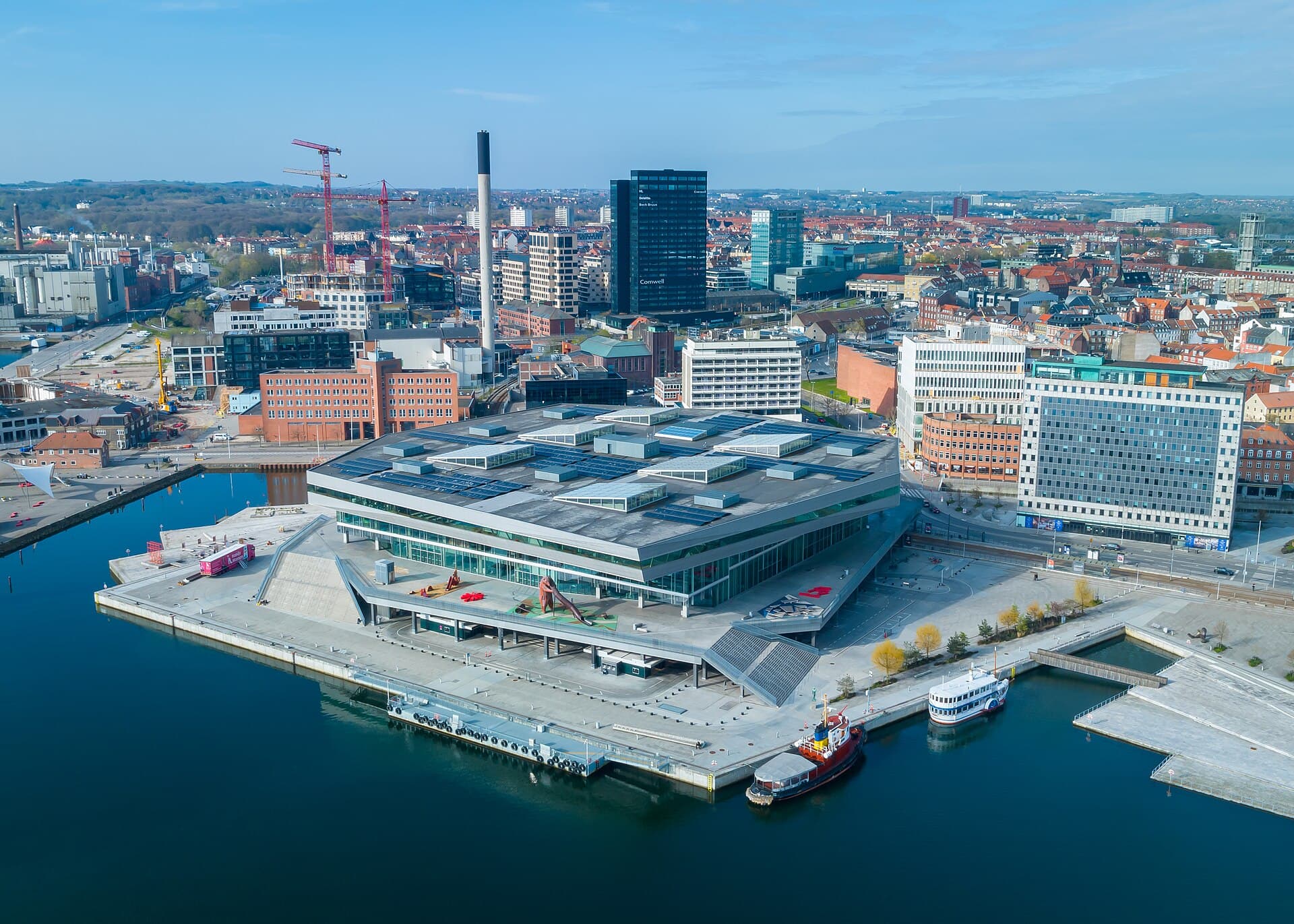
Finally, explore Dokk1, Scandinavia's largest public library and a modern cultural hub on the harbor front. This acclaimed building also integrates public services, office spaces, an automated underground parking facility, and a light rail station, serving as a dynamic connection between the city center and the revitalized waterfront.
Aarhus offers enjoyment throughout the year, but the optimal time to visit depends on your preferences. Summer (June to August) brings mild temperatures, averaging 15-20°C (59-68°F), with extended daylight hours, making it ideal for outdoor activities and experiencing the city's lively street life. Be prepared for occasional rain, so a light jacket and umbrella are advisable.
Spring (April to May) offers pleasant weather with blooming flowers and milder temperatures, while autumn (September to October) provides crisp air and beautiful fall colors. Winter (November to March) is cold, with average daily highs around 1-5°C (35-40°F) and a chance of snow, creating a cozy atmosphere, particularly during the festive season.
Aarhus is readily accessible by train from Copenhagen, with a journey lasting approximately three hours. The city is also served by Aarhus Airport (AAR) and Billund Airport (BLL), with Billund being larger but further away. Public transportation within Aarhus is efficient, primarily relying on buses, and the city also offers free city bikes from April to October. The currency used is the Danish Krone (DKK).
While Danish is the official language, English is widely spoken, especially in areas frequented by visitors and among the younger population. Tipping is not customary in Denmark, as service charges are typically included in prices. Aarhus is a city amenable to walking, with many attractions within easy reach, particularly in the city center and Latin Quarter. The city has a population of around 378,361, making it Denmark's second-largest city.
Aarhus in Korean, in Chinese or in Hebrew — and 29 more languages, every stop narrated by a native voice. The widest language range of any self-guided audio tour.
Available in: