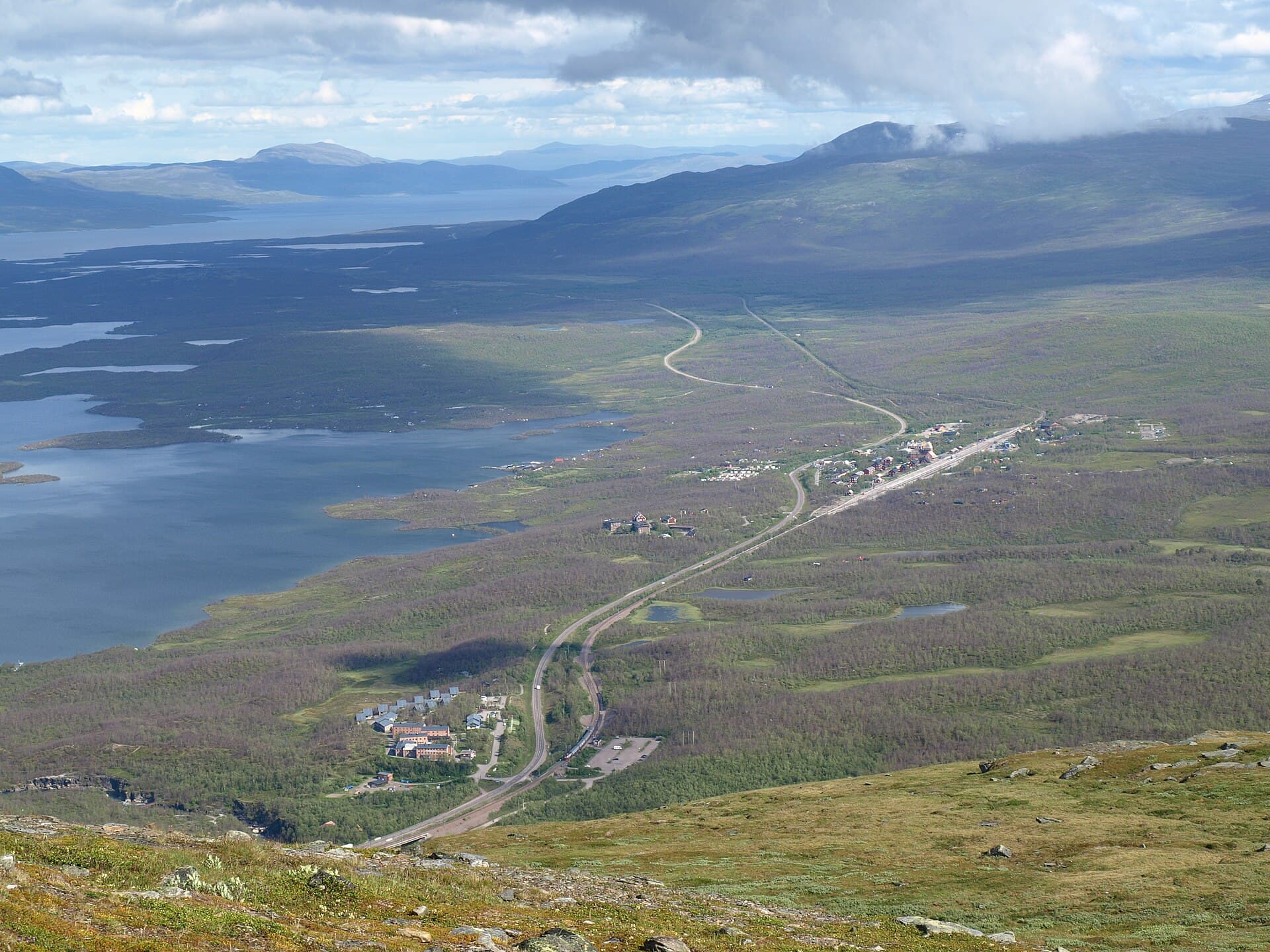
This distinct U-shaped valley, a defining feature of Abisko's landscape, holds a surprising insight into ancient gender roles.
Ojan / CC0, via Wikimedia CommonsAbisko
“Where the Arctic sky unveils its secrets.”
Abisko, as no one tells it.
Not the postcards. The stories even locals don't know — whispered in your ear, right where they happened.
Beyond its cutting-edge Arctic studies, this station holds a singular distinction in global climate monitoring.
Abisko is celebrated as an exceptional location on Earth to witness the Northern Lights, due to a peculiar atmospheric phenomenon.
Discover every secret of Abisko
Every address, every reveal in full — in your ear, right where it happened.
You pick your stops. You walk. The voice reveals what the others miss.
How long do you have in Abisko?
No tours available yet. Check back soon — we're preparing them.
The story of Abisko
Abisko, a small village in Swedish Lapland, lies approximately 200 kilometers north of the Arctic Circle, positioning it as a prime location for experiencing Arctic phenomena. The vast Lake Torneträsk borders it to the north, and subarctic mountains frame its expanse. Abisko National Park encompasses this region, safeguarding its unique flora, fauna, and striking landscapes. The village's Sámi name, Ábeskovvu, translates to 'the forest by the great water,' referring to Lake Torneträsk, Sweden's sixth-largest and largest mountain lake.
Abisko is recognized internationally for its exceptional opportunities to view the Aurora Borealis, frequently cited as one of the most reliable places globally for Northern Lights sightings due to its distinctive microclimate. Beyond the celestial displays, the region offers a diverse array of activities throughout the year, from trekking the renowned Kungsleden trail in summer to dog sledding and ice climbing in winter. Its accessibility by road and rail, including an overnight train directly from Stockholm, further solidifies its appeal as an Arctic destination.
From Iron Ore to Arctic Research
The history of Abisko is deeply interwoven with both the ancient presence of the Sámi people and the arrival of modern industry and scientific inquiry. For millennia, the area around Lake Torneträsk has been home to the Sámi, Europe's northernmost indigenous people. They traditionally followed wild reindeer herds between forest and mountain lands, hunting and fishing, with evidence of pitfall traps for reindeer and moose still visible today. The Sámi's way of life, including semi-nomadic reindeer herding, is central to their cultural heritage, though many now live more modern lives, with some supplementing income through tourism and crafts.
The late 19th and early 20th centuries brought significant transformations with the construction of the Iron Ore Line railway. This railway, built to transport iron ore from Kiruna to the ice-free port of Narvik in Norway, was the world's first fully electrified railroad. The railway's development led to the creation of small communities, including Abisko, and the hiking trail known as 'the navvy road' serves as a reminder of the material transport during its construction.
Abisko National Park itself was established in 1909, making it one of the first national parks in Sweden and Europe. Its primary purpose was to preserve a pristine area of northern Nordic mountain nature and serve as a site for scientific research. This scientific focus led to the establishment of the Abisko Scientific Research Station. Initially founded in 1903 near Vassijaure, a fire in 1910 led to a new station being built in Abisko, opening in 1913. Managed by the Swedish Polar Research Secretariat since 2010, the station conducts ecological, geological, geomorphological, and meteorological research in subarctic environments, contributing significantly to understanding climate change impacts. The STF Abisko Turiststation, which provides lodging and amenities, began accommodating visitors over a century ago, shortly after the railway opened, further cementing Abisko's role as a destination for both research and tourism.
Abisko National Park presents a range of sights and activities. The most prominent natural landmark is Lapporten, a distinctive U-shaped valley sculpted by ancient ice sheets, visible from the village. Lake Torneträsk, Sweden's largest mountain lake, borders the park to the north and provides opportunities for ice activities in winter and expansive views year-round.
For Northern Lights viewing, the Aurora Sky Station stands as a key attraction. Accessible by a chairlift up Mount Nuolja, it offers sweeping views over Swedish Lapland and serves as a primary spot to witness the aurora. The station also features a restaurant and an aurora exhibition. During the summer, Mount Nuolja can be ascended on foot to experience the midnight sun.
Starting (or concluding) at the Abisko Turiststation, the Kungsleden, or King's Trail, a 425-kilometer hiking path, winds through the national park's mountain landscapes. Shorter trails also provide access to features like a scenic canyon near the Tourist Station. The Naturum Abisko visitor center offers a permanent exhibition detailing the park's plants, wildlife, geology, and cultural history. While observing wildlife like moose, hares, and various bird species is possible, spotting lynx or wolverines is less common.
Visitors can also engage in Sámi cultural experiences, learning about reindeer herding and traditional life. Activities like dog sledding, snowshoeing, ice climbing, and ice fishing are popular in winter.
Abisko offers distinct experiences depending on the season. For the Northern Lights, the period between September and mid-April is ideal, with the easiest access to the Aurora Sky Station from December to March. October and November are considered excellent for aurora viewing, offering milder temperatures and the chance to see reflections in unfrozen lakes. Winter, from December to February, brings deep snow, opportunities for winter sports, and the polar night period in December with minimal daylight.
Summer, from June to August, is characterized by the midnight sun, where the sun never fully sets, offering endless daylight for hiking. Temperatures are coolest in winter, averaging between -15.8°C (3.6°F) in February and 12.3°C (54.1°F) in July. Precipitation peaks in summer, though Abisko is one of Sweden's driest locations due to a rain shadow effect. March offers good snow conditions with increasing daylight.
Abisko is accessible by train and car. Daily passenger trains connect Stockholm with Narvik, Norway, stopping at both Abisko Östra (the village) and Abisko Turiststation (near the national park entrance). The E10 highway also links Kiruna and Narvik, passing through the park. Kiruna Airport (KRN) is the nearest airport, approximately 1.5 hours away by train.
Accommodation options include STF Abisko Turiststation, located within the national park, and Abisko Mountain Lodge in Abisko Östra. Booking well in advance, especially for winter, is highly recommended. Abisko can be expensive, so budgeting accordingly is wise. For activities, reservations are generally required, particularly during peak season. Warm layering, including thermal clothing, warm boots, and insulated gloves, is essential for Arctic conditions. Some accommodations and tour operators offer winter clothing rentals. Visa and Mastercard are widely accepted, but the nearest banks and ATMs are in Kiruna.
- What are the chances of seeing the Northern Lights in Abisko?
- Abisko is considered one of the most reliable places on Earth to see the Northern Lights due to its unique microclimate, often called the 'Blue Hole of Abisko,' which results in more clear skies. Staying for at least three to four nights significantly increases your chances.
- Can I visit Abisko without a guided tour?
- Yes, Abisko can be visited independently. The train provides easy access, and there are lodging options and trails to explore on your own. However, many activities, like dog sledding or ice climbing, are offered through guided tours.
- What should I wear for winter activities in Abisko?
- Layering is key. Start with a base layer of non-cotton material to keep dry, add an insulation layer for warmth, and finish with a shell layer for protection against wind and snow. Warm boots, a hat, and insulated gloves are essential. Some accommodations and tour providers offer clothing rentals.
- Is it possible to see the Midnight Sun in Abisko?
- Yes, Abisko is located north of the Arctic Circle, so during the summer months (approximately June to August), the sun never fully sets, providing continuous daylight.
- How do I get to Abisko?
- You can reach Abisko by train from Stockholm, Kiruna, or Narvik, as there are two train stations: Abisko Östra and Abisko Turiststation. It's also accessible by car via the E10 highway from Kiruna.
- Are there opportunities to learn about Sámi culture in Abisko?
- Yes, there are opportunities to engage with Sámi culture, often through experiences that involve learning about reindeer herding, traditional storytelling, and handicrafts. Some tours may involve visiting Sámi-owned businesses in nearby areas like Kiruna or Jukkasjärvi.