The Great Temple's Inner Sanctuary
The sun's precise alignment with the temple's deepest chamber is a marvel of ancient engineering, yet its timing isn't quite what it once was.
Full story unlocks in the tour
 youssef_alam / CC BY 3.0, via Wikimedia Commons
“Where colossal statues tell tales of pharaohs and an impossible rescue.”
Not the postcards. The stories even locals don't know — whispered in your ear, right where they happened.
The sun's precise alignment with the temple's deepest chamber is a marvel of ancient engineering, yet its timing isn't quite what it once was.
Observe the colossal statues of Ramses II, and you will discern some unexpected company at his feet.
Moving mountains sounds like a myth, but for Abu Simbel, it was a very real, incredibly delicate operation.
Discover every secret of Abou Simbel
Every address, every reveal in full — in your ear, right where it happened.
You pick your stops. You walk. The voice reveals what the others miss.
No tours available yet. Check back soon — we're preparing them.
Abu Simbel, a secluded village in southern Egypt near the Sudanese border, holds one of ancient Egypt's most awe-inspiring archaeological sites: the twin temples of Ramses II and his cherished queen, Nefertari. These monumental rock-cut temples, originally carved from a mountainside in the 13th century BCE, stand as a testament to the grandeur and ambition of Pharaoh Ramses II. Their sheer scale and intricate carvings, depicting scenes of battles and divine offerings, offer a profound glimpse into a powerful civilization.
What makes Abu Simbel truly extraordinary is not just its ancient origins, but its incredible modern history. In the 1960s, the temples faced an imminent threat: submersion beneath the rising waters of Lake Nasser, created by the construction of the Aswan High Dam. An unprecedented international effort, led by UNESCO, saw the entire complex meticulously disassembled into thousands of blocks, moved to higher ground, and reassembled, preserving these invaluable treasures for future generations.
The Abu Simbel complex was commissioned by Pharaoh Ramses II, who reigned from 1279 to 1213 BCE, a period known as the 19th Dynasty. Construction of the temples began around 1264 BCE and took approximately 20 years to complete, finishing around 1244 BCE. The Great Temple was dedicated to the gods Amun, Ra-Horakhty, and Ptah, as well as to the deified Ramses II himself, serving as a powerful symbol of his divine status and might. The smaller temple was uniquely dedicated to his chief wife, Queen Nefertari, and the goddess Hathor, a rare honor that underscored her importance.
The temples were strategically carved into a sandstone cliff on the west bank of the Nile, near what was then the southern frontier of pharaonic Egypt, facing Nubia. Their imposing presence was intended to impress upon the Nubians Egypt's power and to assert Egyptian dominance in the region. The Great Temple's interior features reliefs commemorating Ramses II's heroic leadership at the Battle of Kadesh against the Hittites, one of the largest chariot battles in history.
The fate of Abu Simbel took a dramatic turn in the mid-20th century with the decision to construct the Aswan High Dam. The dam's reservoir, Lake Nasser, threatened to submerge numerous ancient monuments, including Abu Simbel, under up to 60 meters of water. In 1959, an international campaign, spearheaded by UNESCO, was launched to save the monuments of Nubia.
Between 1964 and 1968, a monumental engineering feat unfolded. The entire complex was meticulously disassembled into approximately 16,000 blocks, some weighing between 20 and 30 tons. These blocks were then transported to higher ground, 200 meters further inland and 65 meters higher than their original location. Artificial hills were constructed over concrete domes to house the reassembled temples, recreating their original setting and preserving their astronomical alignments. The project, which cost around USD 40 million at the time (equivalent to nearly $400 million today), was completed in September 1968, 18 months ahead of schedule. This remarkable endeavor ensured that Abu Simbel, along with other relocated Nubian temples, became part of the UNESCO World Heritage Site known as the Nubian Monuments.
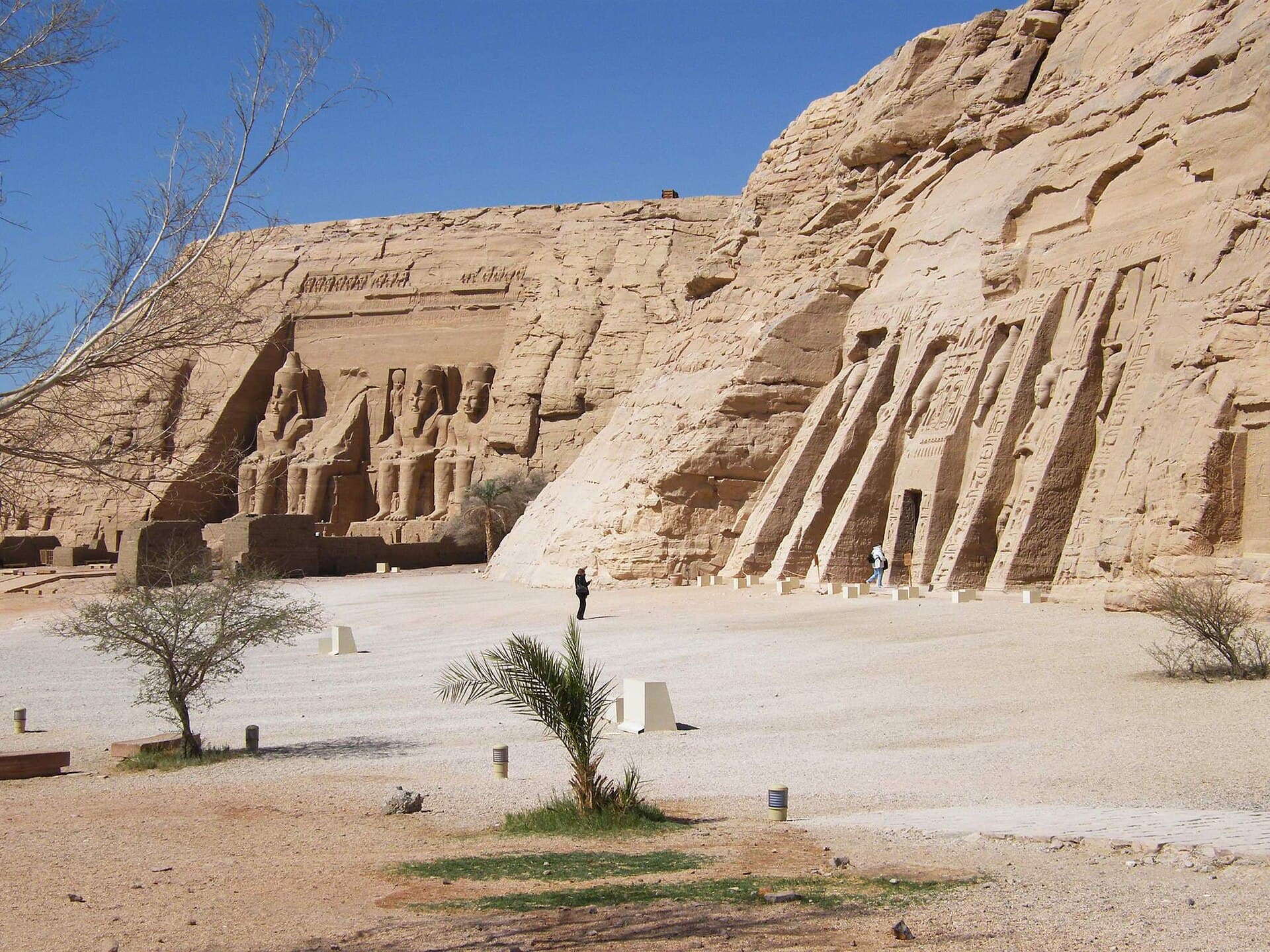
The Abu Simbel complex consists of two primary temples: the Great Temple of Ramses II and the Small Temple of Hathor and Nefertari.
The Great Temple, dedicated to Ramses II and several major deities, is immediately recognizable by its colossal facade featuring four seated statues of Ramses II, each approximately 20 meters (65 feet) tall. Inside, the temple extends 56 meters (185 feet) into the cliff, with a series of halls. The first, a hypostyle hall, contains eight Osiride statues of Ramses, each 9 meters (30 feet) high. The walls are adorned with intricate bas-reliefs depicting Ramses' military campaigns, most notably the Battle of Kadesh. The innermost sanctuary houses seated statues of Ra-Horakhty, the deified Ramses II, Amun-Ra, and Ptah. Twice a year, around February 22nd and October 22nd, the rising sun penetrates the temple's interior, illuminating three of these four statues, leaving Ptah, the god of darkness, in shadow—a remarkable display of ancient astronomical precision.
The Small Temple, situated just north of the Great Temple, honors Queen Nefertari and the goddess Hathor. Its facade features six standing statues, four of Ramses II and two of Nefertari, each about 10 meters (33 feet) tall. This temple is notable for its depiction of a queen on such a grand scale alongside the pharaoh. Inside, reliefs show Nefertari participating in divine rituals. Both temples are carved directly from the rock and offer a powerful visual narrative of ancient Egyptian belief and royal power.
The optimal time to visit Abu Simbel, and Egypt in general, is during the cooler months, from October to April. Temperatures during this period typically range from 20 to 30°C (68-86°F), making exploration more comfortable. Visiting in the early morning, ideally before 9:00 AM, is recommended to avoid the midday heat and larger crowds. The most special times to visit are around February 22nd and October 22nd, when the Sun Festival occurs, marking the solar alignment that illuminates the Great Temple's inner sanctuary. During these dates, ticket prices increase.
Abu Simbel is approximately 230 km (140 miles) southwest of Aswan. The most common way to reach Abu Simbel is by road from Aswan, typically via a private transfer or a guided tour. This journey takes about 3.5 to 4 hours each way. Alternatively, daily flights are available from Aswan to Abu Simbel Airport, with a flight time of about 45 minutes. Many travelers opt for early morning flights, returning to Aswan by midday. Public buses are a budget-friendly option, departing from Aswan in the early morning, though schedules can be inconsistent.
As of 2026, the adult entrance fee for the Abu Simbel Temples is around 822 EGP (approximately $17-$18 USD), with student discounts available for those with a valid ID. During the Sun Festival (February 22nd and October 22nd), ticket prices increase to 1200 EGP. Tickets are typically purchased at the on-site booth and usually require card payment. A photography ticket, costing around 300 EGP, is required for cameras inside the temples, though photography outside is free. While there isn't a strict dress code for the temples themselves, modest clothing that covers shoulders and knees is generally recommended out of respect for local customs. Comfortable walking shoes, a hat, and sunscreen are advisable due to the desert environment.