Tour de Constance
This imposing tower, built for a king, held a secret message etched into its walls by a forgotten prisoner.
Full story unlocks in the tour
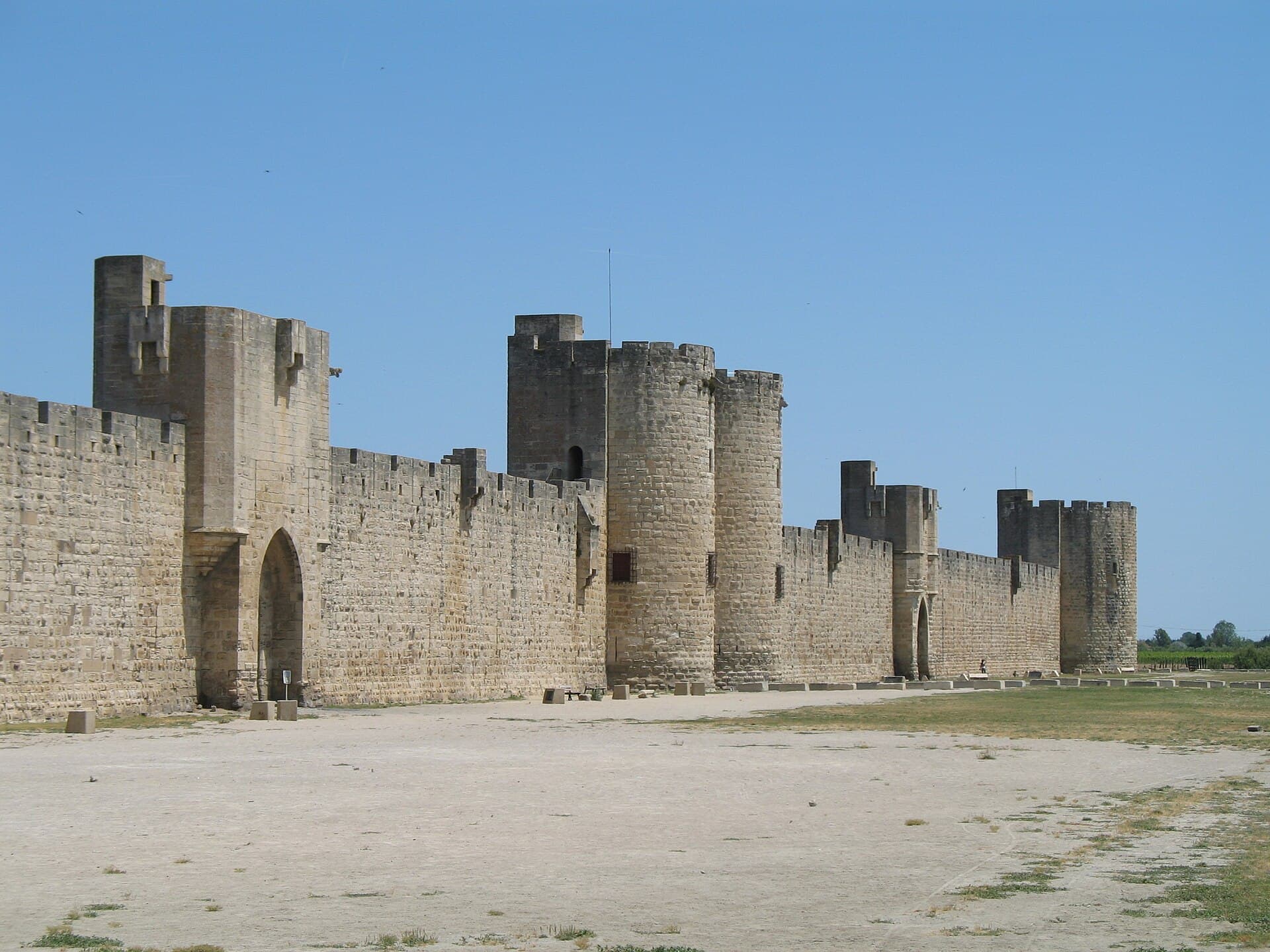 Marc Ryckaert (MJJR) / CC BY 2.5, via Wikimedia Commons
Self-guided audio walking tour of Aigues-Mortes — GPS route, offline playback, story-driven narration in 32 languages.
“Behind formidable walls, a city of salt, crusades, and quiet resilience.”
Not the postcards. The stories even locals don't know — whispered in your ear, right where they happened.
This imposing tower, built for a king, held a secret message etched into its walls by a forgotten prisoner.
The lively pink waters surrounding Aigues-Mortes aren't just a picturesque sight; they hint at a microscopic world.
The city's name, which translates to 'dead waters,' seems to contradict its lively history and surroundings.
Discover every secret of Aigues-Mortes
Every address, every reveal in full — in your ear, right where it happened.
You pick your stops. You walk. The voice reveals what the others miss.


Lume has a built-in augmented-reality guide. Hold your phone up and its camera shows the street ahead of you, with a glowing arrow laid over the real view that always points to your next stop — no map to puzzle over, no wrong turns. Like everything in Lume, it works fully offline.
Aigues-Mortes, a medieval fortified city in the heart of the Camargue, rises dramatically from a landscape of marshes and lagoons. Its formidable 13th-century ramparts, stretching over 1.6 kilometers and punctuated by twenty towers, enclose a town that feels suspended in time. Conceived by King Louis IX, Aigues-Mortes was once France's sole Mediterranean port, a strategic gateway for the Crusades and a hub for trade with the East.
Today, Aigues-Mortes invites exploration, from walking atop its well-preserved walls to wandering its grid-patterned streets. The town's history is interwoven with the surrounding salt marshes, which, at certain times of the year, transform into an expansive pink. Beyond its architectural grandeur, Aigues-Mortes offers a glimpse into Camargue culture, with its unique blend of history, nature, and local traditions.
The history of Aigues-Mortes stretches back to antiquity, with evidence of salt production dating to the 4th century BC. The Roman general Gaius Marius is said to have founded a settlement around 102 BC, and a Roman named Peccius organized early salt production. Benedictine monks established the Psalmody Abbey in the 5th century, sustaining themselves through fishing and salt exploitation.
However, Aigues-Mortes truly rose to prominence in the 13th century under King Louis IX (Saint Louis). At the time, France lacked a direct Mediterranean port, a necessity for Louis IX's ambitions to launch the Crusades. In 1240, he acquired the territory from the Benedictines and embarked on a colossal project to construct a city and a royal port. The town was designed with a grid layout, a characteristic of 'bastide' or planned towns.
Construction began in 1241 with the layout of streets, the building of the Church of Notre-Dame des Sablons, and the formidable Tour de Constance, intended to house the garrison and protect pilgrims and merchants. Stone for these structures was transported by boat from Beaucaire and Les Baux, as the marshy terrain lacked suitable building materials. To attract inhabitants to the somewhat insalubrious marshes, Louis IX granted a charter of privileges in 1246, offering tax exemptions, commercial monopolies, and political advantages.
Louis IX departed from Aigues-Mortes for the Seventh Crusade in 1248 and the Eighth Crusade in 1270, where he died in Tunis. His son and successor, Philip III the Bold, ordered the continuation of the city walls, which were completed around 1302 under Philip IV the Fair. The resulting rectangular fortification system, with its six prestigious towers and ten gates, remains remarkably intact today.
Over the centuries, the sea receded, leaving Aigues-Mortes several kilometers inland, now connected to the Mediterranean by canals. The Tour de Constance also served as a prison, notably for Templars in the 14th century and for Protestant Huguenots after the revocation of the Edict of Nantes in 1685. In 1893, Aigues-Mortes was the site of a tragic massacre targeting Italian salt workers, a dark chapter reflecting anti-Italian racism and difficult working conditions. Today, the ramparts are classified as a historical monument, and the town thrives on tourism, agriculture (salt and wine), and its unique Camargue heritage.
Begin your visit by walking the Towers and Ramparts of Aigues-Mortes. This 1.6-kilometer circuit offers panoramic views of the medieval town, the surrounding salt marshes, and the Camargue. The Tour de Constance, the most prominent of the towers, served as a keep, watchtower, and prison. Climb to its top for expansive vistas.
Within the fortified walls, explore the Place Saint-Louis, the heart of the old town, featuring a 19th-century statue of King Louis IX. The Église Notre-Dame des Sablons, dating from the 13th century, is the oldest monument in Aigues-Mortes and displays contemporary stained glass. Also, seek out the Baroque-era marvels of the Chapelle des Pénitents Blancs and the Chapelle des Pénitents Gris.
Beyond the ramparts, the Salins d'Aigues-Mortes are a compelling sight. These vast salt pans, active since antiquity, produce the famous Camargue salt. Take a guided tour by mini-train, bike, or on foot to witness the salt harvesting process and the striking pink waters, home to numerous bird species, including flamingos.
Consider a visit to the Carbonnière Tower, a 13th-century watchtower located in the marshes, which once controlled access to the city and offers views of the Camargue. For nature enthusiasts, the surrounding Camargue Regional Nature Park is home to wild horses, bulls, and diverse birdlife.
Aigues-Mortes enjoys a Mediterranean climate with hot, dry summers and mild, wetter winters. Spring (April-May) and autumn (September-October) offer pleasant temperatures, ideal for walking and exploring, with averages ranging from 13°C to 21°C. These seasons also see fewer crowds and fewer mosquitoes than the peak summer months. July and August are hot and sunny, with average highs around 31°C and minimal rainfall, attracting sun-seekers. While October and November can be rainier, the total precipitation remains moderate. Even in winter (December-March), temperatures are mild, typically 6-12°C, making it possible to enjoy activities like exploring the salt marshes or visiting the Christmas market.
Aigues-Mortes is located in the Gard department, approximately 35 km from Montpellier. You can reach the city by car via the A9 motorway. Montpellier-Méditerranée Airport (25km) and Nîmes Alès Camargue Cévennes Airport (42km) serve the area. Regional TER trains connect Aigues-Mortes on the Nîmes/Le Grau-du-Roi line. The town is also accessible by canal via the Canal du Rhône à Sète.
When visiting the Towers and Ramparts, allow ample time, as the tour is exposed to the sun in summer. Comfortable shoes are essential for walking on the surfaces. For the salt marshes, guided tours are available by mini-train, bike, or on foot. Many shops within the ramparts offer local crafts and products, including Camargue salt, 'Vins des Sables' (sand wines), and Camargue rice. The local specialty is fougasse d'Aigues-Mortes, a brioche-like bread flavored with orange blossom.
Aigues-Mortes in Korean, in Chinese or in Hebrew — and 29 more languages, every stop narrated by a native voice. The widest language range of any self-guided audio tour.
Available in: