Angkor Wat
La tour centrale d'Angkor Wat dissimule un puits profond s'enfonçant dans la terre. À quoi servait-il ?
L'histoire complète se débloque dans le tour
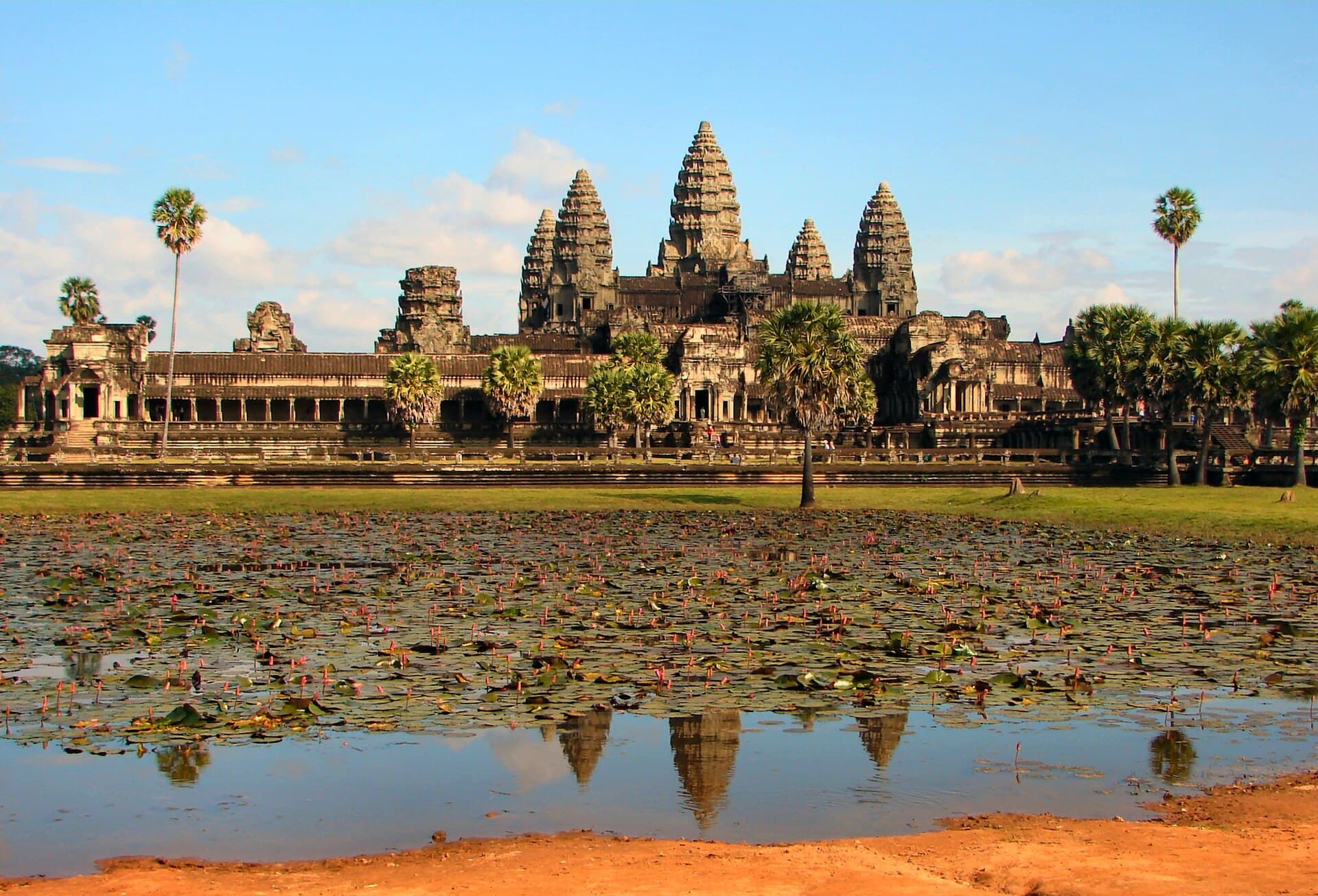 Bjørn Christian Tørrissen / CC BY-SA 4.0, via Wikimedia Commons
Visite audio autoguidée de Angkor — parcours GPS à pied, lecture hors ligne, narration en 32 langues.
“Là où de colossales structures de pierre sommeillent et d'anciennes rivières murmurent des histoires d'un lointain passé.”
Pas les cartes postales. Les histoires que même les habitants ignorent — soufflées à l'oreille, là où elles se sont passées.
La tour centrale d'Angkor Wat dissimule un puits profond s'enfonçant dans la terre. À quoi servait-il ?
Le nom de cette terrasse à Angkor Thom suggère une affliction royale, pourtant le récit véritable est plus complexe.
Parmi les sculptures élaborées d'Angkor Wat, certains animaux apparaissent qui ne sont pas indigènes au Cambodge.
Découvrez tous les secrets de Angkor
Chaque adresse, chaque révélation en entier — dans ton oreille, là où elle s'est passée.
Tu choisis tes lieux. Tu marches. La voix te révèle ce que les autres ignorent.


Votre visite audioguidée de Angkor vous attend — choisissez vos lieux, votre langue, et lancez-vous dès votre arrivée.
AcheterLume intègre un guide en réalité augmentée. Levez votre téléphone : sa caméra montre la rue devant vous, avec une flèche lumineuse posée sur l'image réelle qui pointe toujours vers votre prochain arrêt — aucune carte à déchiffrer, aucun mauvais virage. Comme tout dans Lume, ça fonctionne entièrement hors-ligne.
Angkor, un vaste parc archéologique au Cambodge, abrite les vestiges des magnifiques capitales de l'Empire khmer. Le plus emblématique d'entre eux est Angkor Wat, le plus grand monument religieux sur Terre. Plus qu'une simple collection de temples, Angkor représente une ancienne ville sophistiquée qui a autrefois accueilli une population pouvant dépasser un million d'habitants.
Explorer Angkor est un voyage dans un monde révolu, où des sculptures de pierre complexes narrent des sagas épiques et des structures colossales émergent de la jungle. L'échelle même de l'architecture, la précision de ses alignements astronomiques et le détail artistique de chaque sculpture témoignent d'une civilisation d'une ingéniosité et d'une dévotion spirituelle profondes.
Bien qu'Angkor Wat attire fréquemment l'attention, le Parc archéologique d'Angkor plus large englobe des centaines de temples et de sanctuaires, chacun possédant son propre caractère et son histoire, invitant à une exploration plus approfondie au-delà des sites les plus renommés.
L'histoire d'Angkor est en grande partie celle de l'Empire khmer, une formidable civilisation qui a prospéré en Asie du Sud-Est du IXe au XVe siècle. La construction d'Angkor Wat, le temple le plus célébré, a commencé au début du XIIe siècle sous le règne du roi Suryavarman II, qui a régné de 1113 à environ 1150 de notre ère. Il a été initialement conçu comme un temple hindou dédié à Vishnou, le dieu de la préservation, et a probablement servi de temple d'État et de lieu de repos final pour Suryavarman II.
La conception architecturale d'Angkor Wat est une expression physique de la cosmologie hindoue, avec ses cinq tours centrales symbolisant les sommets du mont Meru, la demeure mythique des dieux et le centre de l'univers. Les murs et les douves environnants représentent les chaînes de montagnes et l'océan cosmique. Fait inhabituel, Angkor Wat fait face à l'ouest, une direction associée à Vishnou et, dans certaines interprétations, à la mort et à l'au-delà, ce qui renforce son rôle de temple funéraire.
La construction d'Angkor Wat fut une entreprise monumentale, estimée à 300 000 ouvriers et 6 000 éléphants sur une période d'environ 30 à 37 ans. Les blocs massifs de grès, certains pesant jusqu'à 1 500 kg, ont été extraits de la montagne de Phnom Kulen, à environ 35 à 50 km de là, et transportés sur le site via un réseau sophistiqué de canaux et de rivières. La précision de la maçonnerie est remarquable, certaines zones présentant des joints sans soudure, un témoignage des techniques de construction anciennes.
Au fil des siècles, le paysage religieux d'Angkor s'est transformé. Bien qu'initialement hindou, Angkor Wat est progressivement devenu un temple bouddhiste à partir de la fin du XIIIe ou du XIVe siècle, et il reste aujourd'hui un centre actif de culte bouddhiste. Ce changement est évident dans le mélange de symbolisme hindou et bouddhiste que l'on trouve dans tout le complexe.
Après le XVe siècle, la capitale khmère a été déplacée, et bien qu'Angkor Wat n'ait jamais été entièrement abandonné, une grande partie de la ville environnante a été reconquise par la jungle. La compréhension occidentale d'Angkor a été largement ravivée au milieu du XIXe siècle, le naturaliste français Henri Mouhot étant souvent crédité de sa reconnaissance renouvelée. Au cours des dernières décennies, la technologie LiDAR avancée a révélé qu'Angkor Wat faisait partie d'un complexe urbain encore plus vaste et étendu que ce que l'on pensait auparavant, avec une infrastructure sophistiquée de canaux et de routes.
Aujourd'hui, Angkor est un site du patrimoine mondial de l'UNESCO, attirant des millions de visiteurs chaque année et constituant un puissant emblème du Cambodge, figurant même sur son drapeau national.
Angkor Wat, la structure primordiale, mérite une visite dédiée. Prévoyez plusieurs heures pour explorer ses trois galeries principales, ornées de près de 1 200 mètres carrés de bas-reliefs complexes décrivant des épopées hindoues et des scènes historiques. Le groupe central de tours, représentant le mont Meru, est particulièrement frappant.
Au-delà d'Angkor Wat, aventurez-vous dans Angkor Thom, une ancienne cité fortifiée. Ici, le temple du Bayon se distingue par ses plus de 200 visages souriants énigmatiques sculptés dans ses tours. À proximité, la Terrasse des Éléphants, une plateforme de 350 mètres de long, était autrefois utilisée par le roi Jayavarman VII pour observer ses armées victorieuses et les cérémonies publiques. Ses murs sont ornés de sculptures détaillées d'éléphants, de garudas, de guerriers et de danseurs.
Adjacente à la Terrasse des Éléphants se trouve la Terrasse du Roi Lépreux, avec sa statue distinctive et ses reliefs complexes de figures mythiques. Pour une expérience différente, visitez Ta Prohm, où des racines d'arbres géantes s'entrelacent de manière spectaculaire avec les structures en pierre, créant une atmosphère surréaliste.
La saison sèche, de novembre à avril, offre un temps agréable avec des températures plus fraîches et une faible humidité, ce qui en fait la période la plus prisée pour visiter. De décembre à février, les températures sont les plus fraîches, mais il y a aussi le plus grand nombre de foules et les prix les plus élevés. Novembre peut être une excellente période avec un temps agréable et moins de visiteurs que le pic.
Si vous préférez moins de touristes, envisagez de visiter pendant les mois plus chauds et plus humides de mai à octobre. Bien que des averses quotidiennes se produisent l'après-midi, les matins sont souvent clairs et les paysages sont verdoyants et luxuriants. Arriver aux temples tôt le matin (pour le lever du soleil) ou après 14h00 peut aider à éviter les heures les plus chargées.
Un pass de plusieurs jours est recommandé pour vous immerger pleinement dans le Parc archéologique d'Angkor, car il y a bien plus à voir qu'Angkor Wat. Prévoyez au moins trois heures pour Angkor Wat lui-même.
Habillez-vous respectueusement, en couvrant les épaules et les genoux, car ce sont des sites religieux actifs. Des chaussures de marche confortables sont essentielles, car vous ferez beaucoup d'exploration à pied. Restez hydraté, surtout pendant les mois les plus chauds. Envisagez d'engager un guide local pour enrichir votre expérience avec un contexte historique et des aperçus des sculptures complexes.
Bien que les promenades à dos d'éléphant ne soient plus autorisées, vous pouvez toujours observer les éléphants dans leur habitat naturel dans les centres de conservation. Soyez prêt pour les vendeurs, en particulier autour des temples principaux, et pratiquez une négociation polie si vous achetez des souvenirs.
Angkor en coréen, en chinois ou en hébreu — et dans 29 autres langues, chaque étape narrée par une voix native. La plus large gamme de langues de tous les audioguides autoguidés.
Disponible en :