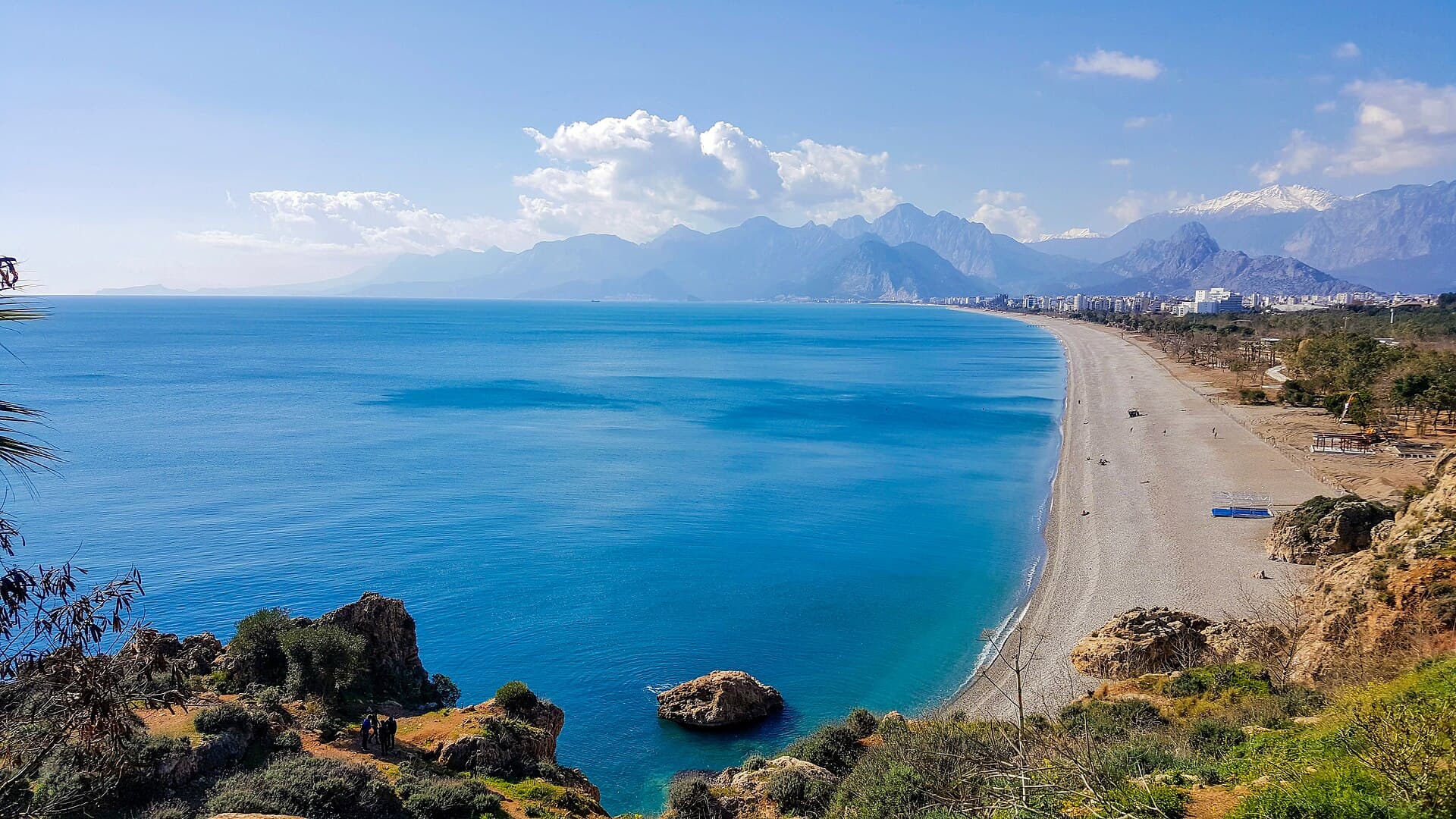
Antalya, TurkeyEsginmurat / CC BY-SA 4.0, via Wikimedia Commons
TR

Antalya

Where ancient echoes meet turquoise waters and citrus groves.

The secrets of Antalya

Antalya, as no one tells it.

Not the postcards. The stories even locals don't know — whispered in your ear, right where they happened.

3 secrets below. Many more wait inside the tour.
Hadrian's Gate

Stepping through Hadrian's Gate, one treads upon a history far deeper than initially perceived.

Full story unlocks in the tour
Kaleiçi (Old Town)

The charming old town of Kaleiçi guards a secret beneath its venerable paving stones.

Full story unlocks in the tour
Antalya Aquarium

Beyond its considerable scale, one attribute of the Antalya Aquarium distinguishes it globally.

Full story unlocks in the tour
The full tour

Discover every secret of Antalya

Every address, every reveal in full — in your ear, right where it happened.

Get the key to Antalya

You pick your stops. You walk. The voice reveals what the others miss.

Choose your time

How long do you have in Antalya?

No tours available yet. Check back soon — we're preparing them.

About Antalya

The story of Antalya

Antalya, frequently called the 'capital of Turkish tourism,' is an expansive city on Turkey's southwestern coast, where the Taurus Mountains greet the Mediterranean Sea. It is a place where ancient remnants, active city life, and compelling natural beauty converge, offering a varied experience for travelers. From its historic Old Town, Kaleiçi, with its Ottoman-era architecture and Roman artifacts, to the sweeping beaches and dramatic waterfalls, Antalya presents a singular blend of culture and repose.

Known as the 'gateway to the Turkish Riviera,' Antalya is a significant center along the Turquoise Coast, drawing millions of visitors each year. The city is celebrated for its Mediterranean climate, which nourishes abundant citrus trees, especially oranges, found in markets and orchards. Whether one seeks to explore ancient sites, savor traditional Turkish cuisine, or simply unwind by the sea, Antalya provides a memorable journey through time and natural splendor.

History

From Attaleia to Antalya: A Journey Through Empires

The city now known as Antalya was established around 200 BCE by King Attalus II of Pergamon, who named it 'Attaleia' after himself. Some archaeological discoveries suggest the city's origins might even stretch back to the 3rd century BCE. This Hellenistic connection was brief, as Attalus III, the successor to Attalus II, bequeathed the kingdom to the Roman Empire in 133 BCE.

Under Roman governance, Attaleia thrived, becoming a significant city within the province of Pamphylia Secunda. This era saw the construction of notable monuments, including Hadrian's Gate, erected in 130 CE to honor Emperor Hadrian's visit. The region also experienced the early dissemination of Christianity during the Roman period, and later, Attaleia gained prominence within the Byzantine Empire.

Antalya's strategic location meant it changed hands numerous times throughout history. In the early 13th century, the city was conquered by the Seljuk Turks. The Seljuks made it the capital of the Turkish beylik of Teke, though it experienced a period of Cypriot rule between 1361 and 1373. The Arab traveler Ibn Battuta, who visited between 1335 and 1340, described 'Adalia' as a beautiful and multicultural city.

In 1391, and then definitively in 1423 by Sultan Murad II, Antalya was incorporated into the Ottoman Empire, which brought a period of relative peace and stability for over five centuries. During the second half of the 17th century, the Ottoman explorer Evliya Çelebi noted a city of 3,000 houses with diverse neighborhoods. Following World War I, Antalya was occupied by Italy for three years before being returned to newly independent Turkey during the Turkish War of Independence. From a quiet town until the 1970s, Antalya has grown into Turkey's fifth-largest city, a major metropolis and a pivotal part of the Turkish Riviera.

What to see

Begin your exploration in Kaleiçi, Antalya's historic Old Town. Wander through its narrow, stone-paved passages, admiring the Ottoman-era houses and Roman artifacts. Key sights here include Hadrian's Gate, a grand Roman triumphal arch, and the Hıdırlık Tower, adjacent to the ancient harbor. You can take a glass elevator from the main street level down to the harbor for sweeping views. The Antalya Marina is a picturesque spot for sailing or enjoying the sight of yachts and day trip boats.

For natural wonders, the Düden Waterfalls are a compelling sight. The Lower Düden Waterfall dramatically plunges directly into the Mediterranean Sea, creating rainbows in the mist. The Upper Düden Waterfall is also worth a visit. Antalya offers several beaches, with Konyaaltı Beach and Lara Beach being favored choices for swimming and water sports. Konyaaltı presents a mix of pebble and sand with views of the Beydağları Mountains.

History enthusiasts should venture beyond the city center to ancient sites like Aspendos Theater, one of the best-preserved Roman theaters in the world, still hosting performances today. Perge Ancient City offers extensive Greco-Roman ruins, including marble columns and a vast stadium. For a distinctive experience, consider Termessos, an ancient city situated high in the Taurus Mountains, known as the 'Eagle's Nest' and the only place Alexander the Great failed to conquer.

When to visit

Antalya experiences a Mediterranean climate with hot summers and mild winters. The most pleasant times to visit are spring (April to May) and fall (September to October). During these shoulder seasons, temperatures are comfortable for sightseeing and outdoor activities, ranging from 15°C to 30°C, and the crowds are lighter than in peak summer. The sea remains warm enough for swimming into October. Summers (June to August) are very hot, often exceeding 35°C, making beach activities popular but sightseeing challenging due to the intense heat. Winters (November to March) are quieter, with milder temperatures suitable for cultural exploration.

Practical

Antalya International Airport (AYT) is situated about 20 minutes east of downtown, with numerous international direct flights. While public transportation like buses and trams are available, renting a car is suggested for exploring the broader region and its scattered attractions. When using taxis, ensure the meter is set and running. For local transport within the city, an AntalyaKart card can be used for buses.

Accommodation options range from large resorts, particularly on Lara Beach, to charming boutique hotels within Kaleiçi. Note that some roads in Kaleiçi are not accessible by car, so you might need to walk with luggage. It is advisable to avoid drinking tap water and stick to filtered or bottled water. While shopping, be mindful of street vendors selling counterfeit designer goods, especially in tourist areas where prices can be inflated.

Good to know
What is Antalya known for?
Antalya is recognized for its Mediterranean coastline, extensive history, flavorful Turkish cuisine, and citrus fruits like oranges. It harmonizes ancient ruins, beautiful beaches, and mountain landscapes.
Is Antalya worth visiting?
Yes, Antalya is considered a compelling destination for various travelers, offering a blend of ancient ruins, distinctive neighborhoods like Kaleiçi, and the Mediterranean coastline.
How many days are enough for Antalya?
While three days allow a glimpse of Antalya's attractions, four to five days are suggested for a more immersive experience, including coastal scenery and ancient sites.
What language is spoken in Antalya?
The official language spoken in Antalya, and throughout Turkey, is Turkish.
What currency is used in Antalya?
The official currency used in Antalya, and throughout Turkey, is the Turkish Lira (TRY).
Is it safe to drink tap water in Antalya?
It is generally advised to avoid drinking tap water in Antalya and to stick to filtered or bottled water, as the local supply may not always be treated to international standards.
Antalya
From€9.00
No booking · activate anytime · 12h to walk it
Get the key to Antalya