The Temple of Aphrodite
This grand temple, the city's spiritual heart, underwent a dramatic transformation.
Full story unlocks in the tour
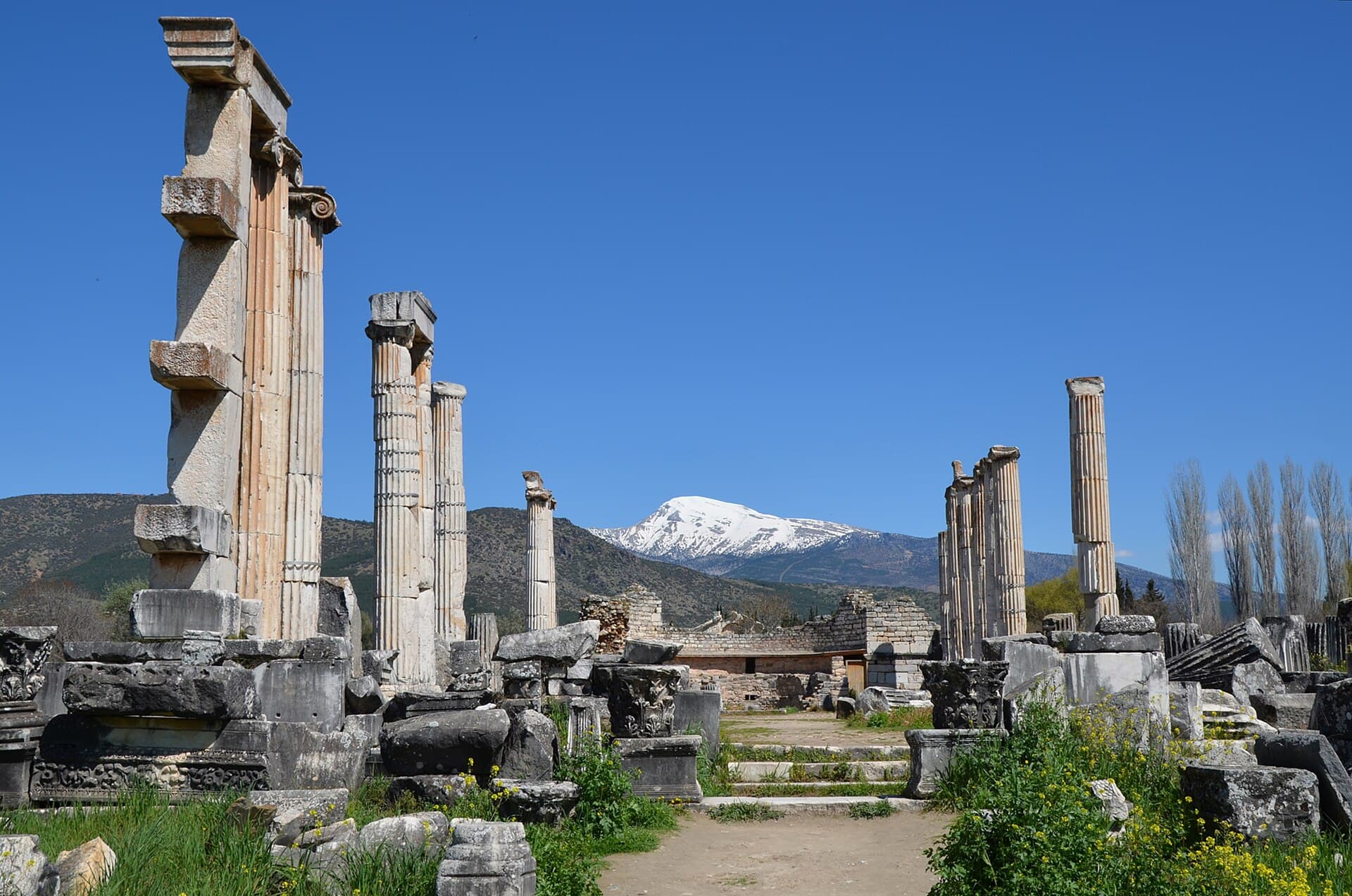 Carole Raddato from FRANKFURT, Germany / CC BY-SA 2.0, via Wikimedia Commons
Self-guided audio walking tour of Aphrodisias — GPS route, offline playback, story-driven narration in 32 languages.
“Where marble echoes devotion and masterful hands.”
Not the postcards. The stories even locals don't know — whispered in your ear, right where they happened.
This grand temple, the city's spiritual heart, underwent a dramatic transformation.
This ancient assembly hall was remarkably preserved for centuries, out of sight.
Aphrodisias possesses one of the largest and most intact stadiums of the ancient world.
Discover every secret of Aphrodisias
Every address, every reveal in full — in your ear, right where it happened.
You pick your stops. You walk. The voice reveals what the others miss.


Your self-guided audio tour of Aphrodisias is ready — pick your landmarks, choose your language, and start the moment you arrive.
BuyLume has a built-in augmented-reality guide. Hold your phone up and its camera shows the street ahead of you, with a glowing arrow laid over the real view that always points to your next stop — no map to puzzle over, no wrong turns. Like everything in Lume, it works fully offline.
Aphrodisias, named for Aphrodite, the Greek goddess of love and beauty, is an ancient Greco-Roman city in southwestern Turkey. It lies inland in the fertile Büyük Menderes River valley, near the modern village of Geyre, standing as a testament to Hellenistic and Roman urbanism and artistic prowess. Recognized as a UNESCO World Heritage site in 2017, Aphrodisias is particularly renowned for its exceptional marble sculpture tradition and its remarkably preserved monumental architecture.
Unlike more crowded ancient sites, Aphrodisias offers a tranquil and immersive experience, allowing visitors to wander among its extensive ruins in relative quiet. The city's prosperity was built upon its proximity to high-quality marble quarries, which fueled a celebrated school of sculpture. This legacy is evident in the abundance of statues, reliefs, and architectural details that adorn the site and fill its on-site museum.
The earliest traces of human presence at Aphrodisias date back to the Neolithic period, around 5800 BCE, with evidence of settlements from the Late Copper Age and Early Bronze Age. The area's fertile soil and water sources made it an ideal location for early agricultural communities. The settlement began to grow into a city in the 2nd century BCE, adopting a grid plan characteristic of Hellenistic urban design. It was during this period that the city was named Aphrodisias, after its patron goddess, Aphrodite, whose cult image was a unique blend of Greek and Anatolian traditions.
Aphrodisias truly flourished under Roman rule, particularly from the 1st century BCE to the 5th century CE. The city gained special privileges, including autonomy and tax exemptions, from Roman emperors, beginning with Augustus. This patronage, combined with abundant local marble quarries, allowed Aphrodisias to become a preeminent center for marble sculpture and monumental architecture in the Roman Empire. Sculptors trained here were renowned throughout the ancient world, with their works found across the empire, including at Hadrian's Villa in Tivoli, Italy.
In the later 3rd century CE, Aphrodisias was designated the capital of the new Roman province of Caria. The city maintained its classical character into late antiquity, even as Christianity spread. However, around 500 CE, the Temple of Aphrodite was converted into a Christian church, signifying the city's religious transition. A series of earthquakes and shifting trade routes contributed to the city's gradual decline and eventual abandonment by the 12th century. The modern rediscovery of Aphrodisias began in the 18th century, with systematic excavations starting in the early 20th century and continuing to this day.
Aphrodisias offers a wealth of well-preserved structures and artistic masterpieces. Begin at the Tetrapylon, a monumental gate with sixteen reconstructed columns, whose intricate reliefs provide a dramatic entrance to the site. The Temple of Aphrodite, the city's spiritual core, reveals its original Ionic design and the later modifications from its conversion into a Byzantine church.
Do not overlook the Sebasteion, a temple complex dedicated to the Roman imperial dynasty. Its elaborate marble reliefs, depicting emperors alongside mythological figures, offer a unique artistic narrative. The Stadium is a standout, an elliptical arena with a capacity of 30,000, considered one of the best-preserved ancient stadiums globally. The Theater, capable of seating 8,000 spectators, provides insight into the city's cultural life with its well-preserved stage buildings and intricate reliefs. Explore the Hadrianic Baths and the Bouleuterion (Council House), civic buildings that showcase the city's urban planning and artistry.
The Aphrodisias Museum, located on-site, is an essential part of the visit. It houses an extensive collection of sculptures, reliefs, and artifacts unearthed from the excavations, including the cult statue of Aphrodite and masterpieces from the Sebasteion. Unique exhibits include unfinished sculptures, offering a rare glimpse into ancient marble carving techniques.
The ideal times to visit Aphrodisias are spring (April-May) and autumn (September-October). During these months, the weather is pleasantly mild, making it comfortable to explore the expansive outdoor site. The landscape is also more lush in spring, and crowds are generally smaller than during the peak summer months. Summer (June-August) can be very hot, making midday exploration less comfortable, though early morning or late afternoon visits are still viable. Winter months (November-March) are cooler and less busy, but some coastal hotels may be closed.
Aphrodisias is located near the village of Geyre in Aydın Province, approximately 100 kilometers from Aydın city center and 60 kilometers from Denizli. The easiest way to reach the site is by private car, with free parking available at the entrance. Public transportation is available via buses from Aydın or Denizli to Karacasu, followed by minibuses to Geyre village, though this can be time-consuming. Allow at least three to four hours to explore the archaeological site and the museum comfortably. The site is open daily, typically from 8:30 AM to 7:00 PM in summer, with slightly earlier closing times in winter; check current hours before visiting. Entrance fees apply, with discounts for students and teachers, and free entry for Museum Pass holders (for Turkish citizens). Wear comfortable walking shoes, as the site covers a large area with ancient stone surfaces. Professional guides are available at the entrance, or you can use brochures and informational panels for a self-guided tour.
Aphrodisias in Korean, in Chinese or in Hebrew — and 29 more languages, every stop narrated by a native voice. The widest language range of any self-guided audio tour.
Available in: