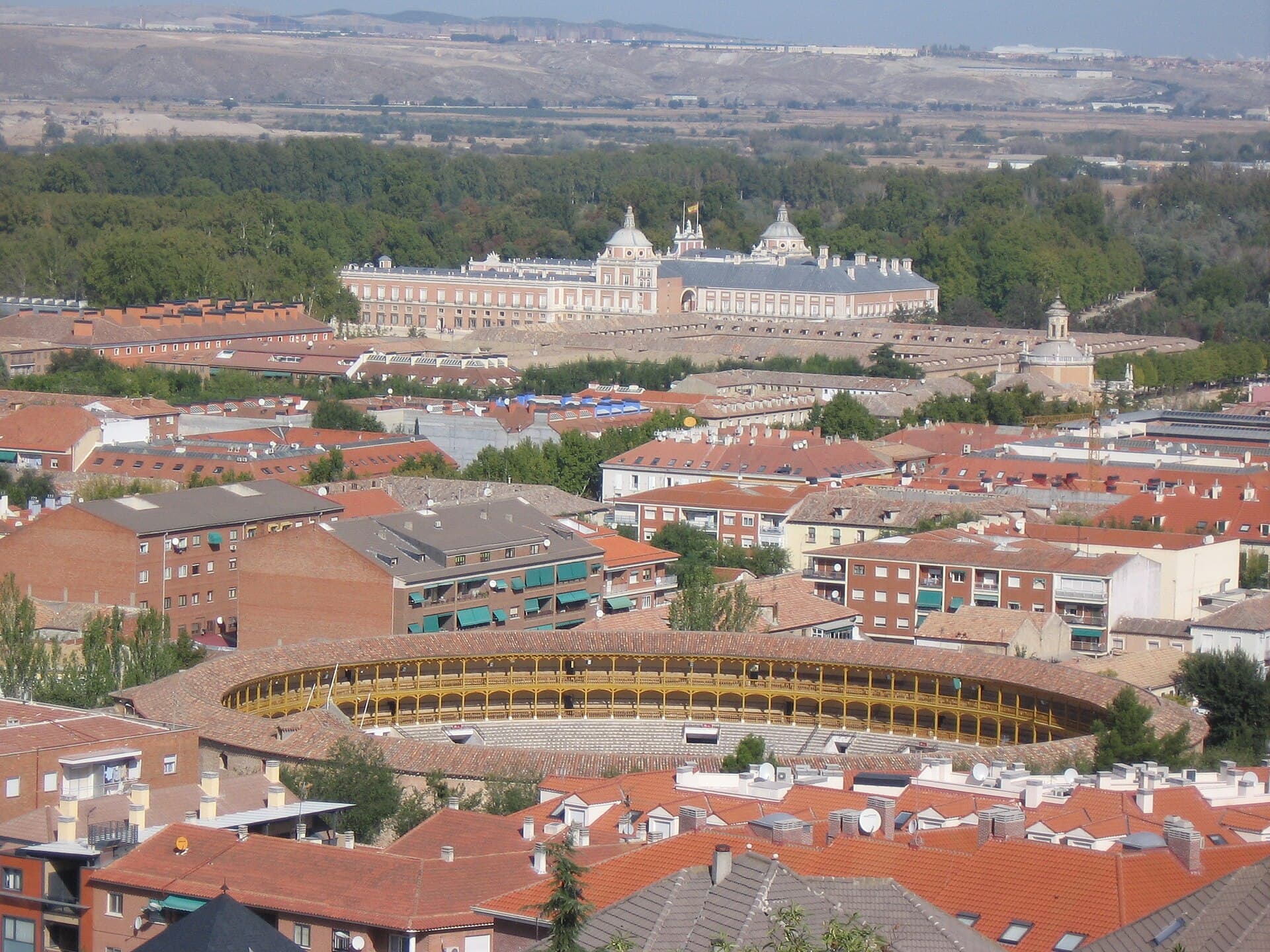
Aranjuez, SpainUnknown author / CC BY-SA 3.0, via Wikimedia Commons
ES

Aranjuez

Where royal whispers linger among verdant gardens and flowing rivers.

The secrets of Aranjuez

Aranjuez, as no one tells it.

Not the postcards. The stories even locals don't know — whispered in your ear, right where they happened.

3 secrets below. Many more wait inside the tour.
Jardín del Rey (King's Garden)

This intimate garden, meant for royal eyes only, holds a secret about its original purpose.

Full story unlocks in the tour
The Royal Palace of Aranjuez

One particular room within the palace is a dazzling, singular work of art, unlike any other in Spanish royal architecture.

Full story unlocks in the tour
Jardín de la Isla (Island Garden)

Beyond its Renaissance design and mythological fountains, this garden once housed some truly unexpected residents.

Full story unlocks in the tour
The full tour

Discover every secret of Aranjuez

Every address, every reveal in full — in your ear, right where it happened.

Get the key to Aranjuez

You pick your stops. You walk. The voice reveals what the others miss.

Choose your time

How long do you have in Aranjuez?

No tours available yet. Check back soon — we're preparing them.

About Aranjuez

The story of Aranjuez

Aranjuez, a UNESCO World Heritage Cultural Landscape, offers a serene escape south of Madrid where royal history intertwines with meticulously designed nature. Situated at the confluence of the Tagus and Jarama rivers, this former royal spring residence is celebrated for its grand palace and expansive gardens. It is a place where the Spanish monarchy left a refined mark, evident in its baroque town planning and the harmonious balance between human activity and the natural environment.

Beyond the regal splendor, Aranjuez is also known for its agricultural bounty, particularly its sweet strawberries and green asparagus, cultivated using historic irrigation systems. A visit here provides a glimpse into centuries of royal life, botanical innovation, and a tranquil Spanish lifestyle, making it a compelling day trip from the bustling capital.

History

From Roman Stronghold to Royal Retreat

Aranjuez possesses a long history, dating back to Roman times when it served as a stronghold. In the 12th century, it was a small hamlet under the influence of the castle of Oreja, eventually coming under Muslim control after the 1108 defeat of Castilian and Leonese forces at Uclés. Alfonso VII later retook Oreja, and in 1171, Alfonso VIII donated the area to the Order of Santiago. Aranjuez became the seat of the Mesa Maestral (Master's Table) of the Order of Santiago in 1272.

The Birth of a Royal Site

The connection between Aranjuez and the Spanish Crown began in 1493 when the Catholic Monarchs became administrators of the military orders. King Philip II declared Aranjuez an official Royal Site in 1560, initiating the construction of the Royal Palace. Designed initially by Juan Bautista de Toledo and completed by Juan de Herrera, the palace and its surrounding landscape were envisioned as a Renaissance masterpiece. For nearly two centuries, until 1752, only royalty and nobility were permitted to reside in the town.

Bourbon Grandeur and Urban Development

The 18th century marked a new era of splendor with the arrival of the Bourbons to the Spanish throne. Philip V continued the palace's construction, and Ferdinand VI initiated the reticulated division of the urban area, laying the groundwork for the town's present shape. Successors like Charles III, Charles IV, and Isabella II further contributed to the buildings and spaces, adding side wings to the palace and reflecting French tastes of the time. This period saw Aranjuez become a laboratory for urban innovation, blending French, Italian, and Spanish Baroque gardening styles.

Modern Recognition

Aranjuez witnessed significant historical events, including the Mutiny of Aranjuez in 1808, which led to the abdication of Charles IV. In 1851, Spain's second railway was built to connect Aranjuez with Madrid, a testament to its importance. The town received the title of villa in 1899. In 1940, Joaquín Rodrigo's famous Concierto de Aranjuez brought worldwide recognition to the city. In 2001, UNESCO designated Aranjuez a World Heritage Cultural Landscape, acknowledging its exceptional relationship between nature and human activity and three centuries of royal landscape development.

What to see

Begin your exploration at the Royal Palace of Aranjuez, a grand residence that served as the Spanish Crown's spring home. Inside, discover 18th-century rooms like the Porcelain Room, Arab Room, and Smoking Room, all adorned with notable art. The Hall of Mirrors, inspired by Versailles, and the red-velvet-draped Throne Room are also key highlights.

Surrounding the palace are the extensive Royal Gardens, a UNESCO World Heritage site. The Jardín de la Isla (Island Garden), situated between the Tagus River and a canal, offers shaded paths and mythological fountains. The Parterre Garden, opposite the palace's east façade, showcases an English style with striking fountain sculptures. The expansive Jardín del Príncipe (Prince's Garden), the largest of the four, features broad walkways, diverse tree species, and the neoclassical Casa del Labrador. This pavilion, once a simple country residence, was transformed into an elegant retreat with luxurious interiors.

Wander through the historic town center with its tree-lined streets, traditional plazas like Plaza de San Antonio, and the Mercado de Abastos market hall. The Church of San Antonio is another important local landmark. For a unique experience, consider a ride on the Strawberry Train (Tren de la Fresa), a vintage steam train from Madrid that runs on weekends from April to October.

When to visit

The most pleasant times to visit Aranjuez are during spring (April-June) and early autumn (September-October). In spring, temperatures are ideal (18-25°C), the gardens are in bloom, and it is strawberry and asparagus season. Early autumn offers comfortable temperatures (20-28°C, cooling to 15-22°C in October), beautiful foliage, and fewer crowds. Summers (July-August) can be very hot, with temperatures often exceeding 30°C, making midday exploration uncomfortable despite shaded garden areas. Winters are quiet but cold, with average temperatures around 6-8°C.

Practical

Aranjuez is easily accessible from Madrid. The most convenient way to get there is by taking a RENFE Cercanías C-3 commuter train from Madrid Atocha, a journey of about 45-50 minutes costing €4-6. The historic Strawberry Train also runs on weekends from April to October, offering a nostalgic experience with entertainment and strawberry tasting. The town center is compact and walkable, with the palace and main gardens a 10-15 minute walk from the train station. For the larger Prince's Garden, consider renting a bike or allowing extra time for exploration. Most visitors come for a day trip from Madrid, but overnight stays are possible with mid-range hotels available. Allow a half-day for the palace and main gardens, or a full day to include the Prince's Garden and the town center.

Good to know
Is Aranjuez worth visiting?
Yes, Aranjuez is highly recommended for its blend of historic heritage, UNESCO-listed gardens, and the scenic Tagus River surroundings, making it a complete cultural destination near Madrid.
How long does it take to visit Aranjuez?
A half-day is sufficient to explore the Royal Palace interior and the main gardens (Island and Parterre). A full day allows for a more thorough visit, including the Prince's Garden, Casa del Labrador, and the town center.
Are the gardens in Aranjuez free to enter?
The Island Garden and Parterre Garden are generally included with palace entry or are free to access. The Prince's Garden is also free to enter, though there may be a charge for the Casa del Labrador.
What is Aranjuez famous for?
Aranjuez is famous for its UNESCO World Heritage Cultural Landscape, the Royal Palace and its historic gardens, and its delicious strawberries and asparagus.
Can I take a guided tour of the Royal Palace?
Yes, guided tours of the Royal Palace are available and explain its historical significance, architectural evolution, and court life. Private tours are also an option for a more personalized experience.
Is Aranjuez suitable for wheelchair users?
The main visitor route within the palace is largely step-free with lift access between floors. The gardens feature firm gravel paths, making them accessible.
Aranjuez
From€9.00
No booking · activate anytime · 12h to walk it
Get the key to Aranjuez