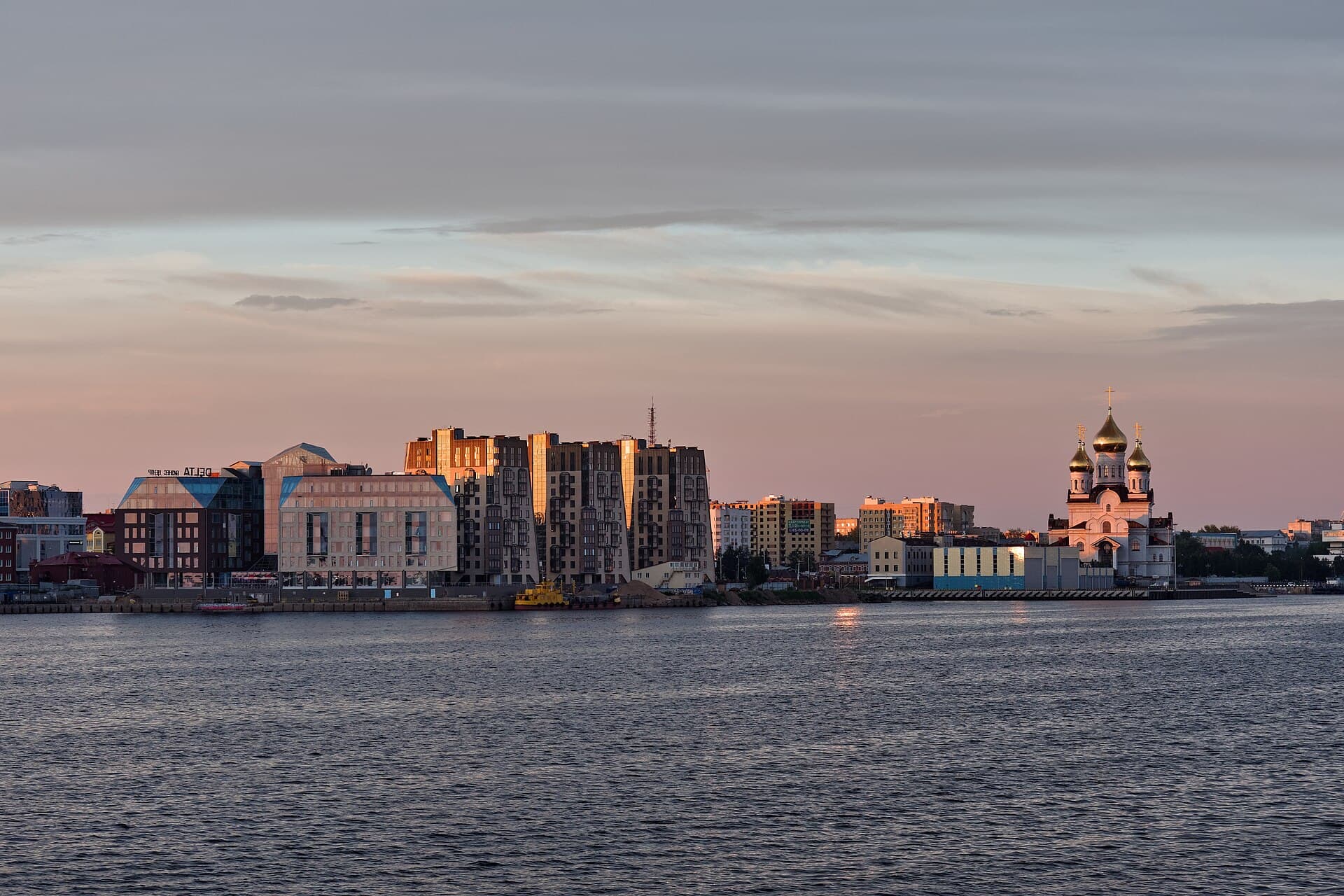
Arkhangelsk is known for its distinctive wooden architecture, but one particular street offers a unique, curated experience.
Alexxx1979 / CC BY-SA 4.0, via Wikimedia CommonsArkhangelsk
“Where the Northern Dvina meets the White Sea, a city of icebreakers and wooden tales.”
Arkhangelsk, as no one tells it.
Not the postcards. The stories even locals don't know — whispered in your ear, right where they happened.
The Northern Dvina is a vital artery for Arkhangelsk, but few realize just how central it is to the daily lives of some residents.
During World War II, Arkhangelsk played a critical role in Allied efforts, a story often overshadowed by more famous fronts.
Discover every secret of Arkhangelsk
Every address, every reveal in full — in your ear, right where it happened.
You pick your stops. You walk. The voice reveals what the others miss.
How long do you have in Arkhangelsk?
No tours available yet. Check back soon — we're preparing them.
The story of Arkhangelsk
Arkhangelsk, often called the "Capital of the Russian North," sits at the mouth of the Northern Dvina River where it spills into the White Sea. This historic port city, founded in 1584 by Ivan the Terrible, served as Russia's primary maritime gateway to Europe for a century and a half, facilitating vital trade routes. Today, with a population of around 293,000, it remains a significant cultural and industrial center, particularly known for its timber and fishing industries, and as a base for Arctic exploration.
The city's unique subarctic climate means long, cold, snowy winters and short, mild summers. Despite its northern latitude, Arkhangelsk does not experience polar days or nights, although summer days are exceptionally long, with the sun seemingly present almost 24/7 in May, June, and July. This blend of historical significance, Arctic proximity, and a distinct climate creates a compelling atmosphere for travelers seeking an authentic northern Russian experience.
From Bjarmaland to Russian Seaport
The area around present-day Arkhangelsk has a history stretching back to Viking times, known to them as Bjarmaland. Ohthere of Hålogaland recounted travels to a settlement by a river and the White Sea around 890 AD, likely the site that would become Arkhangelsk. Viking raids, such as one led by Thorir Hund in 1027, also occurred in this region. By the 12th century, Novgorod merchants had extended their influence north to the Kola Peninsula, drawn by the fur trade, and established trading posts and monasteries, including the Archangel Michael Monastery on Cape Pur-Navolock.
Arkhangelsk was formally founded in 1584 by decree of Tsar Ivan the Terrible as a wooden fortress named Novokholmogory, intended to protect burgeoning trade routes. In 1613, it was officially renamed Arkhangelsk City, in honor of the Archangel Michael Monastery. For 150 years, Arkhangelsk served as Russia's sole seaport for trade with Western Europe, becoming a wealthy trading hub that contributed significantly to the state treasury. During this period, the monumental Gostiny Dvory, a complex combining trade warehouses and defensive functions, was erected between 1668 and 1684.
Peter the Great's Influence and Subsequent Decline
Peter the Great's visits in the late 17th century marked a new chapter, transforming Arkhangelsk into a center for Russian state shipbuilding, with the first state shipyard established in 1693. However, the city's prominence as a port began to wane after 1703 with the founding of Saint Petersburg and Peter I's efforts to divert trade to his new city through exorbitant customs duties. Arkhangelsk experienced a period of decline, which continued until 1762 when the decree was cancelled.
Revival and Modern Roles
The city's economy revived in the late 19th century with the completion of a railway to Moscow in 1898, which facilitated timber exports, making Arkhangelsk a major timber-exporting port. During both World Wars, Arkhangelsk was a crucial port for Allied aid, serving as a key destination for Arctic convoys in World War II. In the post-Soviet era, Arkhangelsk has continued to develop as a center for maritime trade, Arctic research, and regional culture. Today, it remains a major seaport, kept open year-round by icebreakers, and is a base for fishing and shipbuilding industries. The city also serves as a starting point for numerous Arctic expeditions.
Begin your exploration along the Northern Dvina Embankment, the city's lively "display window" and a popular walking spot, offering views of the river and ships. Here, you'll find the Gostiny Dvory, a historic stone trading complex from the 17th century, now housing branches of the Arkhangelsk Regional Museum. Acknowledge Peter the Great's impact on the city at his monument.
For a deep dive into local heritage, visit the Malye Korely Open-Air Museum, located just outside the city. This expansive museum showcases traditional wooden architecture from across the Arkhangelsk region, including peasant houses, churches, and windmills, offering a tangible connection to Pomor life. In the city, Chumbarov-Luchinsky Avenue offers a curated experience of wooden architecture, with relocated and restored historic buildings. The Northern Maritime Museum provides insight into the city's seafaring history and its role in Arctic exploration. For art enthusiasts, the Arkhangelsk Museum of Fine Arts features regional art and historical exhibits.
The most comfortable time to visit Arkhangelsk is during the summer months, from June to August. Temperatures during this period are mild, averaging around 13°C to 17°C, with daily highs reaching 20°C to 25°C. June and July are particularly appealing due to the phenomenon of "White Nights," offering nearly 24 hours of daylight for extended exploration. While summers are relatively warm, be prepared for occasional rain.
For those interested in witnessing the Northern Lights, the best viewing season runs from late September through late March, when nights are long and dark. Arkhangelsk is situated within the auroral zone, making aurora visible during moderate to strong geomagnetic activity. Winters are long and very cold, with average temperatures from December to March ranging from -7°C to -9.5°C, often dropping much lower. Snowfall is heavy during winter.
Arriving in Arkhangelsk is most convenient by air, with Talagi Airport (ARH) located approximately 9.7 km from the city center, offering connections to major Russian cities. A taxi from the airport to downtown typically takes about 35 minutes. Train travel is another option, with direct services from Moscow and Saint Petersburg to Arkhangelsk-Gorod Station, which is centrally located.
Within the city, the center is walkable, but public transportation, including buses, is available for longer distances. River transport is active in summer, connecting the city center with river island vicinities. Taxis are also readily available. The local currency is the Russian Ruble (RUB). It's advisable to carry sufficient cash in Euros or US Dollars for exchange, as international credit and debit cards may not work due to banking restrictions. While generally safe, exercise caution on icy sidewalks during winter and and be mindful of personal belongings. Learning a few basic Russian phrases will be appreciated, as English is limited outside of major hotels and museums.
- What is Arkhangelsk known for?
- Arkhangelsk is known as Russia's first international seaport, a center for timber and fishing industries, and a gateway for Arctic exploration. It's also recognized for its unique wooden architecture and its role in the Arctic convoys during World War II.
- Can you see the Northern Lights in Arkhangelsk?
- Yes, Arkhangelsk is a good location for viewing the Northern Lights due to its northern latitude. The best time to see them is from late September through late March, during periods of moderate to strong geomagnetic activity.
- What is the climate like in Arkhangelsk?
- Arkhangelsk experiences a subarctic climate with long, very cold winters and short, mildly warm summers. Snowfall is heavy in winter, and summers are often rainy.
- How do you get to Arkhangelsk?
- Arkhangelsk is accessible by air via Talagi Airport (ARH), which connects to major Russian cities. It can also be reached by train from Moscow and Saint Petersburg.
- Is Arkhangelsk safe for tourists?
- Arkhangelsk is generally considered safe for tourists. Basic precautions are advised, especially regarding icy sidewalks in winter.
- What is the local currency and language in Arkhangelsk?
- The local currency is the Russian Ruble (RUB). Russian is the primary language, and while English may be limited, especially outside tourist areas, learning some basic Russian phrases is appreciated.