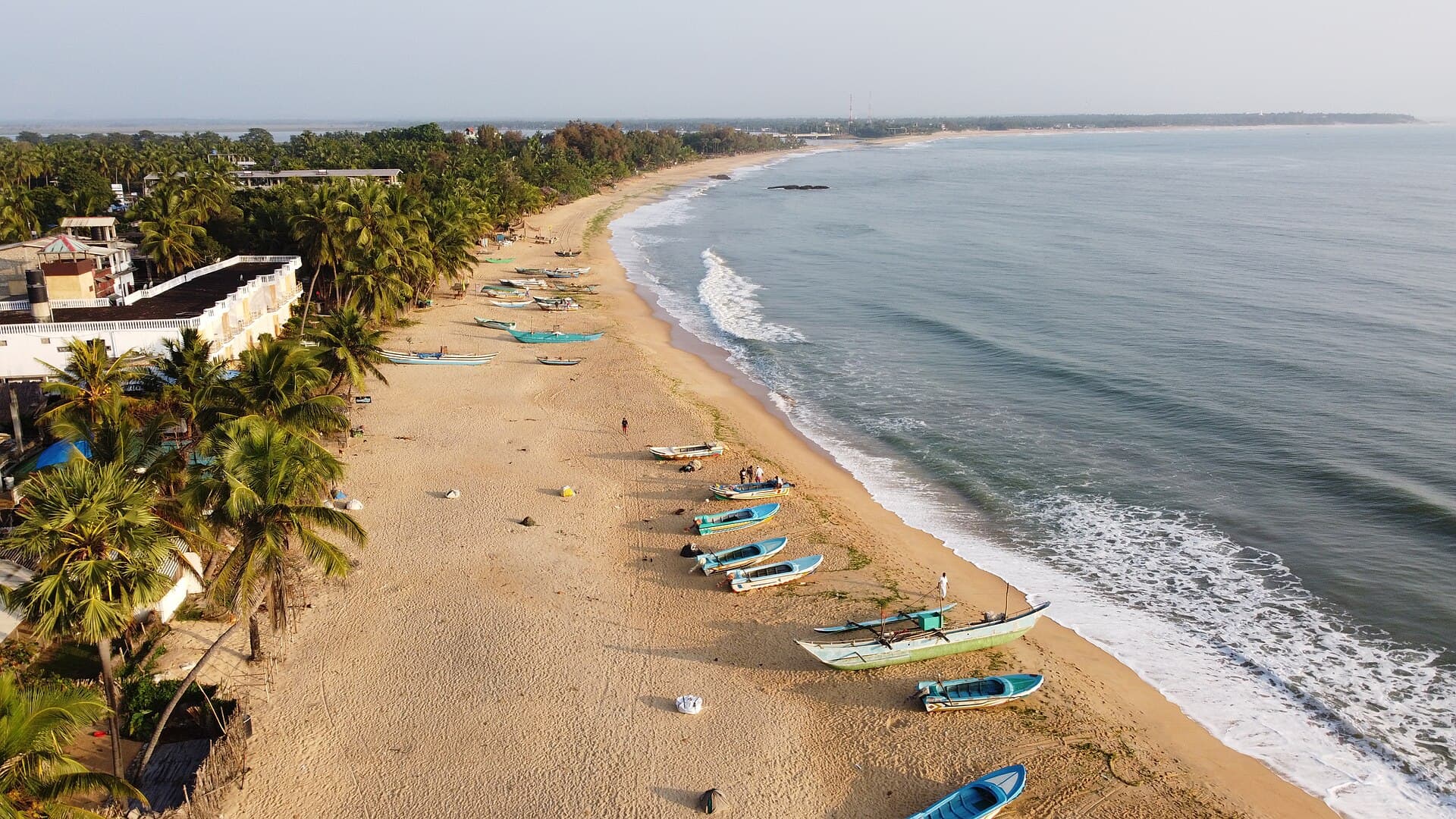
Arugam Bay, Sri LankaDennis Sylvester Hurd / CC0, via Wikimedia Commons
LK

Arugam Bay

Where the Indian Ocean sings of ancient trade and graceful waves.

The secrets of Arugam Bay

Arugam Bay, as no one tells it.

Not the postcards. The stories even locals don't know — whispered in your ear, right where they happened.

3 secrets below. Many more wait inside the tour.
Muhudu Maha Viharaya

Many believe Princess Viharamahadevi, a legendary figure in Sri Lankan history, was shipwrecked at Kirinda.

Full story unlocks in the tour
Arugam Lagoon

Most visitors journey to Kumana National Park for wildlife safaris, but there's a quieter spot right by the village that often goes unobserved.

Full story unlocks in the tour
Arugam Bay's economy

Arugam Bay is now synonymous with surf tourism, but its economic landscape wasn't always so harmonious.

Full story unlocks in the tour
The full tour

Discover every secret of Arugam Bay

Every address, every reveal in full — in your ear, right where it happened.

Get the key to Arugam Bay

You pick your stops. You walk. The voice reveals what the others miss.

Choose your time

How long do you have in Arugam Bay?

No tours available yet. Check back soon — we're preparing them.

About Arugam Bay

The story of Arugam Bay

Arugam Bay, known locally as "Arugam Kudah," is a coastal town on Sri Lanka's southeast coast, along the Indian Ocean in the dry zone. Its Tamil name literally translates to "Bay of Cynodon dactylon." This once-quiet fishing village has transformed into a lively center, celebrated for its world-class surf, diverse wildlife, and a distinctly relaxed atmosphere.

The bay forms a natural point break, where ocean swells curve around the headland, creating long, rideable right-hand waves that attract surfers from across the globe. Beyond the waves, Arugam Bay offers a unique blend of natural beauty and local life. Coconut trees line the shore, fishing boats rest on the sand, and small cafés and guesthouses dot the main road, contributing to a tranquil coastal rhythm.

History

Ancient Roots and Trading Post

Arugam Bay's history stretches back to Sri Lanka's early periods, serving as a significant trading post as early as the 2nd century BCE. Its strategic location along the Bay of Bengal facilitated trade between Sri Lanka's central kingdoms, including Anuradhapura and Polonnaruwa, and distant lands like Persia and Arabia. Archaeological sites nearby still hold remnants of pottery, ancient coins, and maritime tools from this era.

Spiritual Significance

The region also bears the imprints of Sri Lanka's Buddhist heritage. Ancient temples and monasteries, some partially reclaimed by the jungle, are found a short distance from the shore. Among these is the Muhudu Maha Viharaya, a Buddhist temple believed to be over 2,000 years old. According to local legend, the temple was built to honor Princess Devi, who was shipwrecked near Arugam Bay and later married King Kavantissa. The site, though partly in ruins, features intricate stone carvings and statues that offer a glimpse into early Sri Lankan civilization.

Colonial Influence and Civil War

While the colonial footprint is more pronounced on Sri Lanka's western coast, European influence was felt in Arugam Bay through trade restrictions and resource extraction, particularly during the British campaign to control the island.

The region faced significant turmoil during the civil war between 1983 and 2009, being close to conflict areas. Many communities were displaced, and tourism dwindled. Despite these challenges, the people of Arugam Bay demonstrated resilience, preserving their culture and traditions.

Tsunami and Resurgence

In 2004, the Indian Ocean tsunami devastated much of Sri Lanka's eastern coast, including Arugam Bay, sweeping away villages and causing immense loss of life. In the wake of the disaster, the local community came together to rebuild. Today, reminders of the tsunami are still part of the bay's story. With the end of the civil war in 2009, Arugam Bay has re-emerged as a sought-after destination, particularly for surfers.

What to see

Arugam Bay offers a range of activities beyond its famous surf breaks. For wildlife enthusiasts, Kumana National Park (also known as Yala East) is a short drive away, providing opportunities to observe elephants, leopards, sloth bears, crocodiles, and a diverse array of birdlife, often with fewer crowds than other national parks. Closer to the village, wild elephants can sometimes be seen at dusk emerging from the jungle near the Arugam Lagoon. Pottuvil Lagoon offers serene boat safaris through mangrove channels, where you can observe crocodiles, kingfishers, and traditional fishing boats.

For expansive views, a climb up Elephant Rock, located about 5km south of Arugam Bay, is recommended, especially at sunset. History and culture can be explored at the ancient Muhudu Maha Viharaya temple near Pottuvil, dating back to the 2nd century BCE, and the Kudumbigala Monastery, built in 246 BCE, which offers peace and historical insight. Exploring the farmlands and quieter beaches to the south of town by moped or tuk-tuk reveals different landscapes, from pine forests to palm-fringed fields.

When to visit

The ideal time to visit Arugam Bay is during its dry season, from April to September. This period brings consistent dry weather, ample sunshine, and the most favorable surfing conditions with warm water. June to August are the busiest months, offering the best waves and a lively atmosphere. April and May, as well as September and October, are considered shoulder seasons with very good conditions and fewer crowds. The off-season, from November to March, brings monsoon rains and flatter surf, with many guesthouses and restaurants closing.

Practical

Arugam Bay is situated on the southeast coast of Sri Lanka, approximately 320 kilometers east of Colombo. Reaching it from Colombo can take 6-8 hours by private taxi or 9-10 hours by local bus. An air-conditioned direct bus also departs daily from Maradana Zahira College in Colombo at 8 PM, arriving at Pottuvil Bus Station around 3:45 AM. Domestic flights to Batticaloa are another option, followed by a three-hour drive to the bay. Once in Arugam Bay, local transportation is primarily by tuk-tuk, with rides typically costing $1-2. Renting a scooter is also a popular way to explore the surrounding areas and quieter surf spots.

Accommodation options range from budget hostels to boutique hotels and beachfront cabanas, catering to various budgets and travel styles. The food scene is a mix of bohemian cafés, local curry houses, and beach BBQs, with fresh seafood being a highlight.

Good to know
What is Arugam Bay known for?
Arugam Bay is primarily known as Sri Lanka's surf capital, offering world-class right-hand point breaks that attract surfers of all levels. It's also recognized for its relaxed beach atmosphere, abundant wildlife, and access to national parks and lagoons.
Can I see elephants in Arugam Bay?
Yes, you can spot wild elephants around Arugam Bay. They are often seen in the evenings near the edge of the bay, as you head south towards Elephant Rock, and at known elephant spotting locations near the bridge coming into Arugam Bay from Pottuvil. Kumana National Park also offers assured sightings.
Is Arugam Bay suitable for beginner surfers?
Absolutely. While Main Point offers powerful waves for experienced surfers, spots like Baby Point provide gentle waves, making Arugam Bay an excellent place for beginners to learn and progress. Many surf shops in town offer board rentals and lessons.
What kind of food can I expect in Arugam Bay?
Arugam Bay's food scene features a blend of local Sri Lankan cuisine, with fresh East Coast tuna and various curries being prominent, alongside international options like smoothie bowls, Western breakfasts, and even Middle Eastern and Japanese fusion. Many cafés and restaurants line the main beach road.
How do I get to Arugam Bay from Colombo?
You can reach Arugam Bay from Colombo by private taxi (6-8 hours), local bus (9-10 hours), or a direct air-conditioned night bus. Another option is to fly to Batticaloa and then take a taxi for a shorter drive.
Are there historical sites near Arugam Bay?
Yes, Arugam Bay is close to several historical sites. The Muhudu Maha Viharaya, an ancient Buddhist temple near Pottuvil, dates back to the 2nd century BCE. Further inland, the Kudumbigala Monastery, built in 246 BCE, offers historical and spiritual insights.
Arugam Bay
From€9.00
No booking · activate anytime · 12h to walk it
Get the key to Arugam Bay