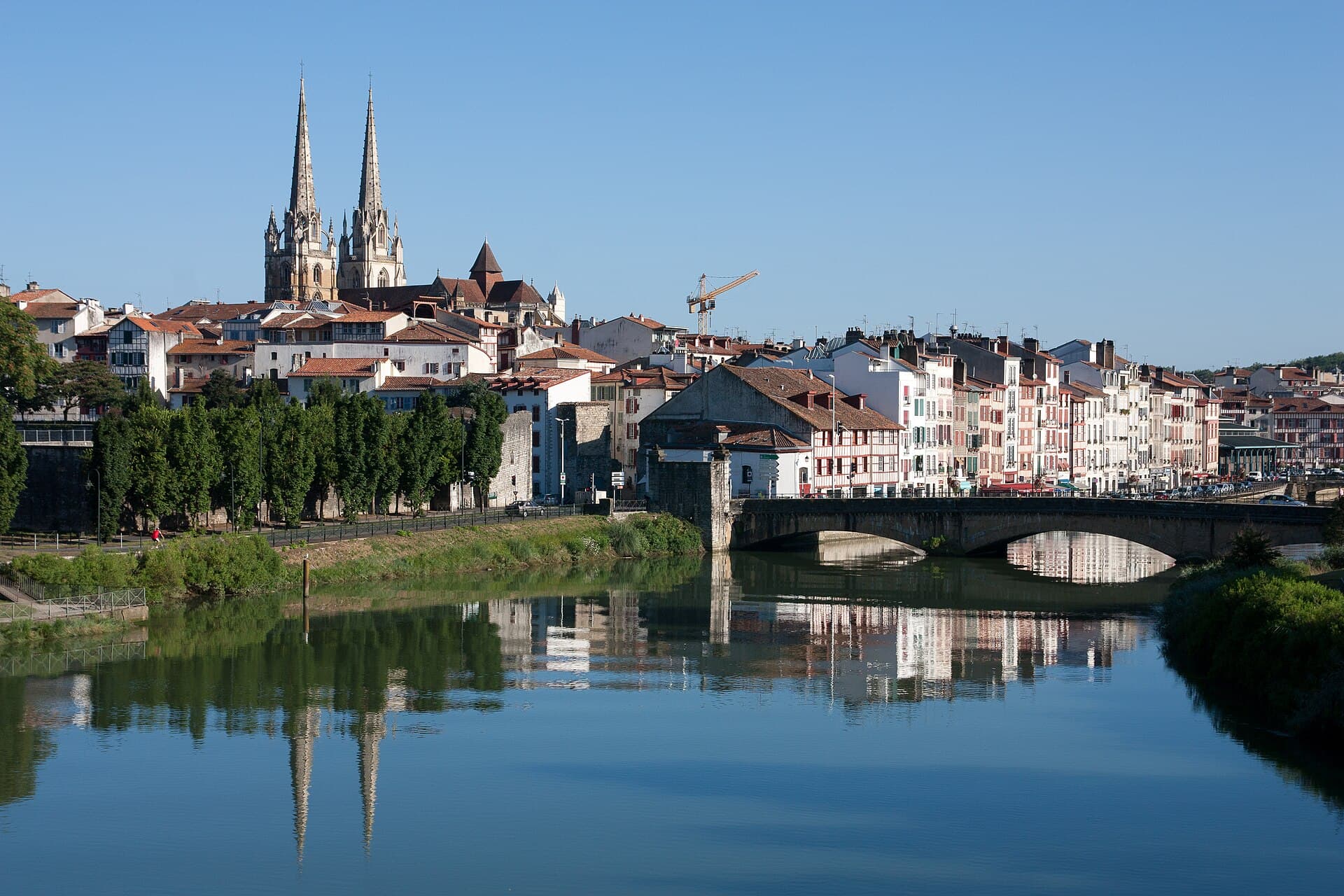
Bayonne is known as France's chocolate capital, but the origins of this sweet tradition are intertwined with a surprising historical migration.
Daniel VILLAFRUELA / CC BY-SA 3.0, via Wikimedia CommonsBayonne
“Where Basque spirit meets Gascon charm, along two rivers and a thousand stories.”
Bayonne, as no one tells it.
Not the postcards. The stories even locals don't know — whispered in your ear, right where they happened.
Bayonne holds a unique place in French culture for a tradition often associated with Spain.
The distinctive flavor of Bayonne ham, a French gastronomic emblem, is linked to a legendary discovery involving a wild boar.
Discover every secret of Bayonne
Every address, every reveal in full — in your ear, right where it happened.
You pick your stops. You walk. The voice reveals what the others miss.
How long do you have in Bayonne?
No tours available yet. Check back soon — we're preparing them.
The story of Bayonne
Bayonne, a city in southwestern France, offers a captivating blend of Gascon and Basque cultures, situated at the confluence of the Nive and Adour rivers. Just a short distance inland from the Atlantic coast, it forms an urban area with neighboring Biarritz and Anglet. Awarded the "Ville d'Art et d'Histoire" (City of Art and History) label, Bayonne reveals a deep historical past spanning over 15 centuries, evident in its medieval streets, Gothic cathedral, and fortified architecture.
The city's dual identity is palpable, with bilingual signs in French and Euskara (the ancient Basque language), red and white Basque flags fluttering, and a strong presence of Basque pelota courts. Beyond its cultural depth, Bayonne is celebrated for its culinary specialties, particularly Bayonne ham and chocolate, which have earned it a place on France's foodie map.
From Roman Outpost to Medieval Port
Human occupation in the Bayonne area dates back to the 1st century AD, with a Roman camp established in the 4th century on the promontory between the Nive and Adour rivers. The Romans fortified the city with a wall to protect against the Tarbelli, Aquitani, or proto-Basque people. By the 12th century, Bayonne had expanded to the confluence of the Nive and Adour, and its first bridge spanning the Adour was constructed.
English Rule and French Allegiance
Bayonne came under English control in 1152 through the marriage of Henry II and Eleanor of Aquitaine, prospering commercially and militarily due to maritime trade. Richard the Lionheart of England took control in 1177, separating it from the Viscount of Labourd. However, at the end of the Hundred Years' War in 1451, Bayonne swore allegiance to France.
Chocolate, Fortifications, and a Shifting River
The 16th century saw a significant development with the arrival of Jewish immigrants escaping the Spanish Inquisition, who settled in the Saint-Esprit quarter across the Adour. These immigrants introduced chocolate-making techniques to France, establishing Bayonne as a prominent chocolate-producing center. In 1578, the course of the Adour River was changed through dredging, allowing Bayonne to regain lost maritime trade and flourish. The city's defenses were further strengthened in the 17th century by the renowned military engineer Vauban, whose fortifications served as models for a century.
Modern Bayonne
During the French Revolution, the Saint-Esprit district was temporarily separated from Bayonne, only to be reunited in 1857. The 19th and 20th centuries saw continued development, including the discovery of the Lacq gas field in 1951, with much of its extracted oil and sulfur shipped from Bayonne's port. Today, Bayonne is an economic, commercial, and port capital of the Basque Country, with business services being the largest source of employment. It forms the heart of a larger urban area that includes Anglet and Biarritz, maintaining its strong Basque and Gascon influences and a profound cultural heritage.
Begin your exploration in Grand Bayonne, the historic core, characterized by colorful half-timbered houses and narrow streets. The Cathédrale Sainte-Marie, a Gothic masterpiece with 19th-century spires and a spacious cloister, is a UNESCO World Heritage site as part of the routes to Santiago de Compostela. Nearby, the Château-Vieux, built on the remains of a Roman castrum, stands as a medieval fortress.
Cross the Nive River into Petit Bayonne, known for its lively street art, particularly prominent during the annual Points de Vue festival. Here, the Musée Basque et de l'Histoire de Bayonne offers a comprehensive journey into Basque life, culture, and traditions, housed in a 17th-century property. Stroll along the quays of the Nive and Adour rivers, where you'll find bustling cafés and restaurants. For a tranquil escape, the Bayonne Botanical Garden, located along the ancient city walls, provides a peaceful haven with diverse flora and a Japanese-style waterfall. Discover the covered market halls (Les Halles) for a taste of local produce and a lively atmosphere.
Bayonne experiences a temperate oceanic climate with mild temperatures year-round. Summers (June-August) are warm, with average highs around 22-25°C, and are the sunniest period, though still with some rainy days. The best time for warm-weather activities is from late June to mid-September. Spring (May and June) and early autumn (September and October) offer pleasant weather with fewer crowds, ideal for exploring the city and surrounding Basque Country. Winters (December-February) are mild, with average temperatures around 8-10°C, but are also the wettest season.
Bayonne is easily accessible, located two hours south of Bordeaux and 45 minutes north of the Spanish border. By train, it's approximately 3 hours 50 minutes from Paris and 2 hours from Bordeaux. Biarritz-Anglet-Bayonne airport is a 15-minute drive from the city, with flights from major French and European cities. The city center is compact and easily explored on foot. The Bayonne Tourist Office, located on Place des Basques, offers a range of services, including guided tours and ticketing, and is accessible for visitors with disabilities. Public transport and parking are also available. Consider booking a chocolate-making workshop or a guided food tour to fully experience Bayonne's culinary delights.
- What is Bayonne famous for?
- Bayonne is known for its distinct Basque and Gascon culture, its historic architecture including the Sainte-Marie Cathedral, and its culinary specialties, particularly Bayonne ham and chocolate. It is also recognized for its bullfighting tradition and the lively Fêtes de Bayonne.
- Is Bayonne part of the Basque Country?
- Yes, Bayonne is considered the capital of the French Basque Country, an unofficial region that straddles the Pyrenees. Its Basque identity is evident in its bilingual signs, cultural events, and the sport of pelota.
- How far is Bayonne from the beach?
- Bayonne is a short distance inland from the Atlantic coast. It is administratively linked to the coastal resorts of Biarritz and Anglet, which offer beaches and a relaxed lifestyle.
- What is Bayonne ham?
- Bayonne ham is a renowned cured ham from southwestern France, made from free-range pigs raised in the Pyrenees foothills. It is treated with Espelette pimentos and salt from Salies-de-Béarn, and holds Protected Geographical Indication (PGI) status.
- When are the Fêtes de Bayonne?
- The Fêtes de Bayonne are a major annual festival that kicks off on the last Wednesday in July at 10 PM in the Place de l'Hôtel de Ville. For five days, the city transforms with festivities, with participants typically dressed in white and red.
- Are there bullfights in Bayonne?
- Yes, Bayonne has a bullfighting tradition and hosts bullfights at Les Arènes de Bayonne, which was inaugurated in 1893. The bullfighting season typically runs from July to September, including the Feria de l'Atlantique.