Branicki Palace
The grand Branicki Palace, often called the 'Polish Versailles,' holds a secret about its post-war survival.
Full story unlocks in the tour
 Rakoon / CC0, via Wikimedia Commons
“Where Eastern and Western European influences converge, Białystok offers a singular cultural experience.”
Not the postcards. The stories even locals don't know — whispered in your ear, right where they happened.
The grand Branicki Palace, often called the 'Polish Versailles,' holds a secret about its post-war survival.
Białystok is the birthplace of a man who believed a universal language could unite humanity, and his childhood observations were key.
Beyond its historical buildings, Białystok's urban landscape narrates stories through striking murals.
Discover every secret of Białystok
Every address, every reveal in full — in your ear, right where it happened.
You pick your stops. You walk. The voice reveals what the others miss.
No tours available yet. Check back soon — we're preparing them.
Białystok, the largest city in northeastern Poland and the capital of the Podlaskie Voivodeship, is a place where diverse histories and cultures have intertwined for centuries. Situated on the Biała River, approximately 200 kilometers northeast of Warsaw, it has long served as a crossroads for migrants from across Central and Eastern Europe, shaped by its proximity to the Belarusian border, which also marks the eastern edge of the European Union and the Schengen Area.
The city's character is forged by a distinctive blend of Polish, Belarusian, Lithuanian, and Jewish influences, evident in its architecture, cuisine, and cultural traditions. While it may not always be at the forefront of every traveler's itinerary, Białystok presents a compelling experience for those interested in exploring a city with a rich, multicultural past and a lively present. Forests are a significant element of Białystok's landscape, covering about 18% of its administrative area, making it the fifth-most forested city in Poland.
Beyond its urban core, Białystok acts as a gateway to the evocative natural landscapes of northeastern Poland, often referred to as the "Green Lungs of Poland." This includes the ancient Białowieża Forest, a UNESCO-listed site and sanctuary for the European bison.
## Early Beginnings and Growth Archaeological findings indicate that the Białystok area saw its first settlements during the Stone Age, with ancient tombs discovered in the Dojlidy district. The town's recorded history commenced around 1437 when Jakub Tabutowicz of the Raczków family received a wilderness area along the Biała River. Białystok was part of Lithuania for 132 years before becoming part of the Polish-Lithuanian Commonwealth.
In 1692, Stefan Mikołaj Branicki secured city rights for Białystok from King John III Sobieski. The Branicki family, particularly Jan Klemens Branicki in the 18th century, played a pivotal role in transforming Białystok. He developed the Branicki Palace into a grand residence, earning Białystok the moniker "Polish Versailles" or "Versailles of Podlachia." During this period, Białystok blossomed as a center of culture and education, with the establishment of Poland's first military technical school in 1745 and one of the country's oldest theaters, the Komedialnia, in 1748.
## Industrialization and Shifting Borders The late 18th century brought the partitions of the Polish-Lithuanian Commonwealth, and in 1795, Białystok was incorporated into Prussia, becoming the capital of the New East Prussia province. This period, though brief, left a distinct impression on the city's ethnic composition. In 1807, under the Treaty of Tilsit, Białystok became part of the Russian Empire. The 19th century witnessed rapid industrial development, with Białystok emerging as a significant textile industry center, second only to Łódź in partitioned Poland, and earning it another designation: "Manchester of the North."
## World Wars and Modern Rebirth Białystok's multicultural character, with a substantial Jewish population, was profoundly impacted by the 20th century's conflicts. At the onset of World War II, approximately 40,000 of the city's 100,000 inhabitants were Jewish. The city endured immense suffering during German occupation from 1941 to 1944, including the burning of the Great Synagogue with an estimated 2,000 Jews inside. Three-quarters of Białystok's industry and buildings were destroyed, and half its inhabitants perished. After the war, Białystok was rebuilt and became the capital of the Białystok Voivodeship in the People's Republic of Poland, and since 1999, it has been the capital of the Podlaskie Voivodeship. Today, Białystok continues to reshape itself into a modern city while preserving its profound, albeit often challenging, history.
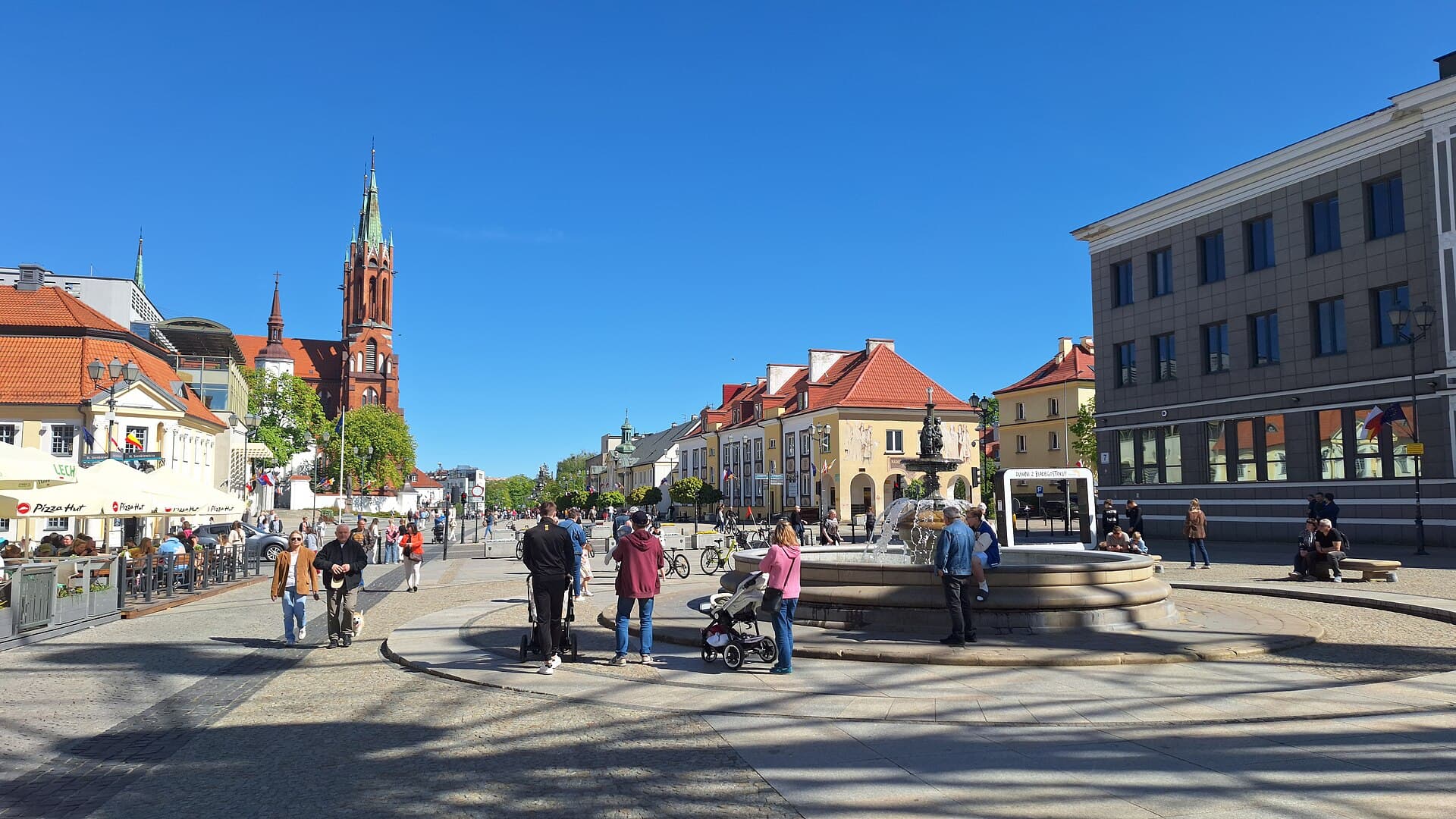
Begin your exploration at the Branicki Palace, a splendid Baroque residence often likened to the "Polish Versailles." Wander through its meticulously restored interiors and expansive gardens. Nearby, the Cathedral Basilica of the Assumption of the Blessed Virgin Mary displays impressive architecture. The Rynek Kościuszki, the main market square, is a lively center with the historic town hall now housing a museum.
Delve into the city's unique linguistic heritage at the Ludwik Zamenhof Centre, dedicated to the creator of Esperanto, who was born in Białystok. For a deeper understanding of the region's past, visit the Sybir Memorial Museum, which focuses on the deportations of Poles to Siberia during Soviet occupation. Observe the dynamic street art scene, with numerous murals adorning buildings across the city, including the renowned "Girl with a Watering Can."
Beyond the city center, consider a visit to the historic Bojary district with its traditional wooden houses. The Orthodox Church of the Holy Spirit is also noteworthy for its impressive iconostasis, the tallest in Poland. Białystok also serves as a convenient base for excursions to natural attractions like the Białowieża Forest, home to European bison, and the charming town of Tykocin, known for its Jewish heritage and Baroque synagogue.
Białystok experiences a warm summer continental climate, marked by warm summers and long, frosty winters. The most agreeable time to visit is during the warmer months, from late spring to early autumn (May to September), when temperatures are mild and the city's many parks and gardens are in full bloom. This period is ideal for exploring the city on foot and enjoying outdoor activities. Winters can be quite cold with considerable snowfall, which might appeal to those seeking a festive, snowy atmosphere, though some outdoor attractions may have reduced hours or accessibility.
The official currency in Poland, including Białystok, is the Polish Złoty (PLN), subdivided into 100 groszy. While electronic payments are widely accepted, it's advisable to carry some cash for smaller purchases or establishments. Currency exchange offices (Kantors) are available in the city, but it's prudent to check current exchange rates before transactions. ATMs are readily accessible throughout the city.
Białystok is well-connected by train from Warsaw, with journeys taking approximately 2.5 hours. The city also has intercity bus connections to major Polish cities and international routes. Within Białystok, public transportation is primarily served by an extensive bus network. While Białystok-Krywlany Airport is within city limits, it does not offer regularly scheduled commercial flights; the closest international airport is Warsaw Chopin Airport. Polish is the official language, but in a city with such a diverse history, you may encounter various languages.