Bielsko-Biała Główna railway station
The main railway station offers more than just transit; it's a journey back to a grander era.
Full story unlocks in the tour
 Bieniecki Piotr / CC BY-SA 4.0, via Wikimedia Commons
“Where Austro-Hungarian grandeur meets Beskid mountain air.”
Not the postcards. The stories even locals don't know — whispered in your ear, right where they happened.
The main railway station offers more than just transit; it's a journey back to a grander era.
This main promenade, often called 'Little Vienna,' carries a subtle hint of its divided past.
Look closely at the historic buildings around the square, and you might notice a curious detail about their origins.
Discover every secret of Bielsko-Biała
Every address, every reveal in full — in your ear, right where it happened.
You pick your stops. You walk. The voice reveals what the others miss.
No tours available yet. Check back soon — we're preparing them.
Bielsko-Biała, a city in southern Poland, rests at the foot of the Silesian Beskids, where the Biała River historically separated the regions of Silesia and Lesser Poland. Often referred to as "Little Vienna" due to its strong Viennese architectural influence, the city presents an unexpected blend of urban sophistication and natural beauty. With a population of approximately 166,765 as of December 2022, it serves as a significant administrative, economic, academic, and cultural center for the Silesian-Lesser Polish border region.
Once two distinct towns—Bielsko on the west bank and Biała on the east—the cities officially merged in 1951. This dual heritage is still evident in its architecture and character. Beyond its historical core, Bielsko-Biała is a gateway to the Beskid Mountains, offering easy access to hiking trails and green spaces. It's a destination that appeals to those seeking both cultural exploration and outdoor adventure, without the overwhelming crowds found in more well-known Polish cities.
The history of Bielsko-Biała is a tale of two towns, Bielsko and Biała, separated for centuries by the Biała River, which often served as a political boundary. Human habitation in the Bielsko area dates back to around 1400 BC, with evidence of a fortified medieval farming settlement from the 12th century. Bielsko was first documented in 1312 when Duke Mieszko I of Cieszyn granted it a town charter. It later fell under the Kingdom of Bohemia in 1327 and was incorporated into the Habsburg monarchy in 1526.
Biała, on the other hand, emerged in the second half of the 15th century on the opposite bank of the river and gained city rights in 1723. The Biała River became a significant border, dividing the district principalities of Cieszyn and Oświęcim from 1316, and later acting as the Czech-Polish state border from 1457 to 1772. In 1772, with the First Partition of Poland, both towns found themselves under Austrian rule, with the river continuing to mark the border between Galicia and Austrian Silesia.
Both Bielsko and Biała prospered due to cloth production, with Bielsko's woolen cloths, marked with "BS," gaining recognition across Europe. By the late 19th century, Bielsko had become a significant textile industry center within the Austro-Hungarian Empire. This industrial prosperity is reflected in the city's elegant architecture, with many impressive buildings, including villas, townhouses, hotels, schools, and factories, constructed between the 1880s and the interwar period. Despite their administrative separation, the two towns functioned as a single urban area throughout the 19th century. Finally, on January 1, 1951, Bielsko and Biała officially merged to form the city of Bielsko-Biała. Today, the city continues its industrial traditions in sectors like automotive, textiles, and machine building, and is recognized for producing high-quality gliders and aircraft.
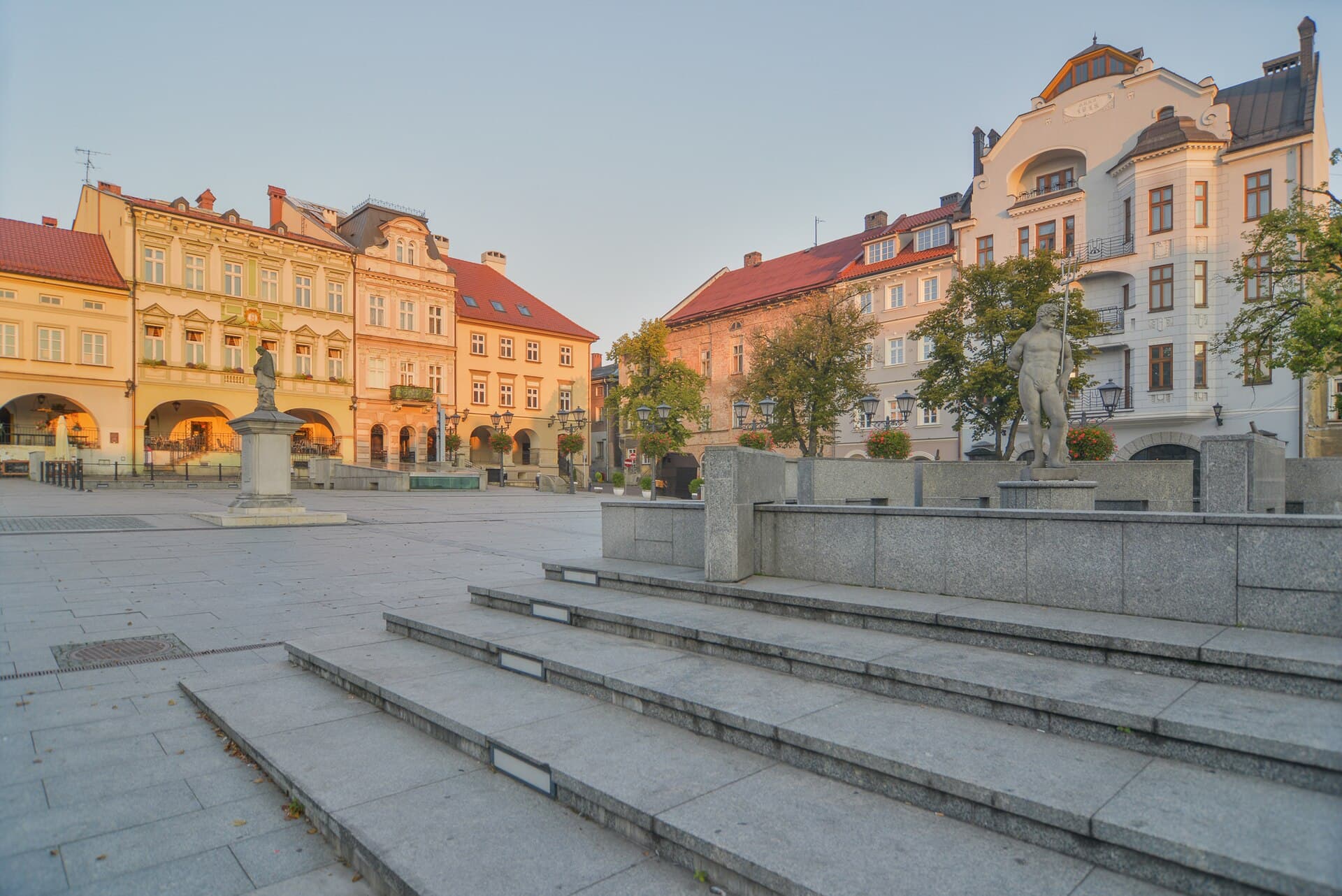
Begin your exploration in the Old Town Market Square (Rynek), a colorful area with 17th and 18th-century buildings and a picturesque fountain featuring a statue of Neptune. From here, stroll along Ulica 11 Listopada, the main promenade, to admire the Viennese-style architecture that gives Bielsko-Biała its nickname. The Sułkowski Castle, the oldest and largest historical building in the city, houses the Museum of Bielsko-Biała and offers insights into the region's past. Do not overlook the Neo-Renaissance Town Hall (Ratusz), built in 1897, with its architectural details reminiscent of Vienna's own town hall.
For a unique cultural experience, seek out the popular Polish cartoon characters, such as Bolek and Lolek and Reksio, scattered as statues throughout the city. These characters were created by a local animation studio. The Stara Fabryka Museum (Old Factory Museum), located in a 19th-century cloth factory, showcases the city's industrial heritage. Nature enthusiasts can take a cable car trip to Szyndzielnia Mountain (1026m) for expansive views and hiking opportunities in the Beskid Mountains.
Bielsko-Biała offers distinct charms throughout the year. Spring and autumn provide clear mountain views and comfortable temperatures, ideal for walking tours and hiking. Summer evenings bring a lively atmosphere with outdoor dining. For winter sports enthusiasts, the colder months are perfect for skiing at nearby resorts like Dębowiec, Klimczok, and Magurka. The city experiences warm summers, with daytime temperatures in July and August around 23-25°C, and fairly mild, snowy winters.
Bielsko-Biała is easily accessible by rail, bus, and car from major Polish cities. The main rail station, Bielsko-Biała Główna, is a short walk from the city center. Once in the city, the Old Town is highly walkable. While younger residents may speak some English, it's helpful to have some basic Polish phrases. The city has a good public transport network. Accommodation options range from hotels in the city center to those offering mountain views. For dining, you'll find a variety of options, including traditional regional Polish cuisine and Mediterranean dishes. The local currency is the Polish Złoty (PLN).