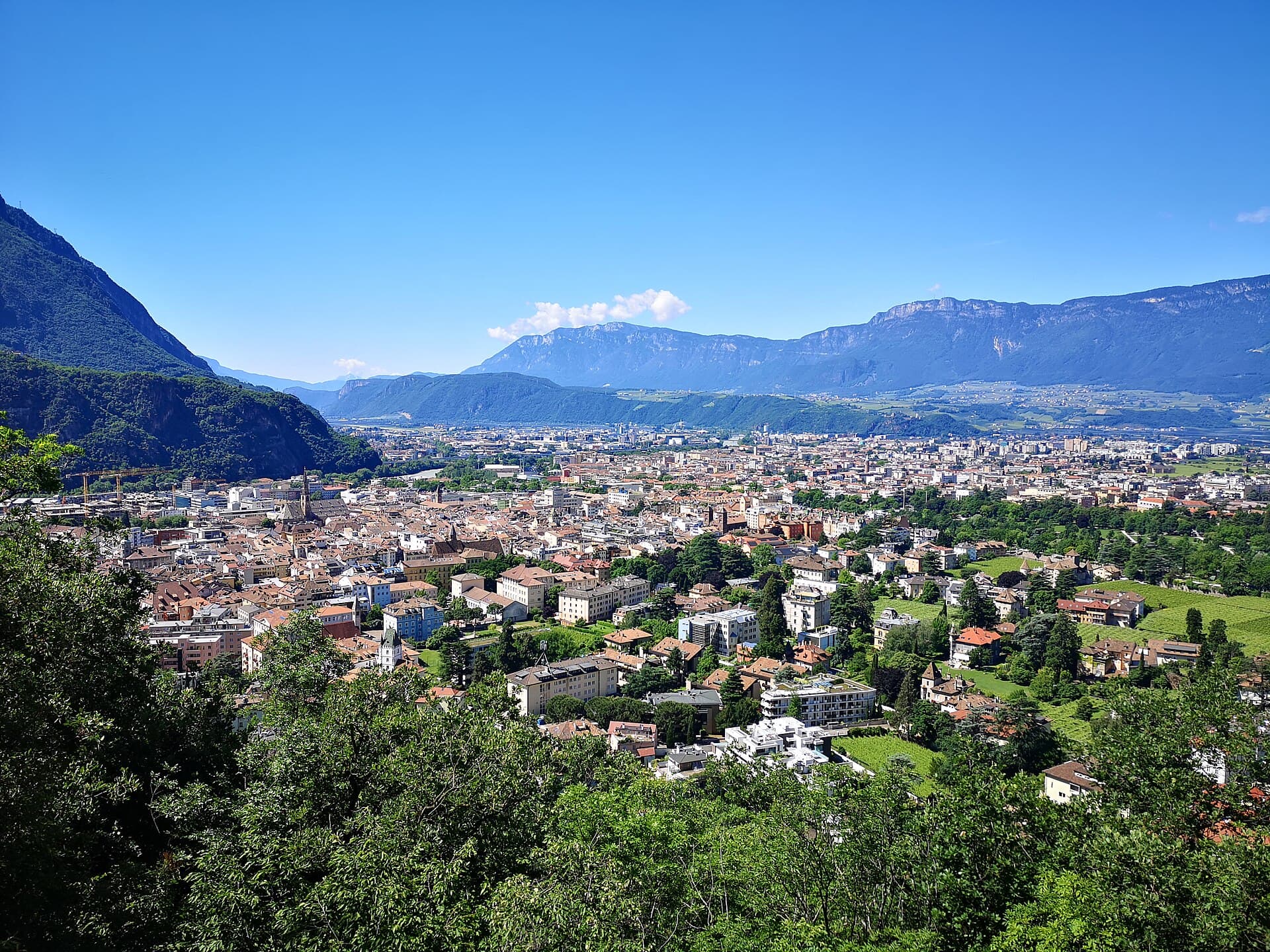
Bolzano, ItalyBartleby08 / CC BY 4.0, via Wikimedia Commons
IT

Bolzano

Where Alpine grandeur meets Mediterranean grace.

The secrets of Bolzano

Bolzano, as no one tells it.

Not the postcards. The stories even locals don't know — whispered in your ear, right where they happened.

3 secrets below. Many more wait inside the tour.
South Tyrol Museum of Archaeology

Ötzi the Iceman, a 5,300-year-old mummy, is Bolzano's most celebrated inhabitant. Yet his emergence was not merely a scientific wonder; it sparked an unexpected international disagreement.

Full story unlocks in the tour
Via dei Portici (Laubengasse)

This medieval arcade, a lively commercial thoroughfare for nearly a thousand years, holds a secret current flowing beneath its stones.

Full story unlocks in the tour
Piazza delle Erbe (Obstmarkt)

Bolzano's animated fruit and vegetable market has been a daily fixture since 1295. However, for centuries, certain provisions could *only* be sold here.

Full story unlocks in the tour
The full tour

Discover every secret of Bolzano

Every address, every reveal in full — in your ear, right where it happened.

Get the key to Bolzano

You pick your stops. You walk. The voice reveals what the others miss.

Choose your time

How long do you have in Bolzano?

No tours available yet. Check back soon — we're preparing them.

About Bolzano

The story of Bolzano

Bolzano, or Bozen in German, stands as the capital of South Tyrol, a northern Italian region where the embrace of Alpine peaks converges with Mediterranean influences. This city, home to over 100,000 people, presents a distinct fusion of Italian, German, and Ladin cultures, evident in its architecture, culinary offerings, and daily rhythms. Surrounded by the formidable Dolomites, a UNESCO World Heritage Site, Bolzano often serves as the "Gateway to the Dolomites," providing an ideal starting point for exploring the region's dramatic mountain expanses.

The city's unique character arises from centuries of layered history, where Germanic roots run deep despite its incorporation into Italy in 1919. You will encounter bilingual street signs, hear both Italian and German spoken frequently, and discover a culinary landscape that draws equally from both traditions. Bolzano offers a quality of life that consistently ranks high in Italy, balancing the energy of a youthful city with old-world refinement.

Beyond its cultural intersection, Bolzano acts as a center for outdoor enthusiasts, granting easy access to walking paths, cycling routes, and ski slopes. Its walkable historic core, animated public squares, and ancient market customs invite exploration, promising a truly singular Italian experience with an Alpine inflection.

History

Bolzano's history unfolds as a compelling narrative of a strategic crossroads, shaped by its position at the confluence of major European trading arteries and the shifting currents of empires. The city's basin held significance even in Roman times, situated along the Via Claudia Augusta, an ancient road connecting northern Italy with southern Germany. Early settlements were dispersed, but the urban layout began to solidify in the late 12th century when the Prince-Bishops of Trento established a new merchant village.

This new commercial center quickly thrived, particularly with the construction of the Via dei Portici (Laubengasse) around 1170. This arcaded street became the throbbing heart of commercial life, drawing traders from across Europe. The city's importance as a mercantile center led to the establishment of the Mercantile Magistrate in 1635 by Claudia de Medici, a special court designed to resolve disputes during the four annual trade fairs.

Over the centuries, Bolzano found itself at the nexus of various powers. It came under the control of the Counts of Tyrol in the 13th century, who even dismantled parts of the city during disagreements with the bishops of Trento. In 1363, Bolzano became part of the Habsburg monarchy, a rule that persisted until 1806 when Tyrol briefly joined the Kingdom of Bavaria under Napoleonic influence. After Napoleon's defeat, Tyrol was returned to Austria.

The 20th century brought profound transformation. Following World War I, Bolzano and the southern part of Tyrol were annexed by Italy in 1919 under the Treaty of Saint Germain. This initiated a period of enforced Italianization, which dramatically altered the city's appearance and cultural landscape, including a new urban plan in 1935. Despite these shifts, the integration of German, Italian, and Austrian cultures has endured, forging the distinctive bilingual and multicultural environment observed today. Bolzano officially became the capital of South Tyrol in 1927 and a university town in 1997 with the establishment of the Free University of Bozen-Bolzano.

What to see

Begin your journey in Piazza Walther, Bolzano's elegant main square and its "living room" for over 900 years. This animated piazza is bordered by cafes and dominated by the Gothic Bolzano Cathedral, with its distinctive tiled roof. From here, wander to Via dei Portici (Laubengasse), the city's inaugural street, a medieval arcaded thoroughfare that has served as a commercial nucleus for nearly a millennium. Explore the shops and admire the historical architecture, including facades adorned with Baroque floral plasterwork and traditional Erker (wooden shutters).

A crucial visit is the South Tyrol Museum of Archaeology, home to Ötzi the Iceman, a remarkably preserved 5,300-year-old mummy found in a glacier. The museum dedicates three floors to detailing his life, discovery, and the scientific insights gleaned from his remains. Just a few blocks away, immerse yourself in the lively Piazza delle Erbe (Obstmarkt), Bolzano's daily fruit and vegetable market since 1295. Here, you will find colorful stalls overflowing with fresh produce, local cheeses, speck, artisan breads, and flowers.

For expansive views, ascend into the surrounding Alpine landscapes on one of Bolzano's three cable cars. The most favored rises to Soprabolzano on the Ritten/Renon plateau, providing access to walking trails and the singular earth pyramids. Alternatively, consider a visit to Castel Roncolo (Runkelstein Castle), just beyond the city center, celebrated for its well-preserved medieval frescoes depicting tales of chivalry.

When to visit

Bolzano welcomes visitors throughout the year, with each season offering distinct experiences. For warm weather activities like walking and cycling in the Dolomites, the ideal time to visit extends from mid-June to late September, when temperatures are mild and skies are clearer. Spring (mid-April to mid-June) and early autumn (September) also offer pleasant conditions, with mild weather and fewer people, though some rainy days may occur. Autumn is particularly rewarding for wine celebrations. If you are drawn to winter sports, December to March provides excellent skiing conditions in the snow-covered Dolomites. Bolzano is also acclaimed for its Christmas market, a popular attraction from late November through December.

Practical

Bolzano is a highly walkable city, allowing for easy exploration of the historic center on foot. Public transportation operates efficiently, with trains, buses, and cable cars connecting Bolzano to surrounding valleys and points of interest. If you intend to journey extensively into the Dolomites, a car can be advantageous, though not strictly necessary. For those driving, parking on the city center's periphery, such as Parcheggio Mareccio, is advisable to avoid congestion.

Many accommodations in Bolzano provide the Bolzano Card (or a similar regional card), which grants free access to public transportation, including cable cars, and complimentary entry to numerous museums throughout the province. This can significantly enrich your exploration of Bolzano and South Tyrol. German is an official language and spoken as frequently as Italian, so greetings in both languages are appreciated. While Bolzano is considered a costly city by Italian standards, budget travelers can manage on $50-80 per day, while mid-range travelers should prepare for $100-200 per day, excluding flights.

Good to know
What languages are spoken in Bolzano?
Bolzano is a trilingual city. Italian, German (specifically the Austro-Bavarian dialect), and Ladin are all official languages. You will hear both Italian and German spoken frequently in daily life.
Is Bolzano expensive to visit?
Compared to other Italian cities, Bolzano is considered quite expensive. Budget travelers might anticipate spending around $50-80 per day, while mid-range travelers should plan for $100-200 per day, not including flights. Prices can fluctuate significantly by season.
What is Bolzano celebrated for?
Bolzano is celebrated for being the home of Ötzi the Iceman, a 5,300-year-old mummy housed in the South Tyrol Museum of Archaeology. It is also known as the "Gateway to the Dolomites" and for its lively Christmas markets.
How do I move around Bolzano?
Bolzano's city center is very walkable. Public transportation, including buses, trains, and cable cars, is efficient and connects to surrounding areas. Many accommodations offer a guest card that includes free public transport and museum entry.
Can I visit the Dolomites from Bolzano?
Yes, Bolzano serves as an excellent base for exploring the Dolomites. You can easily reach walking, biking, and skiing opportunities in the mountains via cable cars and public transport. Many tours to the Dolomites also depart from Bolzano.
What local specialties should I try in Bolzano?
Be sure to sample local delicacies influenced by both Italian and German traditions, such as speck (smoked ham) and Lagrein wine. The daily market in Piazza delle Erbe is an excellent place to find local produce, cheeses, and traditional snacks.
Bolzano
From€9.00
No booking · activate anytime · 12h to walk it
Get the key to Bolzano