Granary Burying Ground
Among the gravestones of patriots, one marker bears unusual scars.
Full story unlocks in the tour
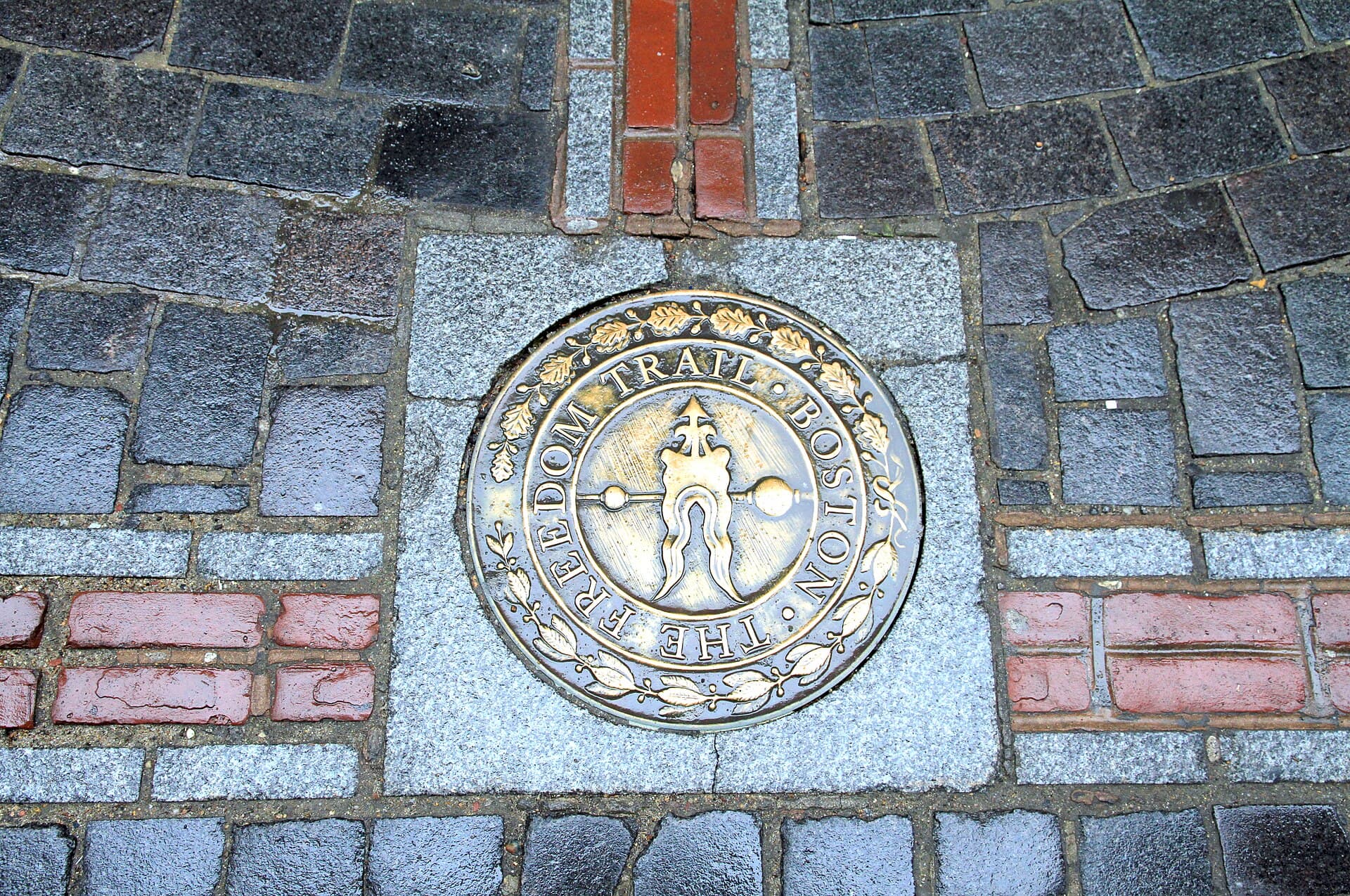 Ingfbruno / CC BY-SA 3.0, via Wikimedia Commons
Self-guided audio walking tour of Boston's Freedom Trail — GPS route, offline playback, story-driven narration in 32 languages.
“Walk the red brick path where a revolution was born.”
Not the postcards. The stories even locals don't know — whispered in your ear, right where they happened.
Among the gravestones of patriots, one marker bears unusual scars.
Look up at the roof of the Old State House, and you'll see two familiar figures that once caused a stir.
This historic cemetery holds the remains of many notable figures, but one particular grave is linked to a pivotal moment in the American Revolution.
Discover every secret of Boston's Freedom Trail
Every address, every reveal in full — in your ear, right where it happened.
You pick your stops. You walk. The voice reveals what the others miss.
Your self-guided audio tour of Boston's Freedom Trail is ready — pick your landmarks, choose your language, and start the moment you arrive.
BuyThe Freedom Trail unfurls as a 2.5-mile (4.0 km) path through Boston, Massachusetts, connecting sixteen sites of profound historical significance. This red-brick route meanders through some of the city's most venerable districts—Downtown, the North End, and Charlestown—drawing visitors into the very heart of the American Revolution.
Conceived in 1951 by journalist William Schofield, the trail was designed to interlink crucial landmarks and breathe life into American history. It offers a journey where one can walk in the footsteps of America's founding figures, exploring the outdoor revolutionary sites that shaped the nation. From public parks and venerable burying grounds to significant churches and government edifices, the Freedom Trail offers a tangible connection to the events that forged American independence.
The story of the Freedom Trail is intrinsically linked to Boston's own narrative, a city that played an instrumental role in the American Revolution. The trail commences at Boston Common, established in 1634 and recognized as America's oldest public park. This land, acquired from the first European settler, William Blackstone, served various purposes over time, including a pasture, a military training ground, and a location for public punishments. During the winter of 1775-1776, over a thousand Redcoats made their encampment on the Common, and it was from this very ground that British brigades departed for Lexington and Concord.
Adjacent to the Common stands the Massachusetts State House, completed in 1798. This structure, with its distinctive golden dome, holds the distinction of being the oldest continuously operating state capital building in America. Its dome was originally crafted from wood, then sheathed in copper by Paul Revere in 1802, and finally gilded in 23k gold in 1876 for the nation's centennial observance.
The Granary Burying Ground, established in 1660, serves as the final resting place for many prominent figures of the Revolution, including Samuel Adams, John Hancock, and Paul Revere. This cemetery provides a direct link to the individuals who shaped American independence.
The Old State House, constructed in 1713, stands as Boston's oldest surviving public building. It functioned as the core of colonial government, housing the Royal Governor's Council Chamber and the Massachusetts Assembly. The Boston Massacre unfolded in its shadow on March 5, 1770, and the Declaration of Independence was first read to Bostonians from its balcony on July 18, 1776.
Faneuil Hall, often referred to as the "Cradle of Liberty," opened in 1742 as a marketplace and meeting hall. It became a crucial venue for colonial protest, hosting numerous town meetings where patriots like Samuel Adams debated grievances against Britain, leading up to events such as the Boston Tea Party.
In the North End, the Paul Revere House, dating to approximately 1680, is the oldest remaining structure in downtown Boston and the sole official Freedom Trail site that is a residence. It was from this dwelling that Paul Revere commenced his renowned midnight ride. Nearby, the Old North Church, built in 1723, is where two lanterns were famously displayed to signal the movement of British troops, initiating Revere's ride. Copp's Hill Burying Ground, established in 1659, is the city's second oldest cemetery and holds the graves of thousands of early Bostonians, including Robert Newman, who placed the lanterns for Revere. The British also utilized Copp's Hill as a strategic vantage point during the Revolution, directing the shelling of Bunker Hill from there.
The trail culminates in Charlestown with the Bunker Hill Monument. This 221-foot granite obelisk commemorates the Battle of Bunker Hill, one of the first major engagements of the American Revolution.
The Freedom Trail offers a 2.5-mile journey through Boston's revolutionary past. Begin at Boston Common, America's oldest public park, where colonial militias once trained and British troops made their encampment. From there, follow the red brick line to the Massachusetts State House, an impressive example of Federal architecture crowned with its iconic gold dome.
Continue to the Granary Burying Ground, the final resting place of Revolutionary War heroes like Samuel Adams, John Hancock, and Paul Revere. Next, you'll encounter the Old State House, the site of the Boston Massacre and where the Declaration of Independence was first proclaimed to Bostonians. The Boston Massacre site itself is marked by a circle of paving stones directly in front of the Old State House.
Faneuil Hall, known as the 'Cradle of Liberty,' served as a marketplace and a vital meeting place for patriots. Crossing into the North End, you'll find the Paul Revere House exterior, the oldest house in downtown Boston and the starting point of his celebrated ride. Just a short walk away is the Old North Church, where the signal lanterns were hung. Finally, explore Copp's Hill Burying Ground, offering views of Boston Harbor and the graves of many early Bostonians. The trail concludes at the Bunker Hill Monument in Charlestown, commemorating a pivotal battle of the Revolution.
The most agreeable times to walk the Freedom Trail are late spring (May-June) or early fall (September-October). During these periods, the weather remains mild and pleasant, and the fall foliage enhances the scenic beauty. Summer brings larger crowds and can be hot and humid. While the trail remains open year-round, winter visits can present challenges due to cold weather and potential snow or ice. To avoid crowds, consider starting your walk early in the morning or later in the afternoon, or visit on weekdays.
The Freedom Trail spans 2.5 miles (4.0 km), and walking the entire path without entering any buildings can take between 2 and 3 hours. To fully explore the sites, plan for 4 to 6 hours, or even a full day or two. The trail is clearly marked by a red line or red bricks on the sidewalk, ensuring easy navigation. Wear comfortable shoes, as the path includes brick, varied street surfaces, and uneven sidewalks. Pick up a map at the Boston Common Visitor Center. While the trail itself is free, some sites, such as the Paul Revere House and the Old State House, require admission. The Freedom Trail is accessible by public transit (MBTA Green, Red, Orange, and Blue lines). Restrooms are available at various points along the trail, including the Boston Common Visitor Center, Faneuil Hall, and the Old North Church.