Bressanone Cathedral Cloister
Within the solemn cloisters of the Bressanone Cathedral, an unexpected artistic detail awaits discovery.
Full story unlocks in the tour
 Oliver Abels / CC BY-SA 4.0, via Wikimedia Commons
“Where Alpine peaks meet Baroque grandeur, and history echoes in two languages.”
Not the postcards. The stories even locals don't know — whispered in your ear, right where they happened.
Within the solemn cloisters of the Bressanone Cathedral, an unexpected artistic detail awaits discovery.
The facade of a venerable hotel in Bressanone narrates a whimsical account of a royal procession.
Bressanone's most ancient district, Stufels, offers a subtle indication of its historical social divisions.
Discover every secret of Bressanone
Every address, every reveal in full — in your ear, right where it happened.
You pick your stops. You walk. The voice reveals what the others miss.
No tours available yet. Check back soon — we're preparing them.
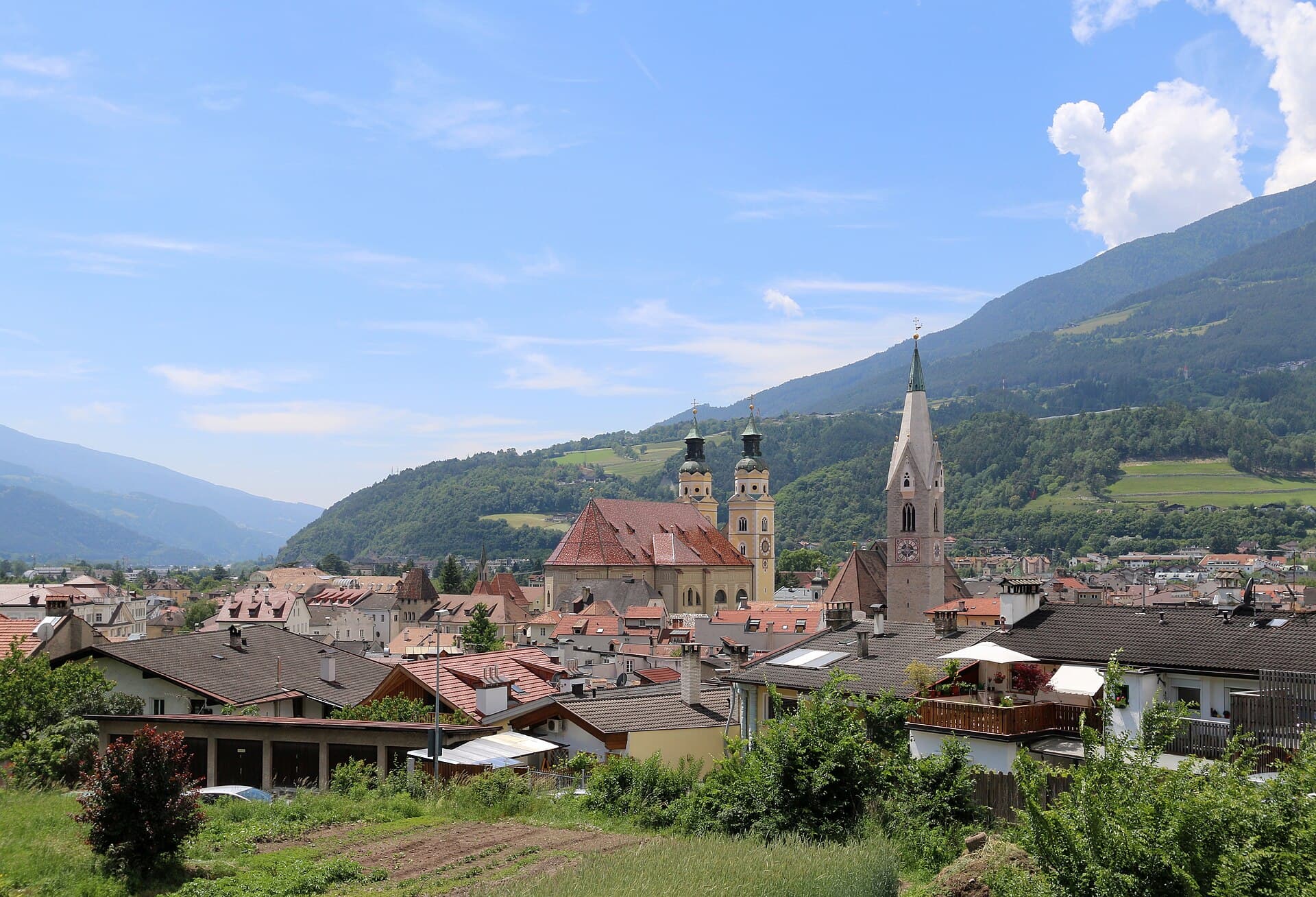
Bressanone, also identified by its German name Brixen, stands as Tyrol's most ancient town, situated in Italy's South Tyrol region. This captivating destination, at the confluence of the Isarco (Eisack) and Rienza (Rienz) rivers, presents a singular fusion of Alpine allure and Italian character. Its dual identity is palpable in the bilingual street signs and the harmonious blend of Austrian and Italian cultures that permeates its architecture, cuisine, and daily rhythms.
With a chronology spanning over a thousand years, Bressanone served as the seat of influential prince-bishops for centuries, leaving an indelible mark on its cultural and architectural landscape. The town's carefully preserved historic core, with its narrow, winding lanes and brightly colored buildings, invites exploration. Beyond the town's urban appeal, Bressanone is encircled by vineyards, apple orchards, and the magnificent Dolomites, offering a portal to outdoor adventures throughout the year.
Bressanone's chronology extends to the Neolithic era, with evidence of early human presence. In Roman times, it functioned as a strategic stop on the Via Rhaetia, a vital route near the Brenner alpine pass, where the Eisack and Rienz rivers meet. In 15 BC, Drusus conquered the area, incorporating it into the Roman province of 'Rhaetia.'
Following the Roman Empire's decline, the land became part of the Duchy of Bavaria in 590 AD. A pivotal moment arrived in 901 AD when King Louis the Child granted the royal court of 'Prichsna' to Bishop Zacharias, initiating Bressanone's enduring and significant role as an episcopal see. The episcopal seat officially relocated from Sabiona to Bressanone around 992 AD. By the 11th century, Bressanone had become the capital of an ecclesiastical principality, governed by prince-bishops who wielded considerable authority and mediated between popes and emperors.
Throughout the Middle Ages, Bressanone thrived as an important artistic and cultural hub. Its strategic placement fostered prosperity through commerce. While some medieval structures persist, many were later adorned with Baroque exteriors. In the 13th century, much of the territory was acquired by the Counts of Tyrol. The Ecclesiastic Principality, encompassing Bressanone, Brunico, and Klausen, persisted until 1803. Bressanone eventually became part of the Habsburg Empire, a period that left a distinct Baroque architectural impression on the city.
The conclusion of World War I brought substantial transformations, as South Tyrol, including Bressanone, was ceded to Italy under the Treaty of Versailles in 1918. The subsequent Fascist era implemented Italianization policies aimed at assimilating the German-speaking population. However, the local populace resisted these efforts, successfully maintaining their unique identity, which is safeguarded by the Italian postwar constitution. This historical context clarifies why Bressanone is known by both its Italian and German names, and why bilingual signage is common throughout the town.
After 1803, Bressanone's prominence diminished, becoming a provincial town. However, with the emergence of tourism, drawing visitors with its mild climate and profound historical and artistic heritage, the city experienced renewed economic development. Today, Bressanone is recognized for its thermal baths, monuments, and invaluable art collections.
Begin your exploration in Bressanone's historic Old Town, a pedestrian-friendly expanse characterized by narrow, winding lanes and brightly colored Alpine-style buildings. The Piazza del Duomo forms the heart of the old town.
The Bressanone Cathedral, dedicated to the Assumption of Mary and St. Cassian, stands as a prominent landmark. While its origins trace to the 10th century, the current Baroque structure was largely rebuilt between 1745 and 1754. Adjacent to the cathedral are the painted cloisters, adorned with vivid frescoes depicting religious narratives.
Across from the cathedral, you will find the Hofburg, the former Bishop's Palace. Its expansive Baroque rooms now house the Diocesan Museum, exhibiting art from the Middle Ages to modern times, alongside a collection of cribs and an imperial wing. The Hofburg's gardens, the Hofgarten, offer a tranquil green space.
Do not overlook the Pharmacy Museum (Pharmaziemuseum Brixen), situated in a beautifully decorated town house, which provides a glimpse into the history of healing arts with its collection of rare medicines. For a different perspective, stroll through Stufels, Bressanone's most ancient district, recognized for its distinctive architecture and creative atmosphere. Just beyond the town, the Abbey of Novacella (Neustift), one of the most significant monasteries in the Alpine region, merits a visit for its Baroque church, extensive library, and winery.
Bressanone reveals distinct appeals throughout the year. Summer (June-August) is ideal for outdoor pursuits like hiking and swimming, though August can be busy. Autumn (mid-September to early November) is particularly picturesque, with brilliant foliage, mild weather perfect for walking, and culinary events like 'Törggelen' and chestnut weeks. Winter (late November to Epiphany) transforms the town with its celebrated Christmas markets and opportunities for alpine activities at nearby Mount Plose. Spring witnesses apple orchards in bloom and offers a pleasant time for walks and day trips.
Bressanone is readily accessible by train from Italy, Austria, and Germany, with regular connections from cities such as Munich, Innsbruck, and Verona. If driving, use the Modena/Brennero toll road (A22), exiting at Chiusa-Val Gardena from the south or Bressanone-Val Pusteria from the north. The official currency is the Euro (€), and while credit cards are widely accepted, carrying some cash for smaller purchases is advisable.
Italian and German are the primary languages spoken. The electrical current is 220 volts, 50 Hz AC, requiring a voltage converter for 110-volt devices from countries like the US. Tipping is not customary but is appreciated; rounding up the bill by a few euros is sufficient. For local information and event details, the Bressanone Tourist Office is located in the old town center at Regensburger Allee 9/Viale Ratisbona 9.