Svensky Monastery
This enduring monastery, a spiritual bedrock for centuries, once hosted a market event far more significant than one might imagine.
Full story unlocks in the tour
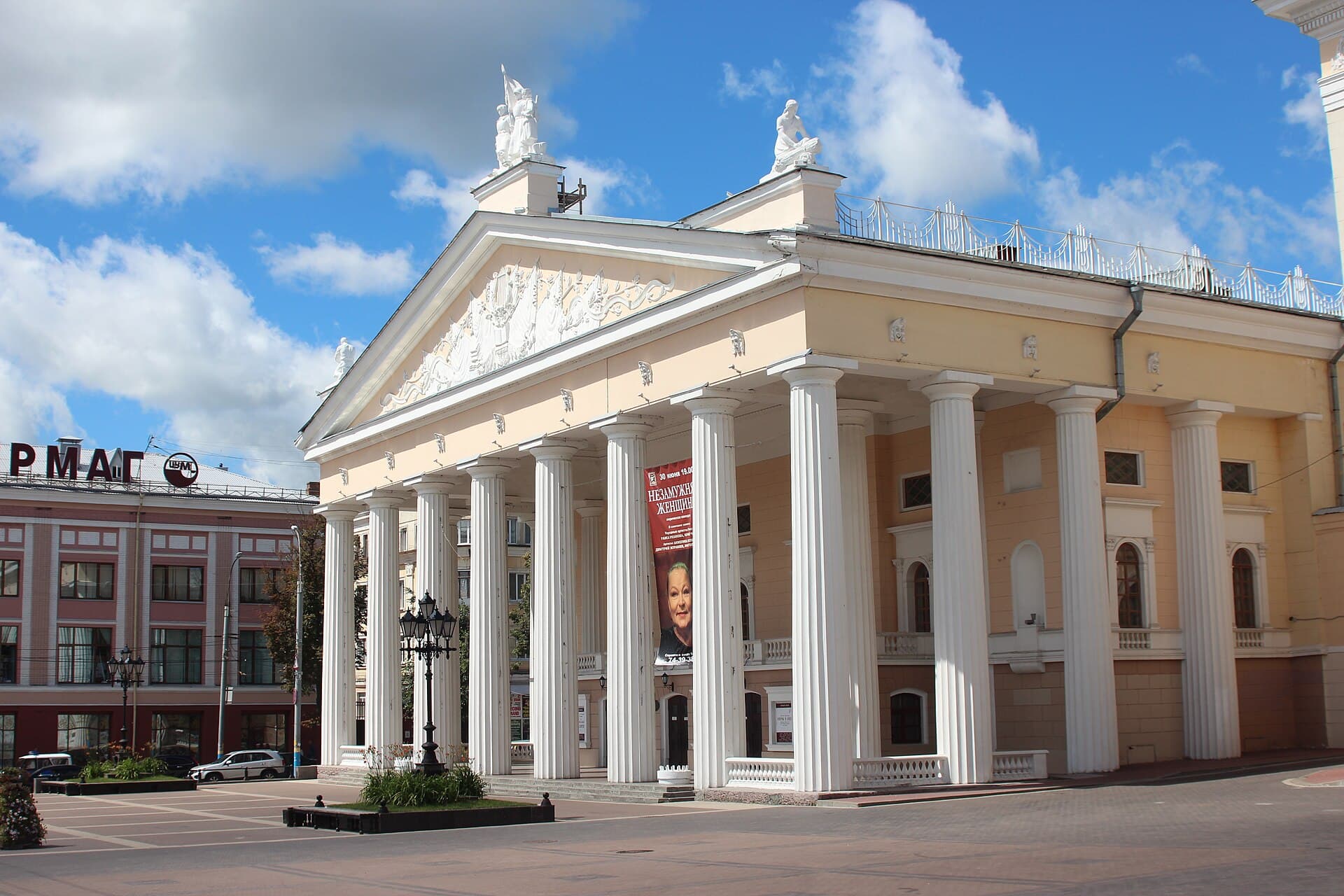 Orangebr / CC BY-SA 4.0, via Wikimedia Commons
“Where ancient forests hold stories of endurance and unexpected beauty.”
Not the postcards. The stories even locals don't know — whispered in your ear, right where they happened.
This enduring monastery, a spiritual bedrock for centuries, once hosted a market event far more significant than one might imagine.
Just beyond Bryansk, a contemporary church safeguards a truly singular, shimmering secret.
Listen closely to the local cadence, and you will discern a subtle linguistic nuance connecting Bryansk to its neighboring lands.
Discover every secret of Briansk
Every address, every reveal in full — in your ear, right where it happened.
You pick your stops. You walk. The voice reveals what the others miss.
No tours available yet. Check back soon — we're preparing them.
Bryansk, a city in western Russia, rests gracefully on the Desna River, approximately 379 kilometers southwest of Moscow. With a documented existence reaching back to at least 985 AD, Bryansk predates Moscow and has played a substantial role across various historical epochs, from Kievan Rus' to the Mongol Empire, and later as a contested territory between Moscow and Poland–Lithuania.
The city serves as the administrative heart of Bryansk Oblast and is recognized for its abundant foliage and distinctive ambiance, often described as one of the most verdant urban areas in the region. Its strategic position has forged a resilient character, evident in its many memorials and museums dedicated to its military past.
Today, Bryansk stands as an important industrial center, particularly in metallurgy and textiles, offering a singular blend of venerable traditions and contemporary life. Its population was estimated at 370,940 in 2026.
The origins of Bryansk are thought to extend to 985 AD, when a fortified settlement was established on the right bank of the Desna River. The city first appears in written records in 1146, under the name "Debryansk," a designation believed to derive from a Slavic term for "dense woodland," reflecting the area's heavily forested terrain. Initially a part of the Chernigov Principality, Bryansk gained prominence after the Mongol invasion of Kievan Rus'. Following the devastation of Chernigov in 1246, Prince Roman Mikhailovich relocated his seat to Bryansk, making it the center of a new principality.
Throughout the medieval era, Bryansk was frequently a site of contention, passing through the control of various Rus' princes, the Mongol Empire, and even becoming part of Lithuania in the 14th and 16th centuries. The Grand Duchy of Moscow ultimately secured Bryansk in 1503, transforming it into a vital fortress during the Time of Troubles. In the 17th and 18th centuries, the city's economy thrived, largely due to the Svenskaya Fair, which grew to be the largest in European Russia.
Under Peter the Great, Bryansk was incorporated into the Kiev Governorate in 1709, and its defenses were strengthened. Empress Catherine the Great further solidified its importance by transferring it to the Oryol Governorate in 1779 and establishing the Bryansk Arsenal in 1783, which manufactured artillery for the Imperial Russian Navy. This marked a turning point, as Bryansk evolved from a regional market town into a significant industrial center for metallurgy and textiles.
The 19th century saw Bryansk's population surpass 30,000 by 1917, and it played a part in the Napoleonic Wars. During the Russian Civil War, it was claimed by both the Belarusian and Ukrainian People's Republics before being taken by Bolshevik forces in 1919. The 20th century brought further trials, with the city enduring extensive damage during World War II when it was occupied by the German Wehrmacht from October 1941 to September 1943. Despite the occupation, approximately 60,000 Soviet partisans were active in and around Bryansk's dense forests, inflicting considerable losses on the German army. In recognition of this valor, Bryansk was later bestowed the title "City of Military Glory." After its liberation, Bryansk became the administrative center of Bryansk Oblast in 1944.
Bryansk presents a compelling blend of historical locations, cultural institutions, and verdant expanses. One of the city's most recognizable emblems is the Mound of Immortality (Kurgan Bessmertiya), an imposing artificial hill within Nightingale Park. This monument, crowned with an 18-meter-high five-pointed star, commemorates those who perished during World War II.
For insight into the city's past, visit Pokrovskaya Mountain, where the Old Intercession Cathedral, constructed in 1698, stands. Nearby, Boulevard Gagarin is a pedestrian thoroughfare in the historic core, lined with 19th-century residences and a monument to Yuri Gagarin, who visited Bryansk in 1966. The Svensky Dormition Monastery, founded in the 13th century, is an architectural landmark situated on a rise overlooking the Desna River.
Those interested in art and history can explore the Bryansk Regional Museum of Local Lore, which displays the lives of ancient peoples in the region, and the Bryansk Regional Art Museum, featuring Russian art from the 19th and 20th centuries. The Park-Museum of A.K. Tolstoy is a cherished destination for locals and visitors, celebrated for its distinctive collection of wooden sculptures inspired by Russian fairy tales.
The most favorable time to visit Bryansk is during late spring (May to June) and early autumn (September to October). These months offer agreeable temperatures, with average highs in May reaching 20°C (68°F) and in September around 18°C (64°F). Rainfall is moderate during these periods, providing a balanced mix of sunny and rainy days for exploration. Summers (July to August) are also warm, with average daily highs in July around 25°C (77°F), but can experience more rain. Winters (November to March) are quite cold, with January being the chilliest month, averaging around -6°C (21°F), often accompanied by snow cover.
Bryansk is reachable by train and bus. Direct trains from Moscow's Kievsky Railway Station arrive at Bryansk-Orlovsky station, with journey durations ranging from 4 to 8 hours, including comfortable express services. Bus routes also connect Bryansk with Moscow and other regional centers such as Kaluga, Kursk, and Smolensk. The city does not have an operational commercial airport for regular passenger flights, so the most convenient arrival point for air travel is Kaluga Airport, approximately 185 km away, from which ground transport can be arranged.
Within Bryansk, the public transport system comprises buses, trolleybuses, and fixed-route minibuses. The local currency is the Russian Ruble (RUB). While credit cards are accepted in most larger establishments, it is advisable to carry cash for smaller purchases and local markets. Bryansk is generally considered a secure city, but standard travel precautions are always recommended.