The Church of Santa Caterina
Observe the bell tower of Santa Caterina closely. It holds a clue about the town's historical defenses.
Full story unlocks in the tour
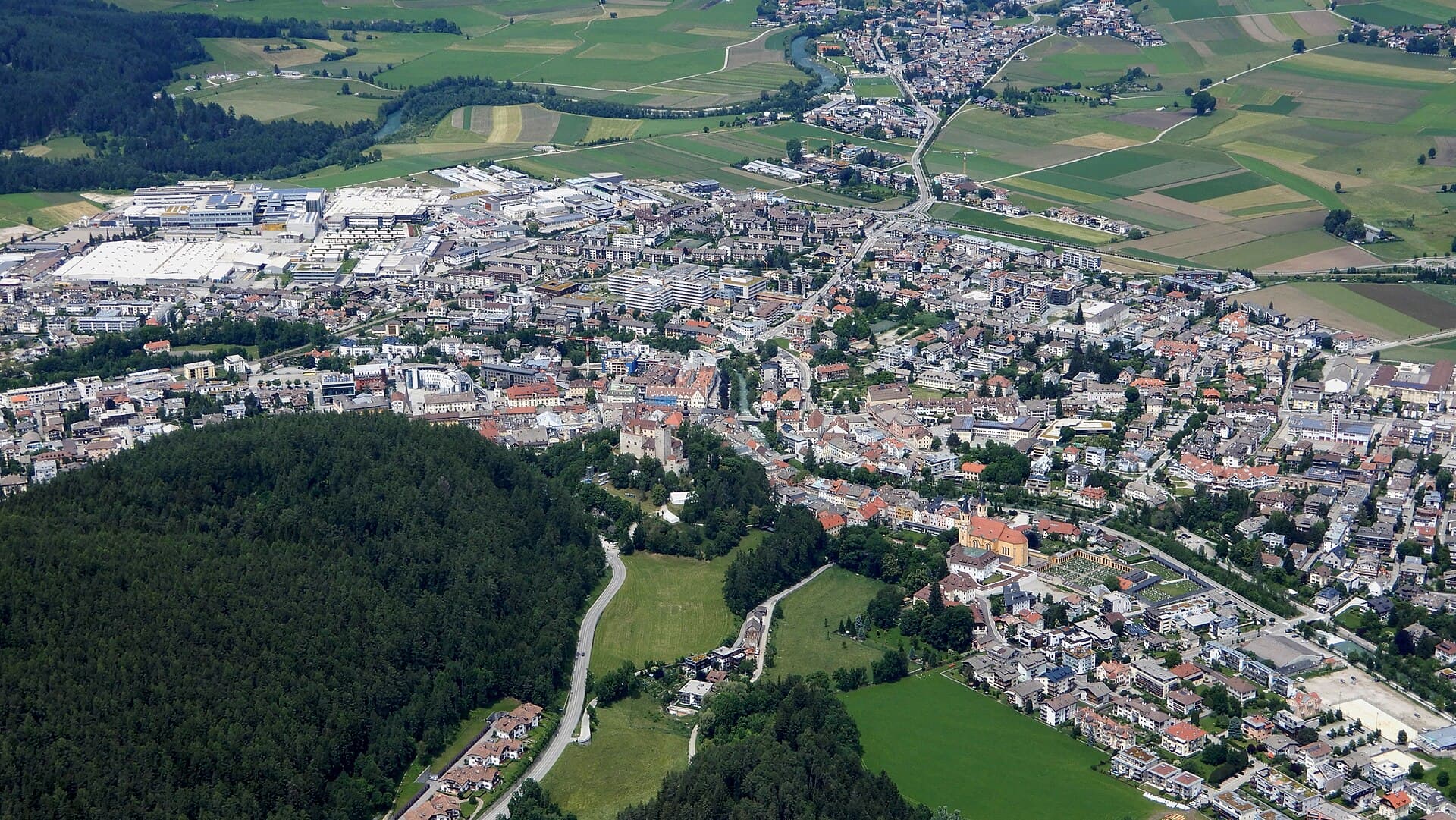 Wolkenkratzer / CC BY-SA 4.0, via Wikimedia Commons
“Where Alpine tradition meets Italian allure in the heart of the Dolomites.”
Not the postcards. The stories even locals don't know — whispered in your ear, right where they happened.
Observe the bell tower of Santa Caterina closely. It holds a clue about the town's historical defenses.
The formidable Brunico Castle, a landmark since the 13th century, once sheltered a surprising resident.
The Rienza River flows through Brunico, delineating more than just the landscape.
Discover every secret of Brunico
Every address, every reveal in full — in your ear, right where it happened.
You pick your stops. You walk. The voice reveals what the others miss.
No tours available yet. Check back soon — we're preparing them.
Brunico, or Bruneck in German, is a town in South Tyrol, northern Italy, situated at an elevation of 835 meters (2,740 feet) in the Puster Valley. It serves as a gateway to the Dolomites and is bordered by the Valle Aurina to the north and Val Badia to the south. The town offers a fusion of natural splendor, historical depth, and contemporary energy, frequently celebrated for its high quality of life. Brunico harmonizes Italian and Austrian cultures, forging a distinctive atmosphere.
With a population just over 16,000 residents, Brunico stands as the economic and cultural heart of the Puster Valley. The Rienza River meanders through the town, with a contemporary section on one side and a medieval quarter on the other. Brunico has earned recognition as one of Italy's most livable towns, presenting a mix of cultural attractions, outdoor pursuits, and local gastronomy.
Visitors can wander through inviting narrow streets, admire colorful buildings, and experience lively squares in the historic center. The town's medieval alleys and architecture craft a picturesque setting, rendering it an appealing destination throughout the year.
## From Roman Outposts to Medieval Stronghold Brunico's strategic location in the Puster Valley, at the nexus of important historical trade routes, indicates the area was settled as far back as prehistoric times, with Roman presence dating to 15 AD. Roman settlements like "Sebatum" and "Littamum" held significance, and the valley formed part of a major road connecting Aquileia to "Aguntum" and the Brenner Pass.
## The Prince-Bishop's Legacy The town's foundation in the mid-13th century is intimately linked to the region's military importance, considering the Puster Valley's numerous fortifications—42 in total. Around 1250, Prince-Bishop Bruno von Kirchberg of Brixen constructed a new residence and castle, giving rise to the town. The name "Brunico" itself derives from Bishop "Bruno," with the suffix "-ico" or "-ek" signifying "hill" or "rock." The town was first documented in 1256 as "apud Bruneke."
## Growth and Challenges Brunico acquired significant privileges in 1370, including the right of jurisdiction from Emperor Charles IV, which fostered a flourishing trade and craft industry, leading to the town's expansion. The early 15th century witnessed the emergence of the first grand residences. Over the centuries, Brunico confronted numerous challenges, including major floods in the 14th and 19th centuries, the plague in 1543-1544, fires, and earthquakes, yet the town was consistently rebuilt.
## Economic Revival and Cultural Identity The period between 1814 and 1914 marked an era of economic growth, propelled by the development of tourism and mountaineering, with the railway opening in 1871. For most of its existence, Brunico was Germanic, remaining so until the end of World War I when the region of South Tyrol became part of Italy. This shift led to the town being re-baptized with its Italian name, Brunico, resulting in a distinct multicultural identity that blends Italian and Germanic influences. Today, Brunico is a center for the Puster Valley's economy, successfully integrating tourism and handicrafts.
Brunico presents a variety of sights, from medieval architecture to contemporary museums. The imposing Brunico Castle, constructed in the 13th century, surveys the town and houses the Messner Mountain Museum Ripa. This museum, established by mountaineer Reinhold Messner, focuses on the culture of mountain peoples worldwide through exhibits, artifacts, and multimedia. Another Messner Mountain Museum, MMM Corones, designed by Zaha Hadid, is located on the summit of Plan de Corones at 2,275 meters, dedicated to traditional mountaineering history.
The historic center of Brunico is defined by narrow streets and colorful buildings. The Via Centrale (also known as Stadtgasse) is a lively street lined with shops, cafes, and restaurants, recognized as a delightful shopping street in South Tyrol. Key sights include the medieval town gates and the 14th-century Chiesa di Santa Caterina, with its distinctive double-bulb spire. The Municipal Museum features sacred artwork and contemporary art exhibitions. For a glimpse into rural life, the Provincial Museum of Teodone customs and traditions explores ancient society with ethnographic collections.
Beyond the town, the Brunico War Cemetery honors British and Commonwealth soldiers from the World Wars. For recreation, the Cron4 wellness center offers pools and saunas, while the Heliks climbing center provides 270 climbing routes.
The ideal time to visit Brunico for warm-weather activities is from late June to late August, when daily high temperatures average above 19°C (66°F). July is the warmest month, with an average high of 23°C (73°F). While these months offer pleasant conditions, they also experience the highest precipitation.
For winter sports enthusiasts, Brunico lies at the foot of the Plan de Corones ski resort, which provides extensive skiing and snowboarding opportunities. The winter season, from November to March, brings average daily high temperatures below 6°C (43°F), with January being the coldest month. The Christmas market is a notable attraction during the festive season.
Brunico is easily accessible, with the nearest airports being Bolzano in Italy and Innsbruck in Austria. Regular train and bus services connect Brunico with other major cities in the region. Once in Brunico, public transportation is efficient, and the town is bike-friendly, offering numerous cycling paths and rental options. Many accommodations provide the Kronplatz Guest Pass, which grants free digital access to public transport for members of Bruneck Kronplatz Tourism.
The official currency is the Euro. German is widely spoken alongside Italian, so having a few basic German phrases can be helpful, though many locals are bilingual. The Tourist Office Bruneck Kronplatz Tourism, located at Piazza Municipio 7, can provide further assistance and information.