Old Princely Court
A stone bust of Vlad the Impaler observes these ancient foundations, yet the true story here extends beyond any vampire lore.
Full story unlocks in the tour
 Madalin Pentelie / CC0, via Wikimedia Commons
“Bucharest: Where Belle Époque facades greet communist-era monuments, and ancient narratives unfold.”
Not the postcards. The stories even locals don't know — whispered in your ear, right where they happened.
A stone bust of Vlad the Impaler observes these ancient foundations, yet the true story here extends beyond any vampire lore.
This monumental edifice is the planet's heaviest structure, but its true burden weighs far more than its physical mass.
The plaza where a dictator's final address ignited a revolution holds a subtle, almost overlooked, detail.
Discover every secret of Bucarest
Every address, every reveal in full — in your ear, right where it happened.
You pick your stops. You walk. The voice reveals what the others miss.
No tours available yet. Check back soon — we're preparing them.
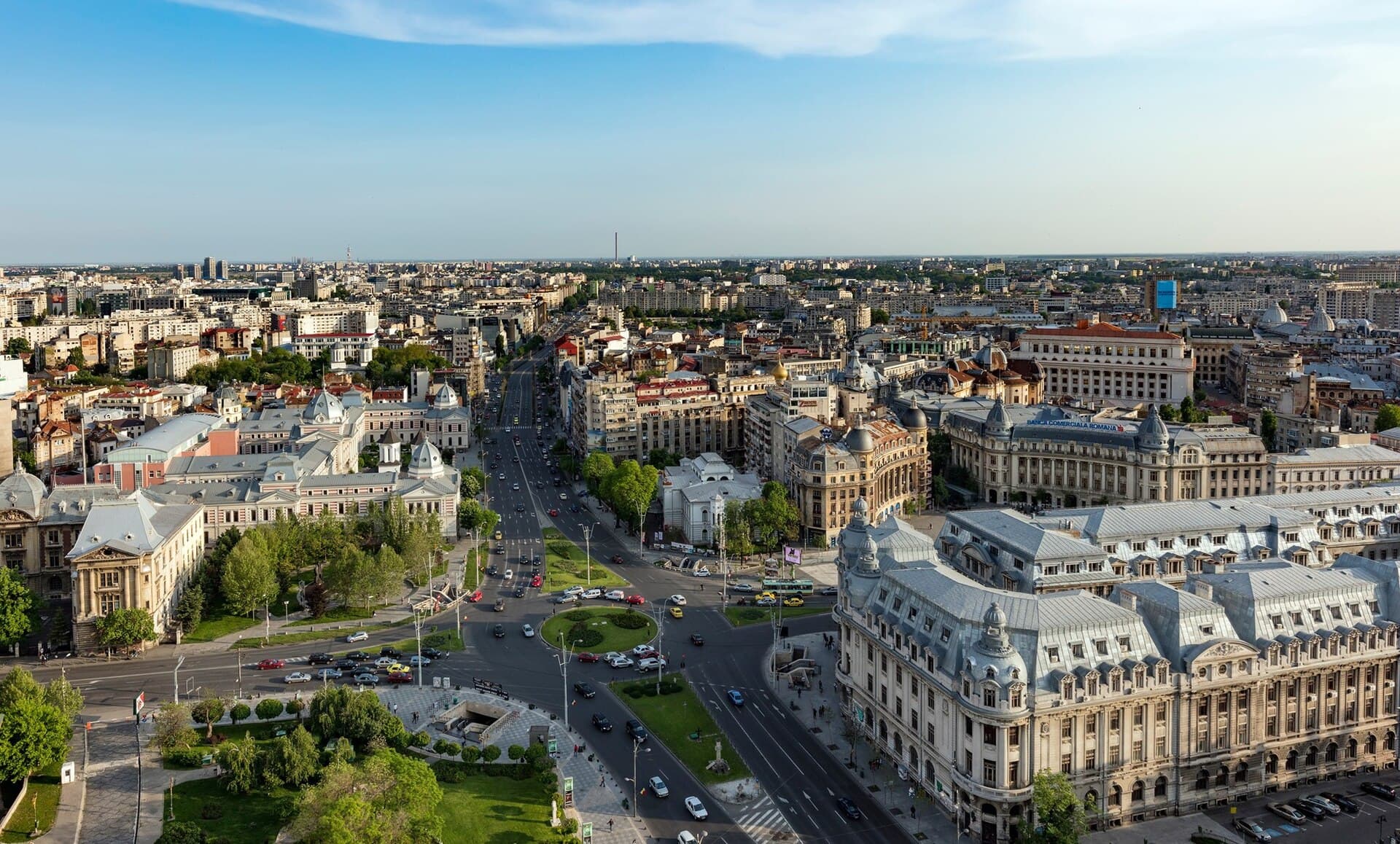
Bucharest, Romania's capital, presents a landscape of striking contrasts, where broad, tree-lined avenues and Belle Époque architecture stand beside the formidable, functional structures of the communist era. Once known as 'Little Paris' or 'Paris of the East' in the early 20th century for its French-inspired elegance, the city possesses a singular character shaped by centuries of diverse influences. From its beginnings as a medieval stronghold to its contemporary identity as a bustling metropolis, Bucharest offers a compelling passage through time, melding historical depth with a lively modern pulse.
The city's dynamic atmosphere is unmistakable, with a thriving café culture, expansive green spaces, and an animated nightlife. Bucharest beckons exploration, revealing layers of history and culture at every turn, from ornate churches to grand palaces and the echoes of a dramatic past. It is a place that surprises and captivates, providing a distinctive Eastern European experience that is both accessible and profoundly engaging.
Bucharest's documented story commences in 1459, when it was first recorded as a dwelling of Vlad III Dracula, the Prince of Wallachia. The Old Princely Court (Curtea Veche), constructed in the mid-16th century by Mircea Ciobanul, became a significant nexus, around which the city began to expand. Its strategic placement along trade routes fostered its development as a commercial center.
Over the centuries, Bucharest experienced periods of both advancement and decline, often swayed by regional conflicts and foreign occupations. In the 18th and 19th centuries, under leaders like Alexander Ypsilantis, the city underwent substantial urban development, with paved thoroughfares and the establishment of its initial schools. A devastating conflagration in 1847 consumed a third of the city, destroying approximately 2,000 buildings.
In 1862, following the unification of Wallachia and Moldavia, Bucharest was declared the capital of the newly formed Principality of Romania. This heralded a period of swift expansion and modernization, earning it the moniker 'Little Paris' due to its cosmopolitan spirit and varied architecture, significantly influenced by French design. Major landmarks like the Arcul de Triumf and Palatul Telefoanelor were erected during the interwar years, as the city's population swelled.
The 20th century presented considerable trials. Bucharest was occupied by German forces during World War I, and later endured extensive bombing during World War II, first by the Allies and then by the Luftwaffe, leaving much of the city in disarray. The post-war era saw the imposition of a communist regime in 1947, which profoundly reshaped the city's physical and social landscape.
Under Nicolae Ceaușescu's governance, particularly in the 1980s, a colossal urban reconstruction effort led to the demolition of a considerable portion of historic Bucharest, including churches and entire communities, to make way for monumental structures like the Palace of the Parliament. This period of forced modernization, often termed the 'golden era,' was characterized by severe scarcities and hardship for the populace. The communist era culminated in the violent Romanian Revolution of December 1989, which commenced in Revolution Square and ultimately led to the overthrow and execution of Ceaușescu.
Since the fall of communism, Bucharest has been in a continuous process of reinvention, embracing democracy and a free market economy. Today, it stands as Romania's most prosperous city and a significant economic and cultural center in the region, continuing to evolve while confronting the visible legacies of its intricate past.
Begin your exploration in the Old Town (Lipscani), a pedestrian-friendly district with ancient streets, Belle Époque structures, and a lively atmosphere of cafes, eateries, and clubs. Here, you can uncover the foundations of the Old Princely Court (Curtea Veche), the former dwelling of Vlad the Impaler.
A visit to the immense Palace of the Parliament is essential. As the second-largest administrative building in the world and the heaviest, its sheer scale is astonishing. Guided visits offer a glimpse into its lavish interiors and the contentious history of its construction.
Revolution Square (Piața Revoluției) is a place of profound historical weight, where the 1989 revolution unfolded. Surrounding the square are significant buildings like the former Royal Palace, now home to the National Museum of Art of Romania, and the elegant Romanian Athenaeum, a distinguished concert hall recognized for its neoclassical architecture.
Walk along Calea Victoriei, Bucharest's oldest and most important thoroughfare, to appreciate a blend of architectural styles, from grand facades to the National Military Circle and the National Museum of Romanian History. For a moment of quiet, visit Cișmigiu Gardens, a beautiful park with a lake, or explore the open-air Dimitrie Gusti National Village Museum in Herăstrău Park, displaying traditional Romanian peasant homes.
Do not overlook the enchanting Cărturești Carusel bookshop, frequently cited as one of the world's most beautiful, or the lively Macca-Vilacrosse Passage with its distinctive yellow glass roof.
The most pleasant times to experience Bucharest are during spring (April to June) and early autumn (September to October). In spring, the city's parks burst with magnolias, hyacinths, and lilies, and temperatures are mild, ranging from 4°C to 18°C in May. This period also hosts events like Spotlight Festival and Romanian Design Week.
Autumn provides comfortable conditions for sightseeing with temperatures around 11°C to 18°C in October, and the city is less crowded as the peak tourist season recedes. Summers (June to August) can be warm and humid, with temperatures reaching 30°C, and the city can be quite busy. Winters (November to February) are cold, with considerable snowfall and shorter daylight hours, making outdoor exploration less inviting.
Bucharest is generally an accessible city to visit, with reasonable prices for lodging, meals, and attractions. The local currency is the Romanian Leu (RON), even though Romania is part of the European Union. Many younger Romanians converse in English, but learning a few basic Romanian phrases like "Mulțumesc" (thank you) and "Bună ziua" (hello) is well-received by locals.
Public transportation is extensive and efficient, with a robust metro system and a network of buses, trams, and trolleybuses. Consider acquiring a reloadable Activ card for effortless travel. Offering a tip of around 10% is customary in restaurants and cafes, and rounding up taxi fares is common. Tap water in Bucharest is safe for drinking. Many museums are closed on Mondays, and some popular attractions, such as the Palace of the Parliament, require advance booking for tours, particularly those in English.