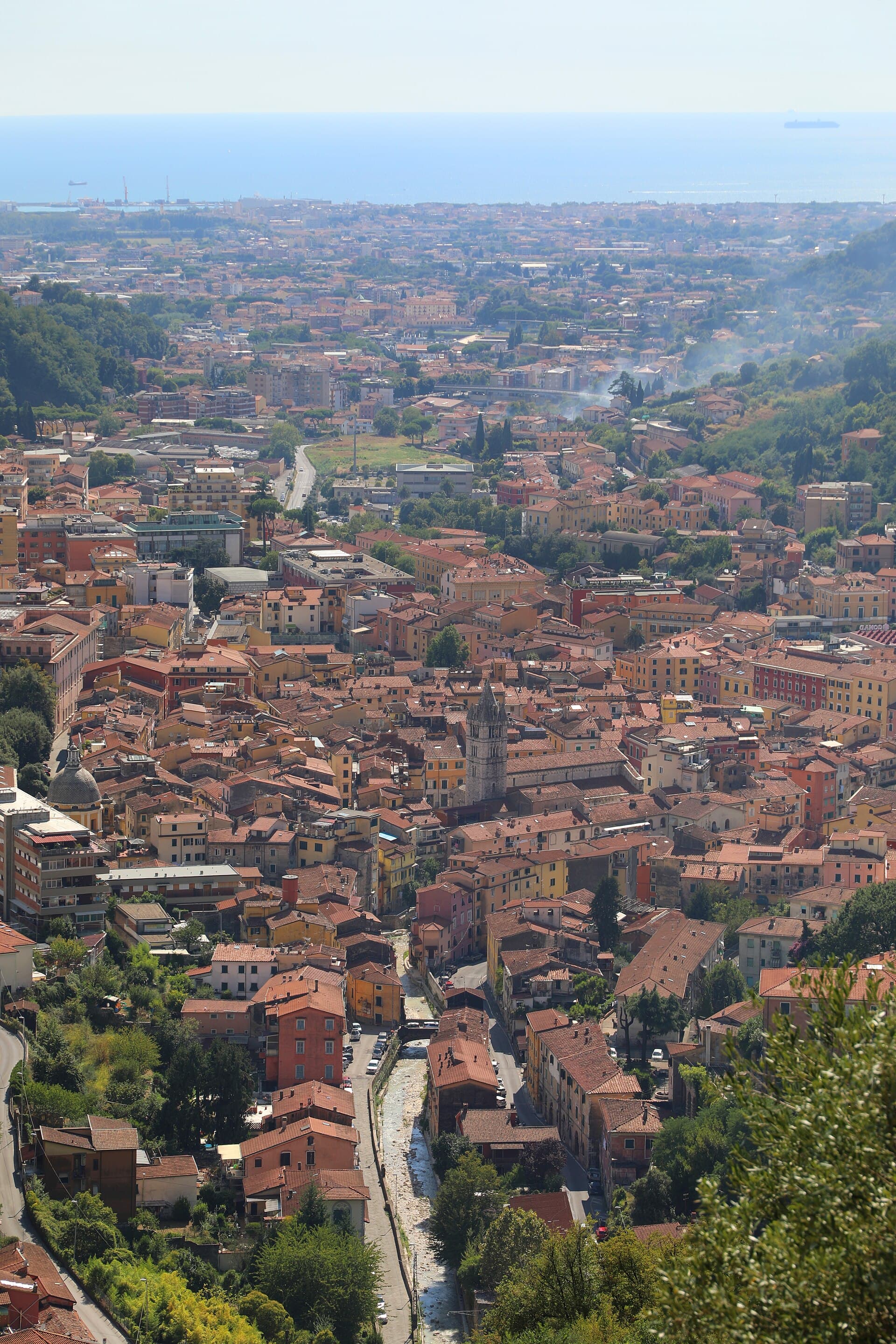
The dazzling white peaks of the Apuan Alps, visible from Carrara, hold a secret that goes back millions of years.
Sailko / CC BY-SA 4.0, via Wikimedia CommonsCarrara
“Where mountains of white gold meet the sea.”
Carrara, as no one tells it.
Not the postcards. The stories even locals don't know — whispered in your ear, right where they happened.
In the 19th century, a unique musical instrument played a crucial role in the dangerous work of marble extraction.
The local delicacy, Lardo di Colonnata, owes its distinctive flavor to a surprising aging process.
Discover every secret of Carrara
Every address, every reveal in full — in your ear, right where it happened.
You pick your stops. You walk. The voice reveals what the others miss.
How long do you have in Carrara?
No tours available yet. Check back soon — we're preparing them.
The story of Carrara
Carrara, a city in northern Tuscany, Italy, is synonymous with marble. Situated along the Carrione River at the foot of the Apuan Alps, Carrara is known worldwide for its prized white and blue-grey marble, which has been quarried for thousands of years. This unique landscape, where mountains appear snow-capped even in summer due to the glistening marble, offers a blend of natural beauty, enduring stories, and artistic heritage.
Beyond its geological marvels, Carrara possesses an independent spirit, reflected in its historic center with medieval streets, Baroque architecture, and squares adorned with marble. It's a place where the legacy of master sculptors like Michelangelo and Canova is palpable, and where the tradition of marble extraction and craftsmanship continues to thrive. Whether you seek art, adventure, or simply a unique Tuscan experience, Carrara offers a wide range of discoveries.
From Roman Quarries to Renaissance Masterpieces
The origins of Carrara are deeply intertwined with its marble. Settlements in the area date back to 900 BC, with the town itself forming when the Romans established homes for workers in the marble quarries after conquering Liguria in the early 2nd century BC. The Romans, recognizing the exceptional quality of what they called marmor lunense (Luna marble), used it extensively for iconic structures such as the Pantheon and Trajan's Column, solidifying Carrara marble's foundational role in civilization's history. The marble was then exported from the nearby harbor of Luni.
Throughout the Middle Ages, ownership of the quarries often shifted, with the Malaspina family eventually taking control and moving their seat of power to Carrara in the latter half of the 15th century. Carrara, along with Massa, formed the Duchy of Massa and Carrara, a small state that persisted for centuries. The Renaissance brought a new wave of recognition, as artists like Michelangelo and Donatello personally journeyed to Carrara to select the perfect blocks for their masterpieces. Michelangelo, for instance, spent months in Carrara choosing the stone for works like his Pietà and David.
A Cradle of Anarchism and Civil Resistance
The 19th century saw a significant influx of workers to the marble region, leading to a new level of industry. However, the harsh and dangerous working conditions in the quarries fostered a strong sense of radicalism and worker movements among the cavatori (quarrymen). Carrara became known as a cradle of anarchism in Italy, with the first anarchist group in Italy reportedly founded here in 1885 by revolutionists expelled from Belgium and Switzerland. The quarry workers were instrumental in organizing labor and were key figures in events like the Lunigiana revolt in 1894.
Carrara also played a pivotal role in World War II. On July 7, 1944, the women of Carrara staged a courageous uprising against German troops and their fascist allies who were attempting to deport men for forced labor. This act of civil resistance prevented the town's evacuation and allowed the partisan movement to take root, becoming one of the best-organized forms of resistance in the area. Today, Via VII Luglio in Carrara commemorates this significant historical event.
Begin your exploration with the dramatic Carrara marble quarries in the Apuan Alps. Many offer guided tours, some even by 4x4 vehicles, providing insight into the millennia-old extraction techniques and offering expansive views of the Apuan Alps and the Ligurian-Tuscan coastline. Consider visiting the Cava Museo Carrara a Fantiscritti for a deeper dive into the city's ancient traditions.
In Carrara's historic center, wander through medieval streets that converge at Piazza Alberica, an elegant square surrounded by historic buildings and a statue of Maria Beatrice d'Este. The Carrara Cathedral (Insigne Collegiata - Abbazia Mitrata di Sant'Andrea Apostolo) is a Romanesque-Gothic masterpiece, built entirely of white marble between the 11th and 14th centuries. The Palazzo Cybo-Malaspina, now home to the Academy of Fine Arts, is another architectural highlight, blending 13th-century elements with a 16th-century Renaissance palace. For art and history enthusiasts, the Museo del Marmo (Marble Museum) and the CARMI - Carrara and Michelangelo Museum offer extensive collections and insights into the region's marble heritage. Do not miss the charming quarrymen's village of Colonnata, famed for its unique lardo.
The best time to visit Carrara for warm-weather activities and clear views of the quarries and surrounding landscape is from early July to mid-August. During this period, skies are typically clearest, and temperatures are warm, with average daily highs around 80-83°F (27-28°C). While the summer offers ideal conditions for exploring the outdoors, be aware that the sun reflecting off the marble can make quarry areas feel intensely hot. The cooler season runs from November to March, with average daily highs below 58°F (14°C) and more cloudy and wet days.
Carrara is accessible by car or train. If driving, follow the A11 highway towards Pisa, then the A12 towards La Spezia, exiting at Carrara. Free parking is available near the historic center, such as in San Martino. The nearest train station is Carrara-Avenza, on the Pisa–La Spezia line, with frequent regional trains. From the station, a taxi is recommended to reach the quarries, as direct bus service is limited.
When visiting the quarries, wear sturdy shoes with good grip due to uneven marble surfaces, and consider bringing layers, as temperatures can drop at higher altitudes. Sunscreen and a water bottle are advisable, especially in summer, due to the reflective marble. Many tours offer combined experiences of the quarries, sculpture workshops, and local food tastings. Local specialties to try include Lardo di Colonnata IGP and farinata.
- How do I get to Carrara?
- Carrara is accessible by car via the A12 motorway or by train to Carrara-Avenza station. From the train station, taxis are recommended for reaching the quarries.
- Can I visit the marble quarries?
- Yes, many Carrara marble quarries offer guided tours, some with 4x4 vehicles, providing an up-close look at the extraction process and panoramic views.
- What is Carrara marble used for?
- Carrara marble is primarily used in sculpture, building decor, architecture, and interior design for items like countertops and tiles. Historically, it was used for famous monuments like the Pantheon and Michelangelo's *David*.
- What local food should I try in Carrara?
- A local specialty to try is *Lardo di Colonnata IGP*, a cured pork fat aged in marble basins. You should also sample local wines, olive oil, and *farinata*.
- Is Carrara suitable for a day trip?
- Yes, Carrara is an ideal destination for a day trip, offering a mix of art, history, and nature, and is easily reachable from cities like Florence or Pisa.
- What is the best time of year to visit Carrara?
- The best time to visit for warm-weather activities and clear views is from early July to mid-August, when skies are clearest and temperatures are pleasant.