Chełmno Town Hall
Observe the back wall of Chełmno's Renaissance Town Hall, and you will notice an unassuming iron rod.
Full story unlocks in the tour
 Paweł Schmidt / CC BY-SA 3.0 pl, via Wikimedia Commons
“Where ancient walls echo with enduring stories.”
Not the postcards. The stories even locals don't know — whispered in your ear, right where they happened.
Observe the back wall of Chełmno's Renaissance Town Hall, and you will notice an unassuming iron rod.
Chełmno is known as the 'City of Lovers,' a romantic designation for a historic Polish town. The reason for this connection may surprise you.
Chełmno occupies a profoundly somber place in history, a narrative that many outside Poland might not immediately associate with its name.
Discover every secret of Chełmno
Every address, every reveal in full — in your ear, right where it happened.
You pick your stops. You walk. The voice reveals what the others miss.
No tours available yet. Check back soon — we're preparing them.
Chełmno, a city in northern Poland, invites visitors on a journey through centuries of time, earning its place on Poland's official list of National Historic Monuments. Its well-preserved medieval town center, characterized by a grid-shaped layout, five Gothic churches, and an impressive Renaissance town hall, recounts a story of strategic significance and lasting heritage.
Frequently referred to as the 'City of Lovers' due to the relics of St. Valentine housed in its parish church, Chełmno also possesses one of Europe's most complete circuits of medieval defensive walls. These fortifications, with their many towers and gates, offer expansive views of the Vistula Valley, encouraging visitors to imagine earlier eras.
Beyond its architectural grandeur, Chełmno's past is interwoven with momentous historical events, from its founding under 'Kulm law' by the Teutonic Knights to its role as a regional center and later, a poignant site of remembrance from World War II. It is a place where history is not merely read but deeply felt, from the ancient market square to the steadfast brick walls that have stood for nearly eight centuries.
The origins of Chełmno can be traced back to a document believed to have been issued in 1065 by Duke Bolesław II the Generous of Poland. Its strategic importance expanded considerably in 1226 when Duke Konrad I of Masovia extended an invitation to the Teutonic Knights to Chełmno Land. In 1233, Chełmno was granted city rights under 'Kulm law,' a foundational system that would influence the establishment of over 200 towns in present-day Poland, Lithuania, and Russia, including Warsaw and Gdańsk.
The town remained under the Teutonic Knights' state until 1454. During this era, in 1440, Chełmno became a founding member of the Prussian Confederation, an alliance formed to oppose Teutonic rule. At the Confederation's request, King Casimir IV Jagiellon reintegrated the territory into the Kingdom of Poland. Following the Thirteen Years' War, the Teutonic Knights formally relinquished their claims, acknowledging Chełmno as part of Poland and establishing it as the capital of the Chełmno Voivodeship.
The 17th and 18th centuries witnessed Chełmno experience periods of both prosperity and conflict. In 1692, the local gymnasium was transformed into the Chełmno Academy, which later became a branch of the Jagiellonian University in Kraków, a testament to the city's intellectual life. However, in 1772, during the First Partition of Poland, Chełmno was annexed by the Kingdom of Prussia. It briefly returned to Polish control as part of the Duchy of Warsaw between 1807 and 1815 before being re-annexed by Prussia.
The 19th century brought significant scientific advancements to Chełmno. In 1878, the respected Polish surgeon Ludwik Rydygier opened his private clinic here, performing groundbreaking operations, including the first surgical removal of the pylorus in Poland in 1880 and the world's first peptic ulcer resection in 1881. Chełmno was reintegrated with Poland on January 22, 1920, following Poland's regained independence after World War I.
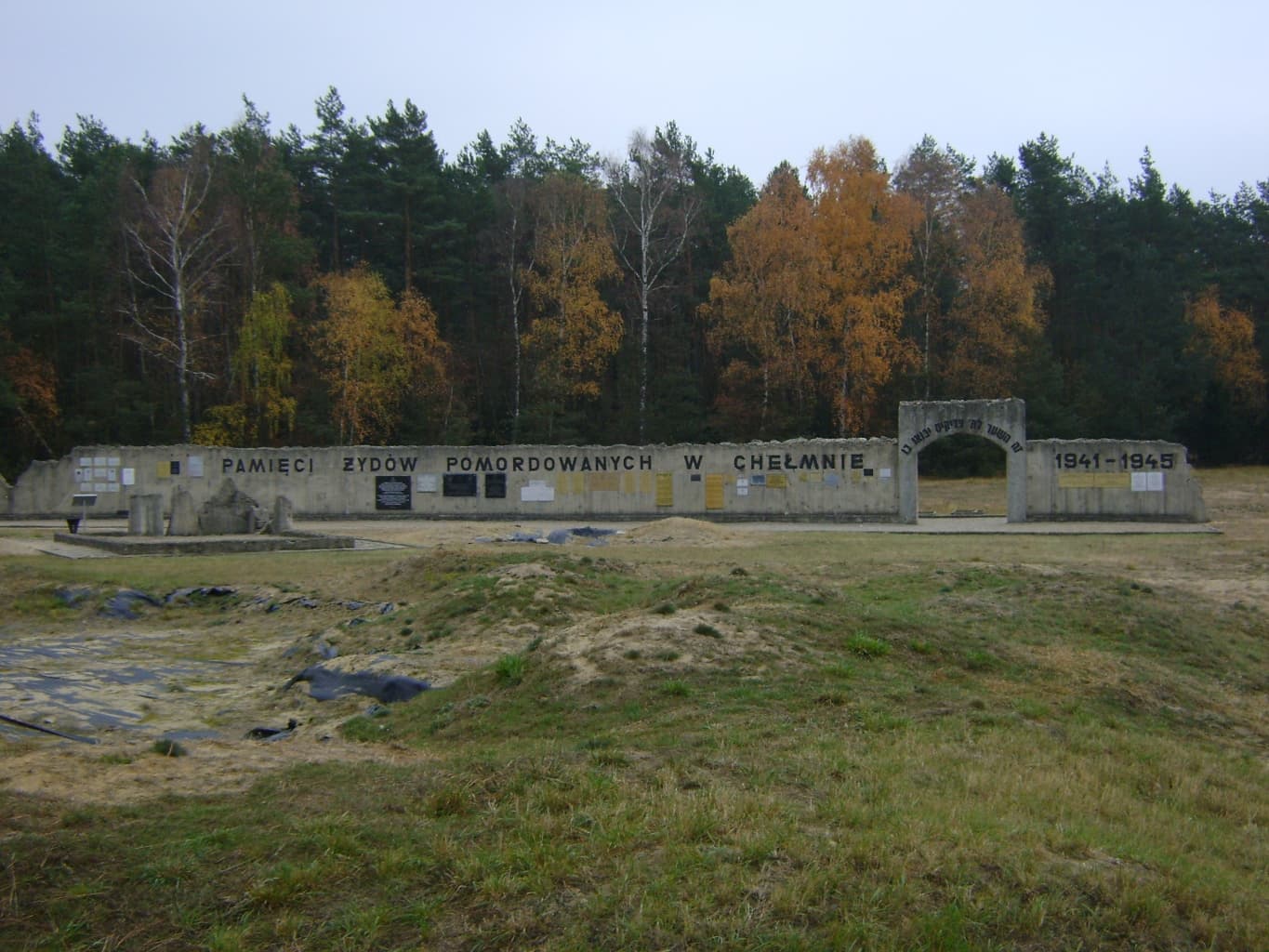
Tragically, during World War II, the nearby village of Chełmno nad Nerem became the site of the Chełmno extermination camp (Kulmhof), the first Nazi German extermination camp. Operating from December 1941 to January 1945, it was here that the Nazis first employed gas vans for mass murder, killing at least 152,000 people, predominantly Jewish individuals from the Łódź Ghetto and surrounding regions.
Begin your exploration in Chełmno's Old Town, designated a National Historic Monument. Its medieval urban plan, featuring a central market square, remains remarkably preserved.
Standing prominently in the market square is the Renaissance Town Hall, a striking building originally from the late 13th century and rebuilt in the Mannerist style between 1567 and 1572. Inside, a museum offers insights into the town's past.
Walk the defensive city walls, which encircle nearly 80% of the city's perimeter, extending over 2,300 meters, with 23 surviving towers. The Grudziądz Gate is one of the few remaining original gates, and a walk along the walls offers evocative views. Notable towers include the Gunpowder Tower, housing an archaeological branch of the Chełmno Land Museum, and the Maiden Tower.
Discover Chełmno's religious heritage through its five Gothic churches. The Church of St. Mary, the former main parish church, constructed between 1280 and 1320, is particularly significant as it safeguards the relics of St. Valentine. Other notable churches include the Church of Saints James and Nicholas, the Church of Saints Peter and Paul, and the Church of Saints John the Baptist and John the Evangelist, part of a former Benedictine and Cistercian nuns' complex.
For a different perspective, visit the Miniature Park of Teutonic Castles, which features 1:30 scale models of nine Teutonic castles, crafted from mini bricks. Also, consider a visit to the Chełmno Extermination Camp Memorial and Museum in the nearby village of Chełmno nad Nerem for a solemn reflection on World War II history.
The ideal time to visit Chełmno for outdoor pursuits is from mid-June to late August, when the weather is pleasant and skies are clearer. For those desiring warmer temperatures, mid-July to mid-August offers prime conditions for hot-weather activities. Spring (May to June) and early autumn (September to October) also provide mild temperatures and fewer crowds, perfect for exploring the city's historic sites and gardens. Winter offers a quiet, serene atmosphere with fewer tourists.
Chełmno is situated in the Kuyavian-Pomeranian Voivodeship, approximately 40-50 km from Toruń and Bydgoszcz, and about 132 km from Gdańsk. The most straightforward way to reach Chełmno is by car, with connections from major cities like Toruń and Bydgoszcz. Parking is often complimentary, especially on weekends.
For those visiting the Chełmno Extermination Camp Memorial and Museum, it is about a 1.25-hour drive from Łódź, 1.75 hours from Poznań, and 2 hours from Warsaw. Admission to the museum is free, and it is open Tuesday through Sunday from 9 AM to 3 PM. Guided tours can be arranged with at least three days' notice.
While Chełmno itself is a compact city, comfortable walking shoes are recommended for exploring the medieval streets and city walls. Polish is the official language, and a handshake is a customary greeting.