Michael Collins, a central figure in Irish independence, is closely linked to Clonakilty. While a museum honoring him stands in Emmet Square, the precise home he occupied there was once a matter of local legend.
Chmee2 / CC BY-SA 3.0, via Wikimedia CommonsClonakilty
“Where bright streets meet the wild Atlantic’s edge.”
Clonakilty, as no one tells it.
Not the postcards. The stories even locals don't know — whispered in your ear, right where they happened.
Clonakilty once possessed its own railway line, a crucial link for the town. However, the closure of this line involved a surprising journey for some of its components.
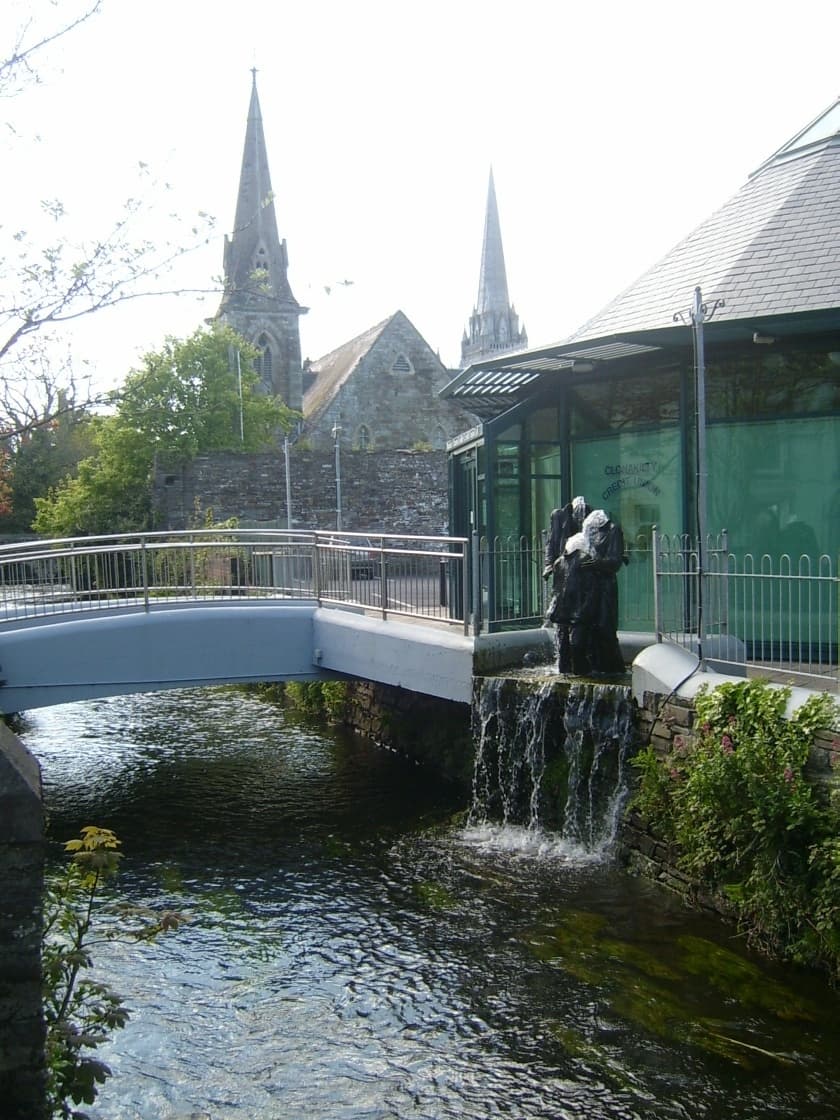
The structure that now serves as Clonakilty's Town Hall and Library possesses a compelling past that speaks to the town's early industry, even including a natural element flowing beneath its foundations.
Discover every secret of Clonakilty
Every address, every reveal in full — in your ear, right where it happened.
You pick your stops. You walk. The voice reveals what the others miss.
How long do you have in Clonakilty?
No tours available yet. Check back soon — we're preparing them.
The story of Clonakilty
Clonakilty, often simply called 'Clon,' is a spirited and colorful town situated at the head of the tidal Clonakilty Bay in County Cork, Ireland. Recognized for its animated atmosphere, welcoming residents, and coastal panoramas, Clonakilty has earned national and international acclaim, including being named 'Best Town in Europe' in 2017 and 'Ireland's Tidiest Small Town' on several occasions. The town serves as a focal point for tourism in West Cork, providing a blend of historical curiosity, a flourishing food culture, and a robust traditional music scene.
The agricultural expanse surrounding Clonakilty is primarily dedicated to dairy farming, contributing to the region's celebrated culinary offerings, most notably the famed Clonakilty Blackpudding. Whether exploring its acclaimed beaches like Inchydoney, delving into the life of revolutionary figure Michael Collins, or enjoying a traditional music session in one of its many establishments, Clonakilty delivers a quintessential West Cork experience.
Clonakilty is also a pioneer in sustainable living, having been Ireland's first Fairtrade Town in 2003 and joining the Cittaslow network, a global movement advocating for a more deliberate pace of life and enhanced quality of living.
Early Settlements and Norman Influence
The Clonakilty area's history extends back to Bronze Age settlements, with evidence of early Celtic civilization, including a well-preserved stone circle at Templebryan. The name Clonakilty itself, appearing in writing as early as 1378 as 'Clogh na Kylte,' translates from Gaelic to 'Castle of the Woods.' This castle is thought to have stood on the site of the present-day Church of Ireland, with a stone from it, known as 'The Kilty Stone,' now found in Asna Square.
Norman settlers constructed fortifications around Clonakilty, and several Norman surnames endure in the West Cork area today. In 1292, Thomas de Roach received a charter from Edward I to hold a weekly market at Kilgarriffe, near the current town.
The Founding and Development of the Town
Clonakilty received its official charter from James I in 1613, through the efforts of Richard Boyle, 1st Earl of Cork, who aimed to establish an English Protestant town. Despite initial difficulties, including being burned by Catholic rebels during the Irish Rebellion of 1641, the town flourished, leading to the construction of notable buildings. The Market House, which later became the Town Hall, was erected in 1696. Over the centuries, trade expanded, leading to the development of quays, corn stores, and mills.
Rebellions and Revolutionary Figures
Clonakilty played a role in various Irish rebellions. In 1691, the town was the location of a battle during the Williamite War in Ireland. During the Irish Rebellion of 1798, the Battle of the Big Cross occurred near Clonakilty, marking the only significant blow struck in Munster during that uprising, commemorated by a statue in Asna Square.
One of Clonakilty's most recognized figures is Michael Collins, a key individual in the Irish War of Independence. Born in Woodfield, near Sam's Cross, Collins resided in Clonakilty during his school years from 1904 to 1906. His legacy is preserved through a bronze statue in Emmet Square and the Michael Collins House museum.
Industrial Past and Modern Recognition
The town's industrial origins are evident, particularly its linen industry, which is highlighted at the West Cork Regional Museum. Clonakilty also had a railway station, opened in 1886, which served as a busy terminus until its closure in 1961. In recent decades, Clonakilty has garnered recognition for its quality of life and community efforts, winning the Irish Tidy Towns Competition in 1999 and receiving gold medals in numerous subsequent years. It was also recognized as a European Destination of Excellence in 2007.
Clonakilty offers a diverse array of places to experience. A visit to the Michael Collins House in Emmet Square provides insight into the life of the Irish revolutionary hero through interactive displays and artifacts. Nearby, a bronze statue of Collins stands in the square where he once lived.
For a glimpse into the past, the West Cork Model Railway Village recreates a bustling 1940s West Cork township with miniature trains and handcrafted figurines. Those who appreciate the outdoors can head to Inchydoney Beach, known for its fine white sand and opportunities for swimming and surfing. Other nearby beaches include Owenahincha and Red Strand.
Those who appreciate food can explore the Clonakilty Blackpudding Visitor Centre to learn about the town's famous delicacy. The Clonakilty Distillery offers tours and tastings of its whiskey and gin, with barley grown on a nearby farm. For a taste of traditional Irish music, DeBarras Folk Club is a celebrated venue with a long history of live performances.
Those interested in history can also visit the ancient Drombeg Stone Circle, an impressive megalithic site, or the ruins of Timoleague Abbey, a Franciscan friary with a history tied to the wine trade.
The ideal time to visit Clonakilty for warm-weather activities is from late June to early September. July is typically the warmest month, with average daily highs around 65°F (18°C) and lows around 55°F (13°C). August also offers mildly cool temperatures, ranging from 55-63°F (13-17°C). While summer is popular, Clonakilty maintains its character year-round, with establishments, music sessions, and the food scene active even in winter, often with fewer crowds and lower accommodation prices. Rainfall is highest in January and lowest in April.
Clonakilty is approximately a 50-minute drive southwest from Cork City and Cork Airport via the N71 road. Bus Éireann route 237 provides regular service from Cork to Clonakilty, continuing to other West Cork towns. The westbound bus stops on Pearse Street, while the eastbound stop is opposite the distillery. West Cork Connect and Local Link also offer bus services.
While the town is compact and easily navigated on foot, a rental car is recommended for exploring the wider West Cork region and its coastal attractions like Inchydoney Beach, which is about a five-minute drive from the town center. Free parking is available at locations such as the Model Railway Village and Deasy's Public Car Park.
Accommodation options include hotels, B&Bs, and self-catering facilities. Many establishments and restaurants are within a short walk of the Clonakilty Distillery, which itself has free parking.
- What is Clonakilty known for?
- Clonakilty is recognized for its colorful shop fronts, welcoming atmosphere, beautiful beaches like Inchydoney, and its strong connection with Irish revolutionary leader Michael Collins. It's also celebrated for its traditional black pudding and lively music scene.
- Is Clonakilty on the Wild Atlantic Way?
- Yes, Clonakilty and its surrounding beaches are part of Ireland's Wild Atlantic Way, a scenic coastal driving route.
- How far is Clonakilty from Cork Airport?
- Clonakilty is approximately 49-60 kilometers (30-37 miles) from Cork Airport, depending on the route taken. The direct route is about 49km, while the scenic Wild Atlantic Way route is 60km.
- Do I need a rental car to visit Clonakilty?
- While Clonakilty town itself is walkable, a rental car offers the freedom to explore the wider West Cork region, including its many beaches and historical sites, at your own pace.
- What is Clonakilty black pudding?
- Clonakilty black pudding is a traditional Irish blood sausage made with local beef, oatmeal, and a distinctive blend of spices. It has been produced in the town since the 1880s and is considered one of Ireland's finest.
- What is the 'Kilty Stone'?
- The 'Kilty Stone' is a stone from the original 'Castle of the Woods' (Cloch na gCoillte), from which Clonakilty derives its name. It is now located in Asna Square in the town.