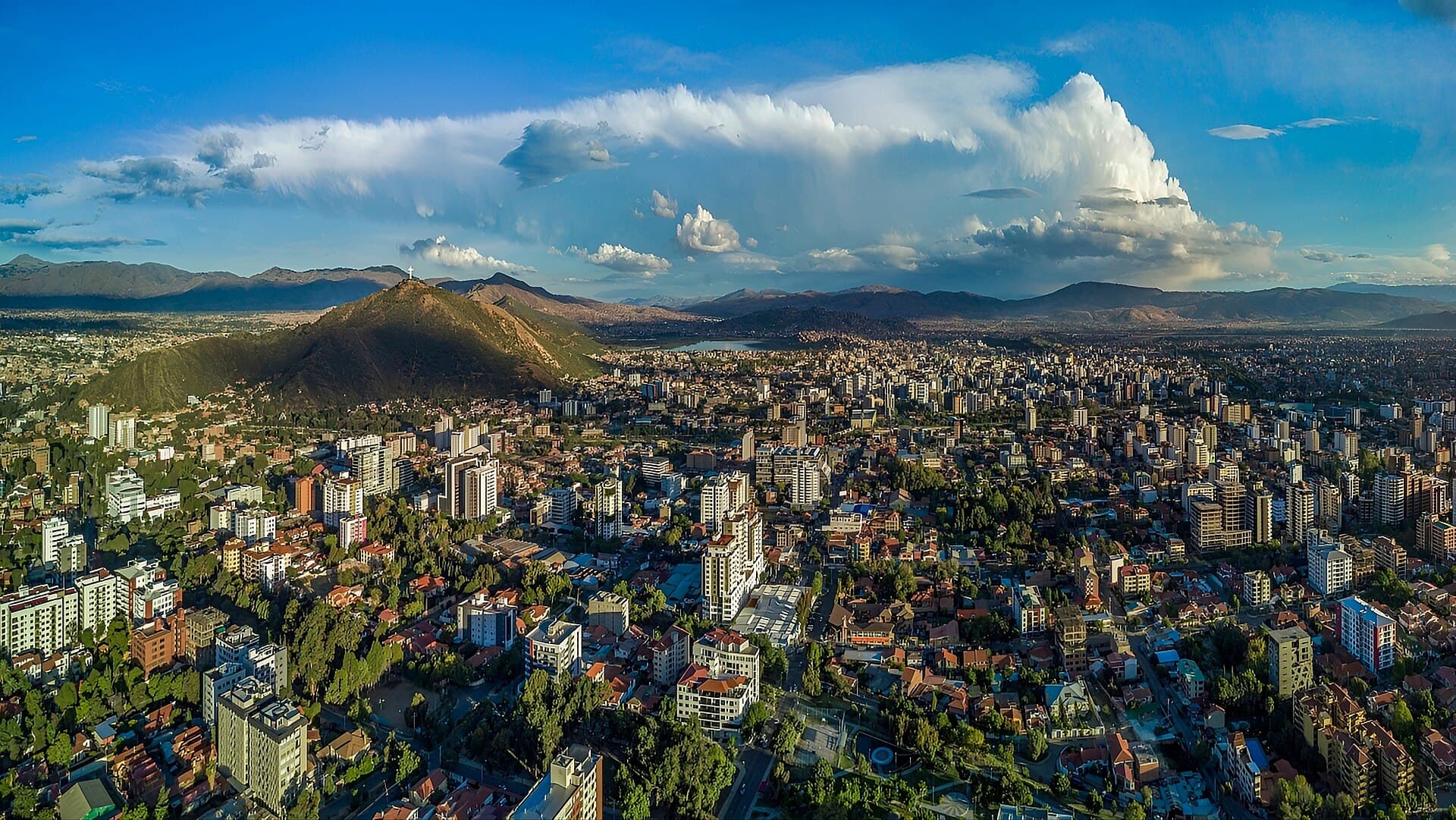
Cochabamba, BoliviaParallelepiped09 / CC BY-SA 4.0, via Wikimedia Commons
BO

Cochabamba

Cochabamba: Where the Andes cradle a culinary heart and endless spring.

The secrets of Cochabamba

Cochabamba, as no one tells it.

Not the postcards. The stories even locals don't know — whispered in your ear, right where they happened.

3 secrets below. Many more wait inside the tour.
Cristo de la Concordia

The immense Cristo de la Concordia statue surveys Cochabamba, a figure of tranquility. Yet, a specific detail about its stature sparks a quiet rivalry.

Full story unlocks in the tour
Palacio Portales

Simón I. Patiño, a tin baron of immense fortune, commissioned Palacio Portales to be a European-inspired manor in Bolivia. Despite its splendor, he never truly inhabited it.

Full story unlocks in the tour
Convento de Santa Teresa

The Convento de Santa Teresa, a historic convent in Cochabamba, contains more than just religious meaning. Its walls once sheltered a unique assortment of occupants.

Full story unlocks in the tour
The full tour

Discover every secret of Cochabamba

Every address, every reveal in full — in your ear, right where it happened.

Get the key to Cochabamba

You pick your stops. You walk. The voice reveals what the others miss.

Choose your time

How long do you have in Cochabamba?

No tours available yet. Check back soon — we're preparing them.

About Cochabamba

The story of Cochabamba

Cochabamba, often called the "City of Eternal Spring" or "The Garden City," unfolds in a fertile Andean valley at an elevation of approximately 8,432 feet (2,570 meters) above sea level. This central Bolivian city, the country's fourth largest, offers a distinct experience from the higher-altitude cities of La Paz or the tropical lowlands of Santa Cruz. Its name, derived from the Quechua words qucha (lake) and pampa (open plain), suggests the region's natural abundance. Cochabamba is known as Bolivia's gastronomic capital, a reputation earned through a lively food culture that permeates daily life.

Beyond its culinary delights, Cochabamba provides a relaxed pace and a deep immersion into Bolivian daily life, where indigenous Quechua traditions and modern influences coexist. The city serves as an ideal base for exploring the central valleys, which are dotted with Inca archaeological sites, colonial villages, and dramatic Andean landscapes. Its agreeable climate, characterized by stable temperatures year-round, makes it an attractive destination for those seeking to experience Bolivia's cultural richness without the extremes of other regions.

History

From Ancient Plains to Colonial Granary

The Cochabamba Valley has been continuously inhabited for thousands of years, a testament to its fertile soils and mild climate. Indigenous groups such as the Tiwanaku, Tupuraya, Mojocoya, Omereque, and later the Inca, all recognized the valley's agricultural potential. Under the Inca Empire, the area became a crucial center for maize production.

The Spanish conquistador Sebastián Barba de Padilla officially refounded the city on January 1, 1574, initially as Villa de Oropeza, though an earlier settlement attempt occurred in 1571. The city was eventually renamed Cochabamba in 1786, adopting its Quechua name meaning "plain full of small lakes." During the colonial era, Cochabamba flourished as an agricultural hub, earning the moniker "Granary of Bolivia" by supplying food, especially grain, to the silver-mining cities like Potosí. This agrarian focus distinguished it from many other Spanish settlements in the region, shaping its economic prosperity and cultural identity, which blended Spanish and indigenous traditions.

A Cradle of Independence and Modern Development

Cochabamba played a significant role in Bolivia's struggle for independence from Spanish rule. The uprising on September 14, 1810, was one of the first in the region, marking a pivotal moment in the Bolivian War of Independence. The city's history is notably marked by the heroic defense of the "Heroines of the Coronilla" in 1812, when women courageously defended the city after the male soldiers had fallen, becoming a powerful symbol of national courage. Bolivia finally achieved independence in 1825, and the Department of Cochabamba was officially created on January 23, 1826.

The 20th century brought further transformation. In 1936, Cochabamba was the site of the first oil nationalization in South America, underscoring its growing economic importance. The 1950s saw significant industrial development with the construction of the San José dam, leading to growth in textiles, food processing, and chemical industries. More recently, Cochabamba has continued to evolve, with the completion of the monumental Cristo de la Concordia statue in 1994, which has become a defining symbol of the city.

The Water Wars and Beyond

In the late 1990s and early 2000s, Cochabamba became the epicenter of the "Water Wars," a series of protests against the privatization of the city's water supply. These public revolts, fueled by unaffordable water rates and inadequate supplies, led to violence and ultimately forced the Bolivian government to rescind privatization contracts. This period is often credited with contributing to the rise of Evo Morales. Today, Cochabamba balances its profound historical legacy with a dynamic contemporary life, embracing its role as a cultural and gastronomic center while navigating modern challenges.

What to see

Begin your exploration at the Cristo de la Concordia, a towering statue of Jesus Christ atop San Pedro Hill. Taller than Rio de Janeiro's Christ the Redeemer, it offers sweeping 360-degree views of the city and the surrounding valley. Access the summit via a cable car for an easy ascent, or challenge yourself with the 1,399 steps.

The Plaza 14 de Septiembre forms the heart of Cochabamba, a lively central square surrounded by colonial buildings and the Metropolitan Cathedral. It's a prime spot for observing people, enjoying a traditional garapiña, and experiencing local life.

For a glimpse into opulent history, visit Palacio Portales, a luxurious early 20th-century mansion commissioned by tin magnate Simón I. Patiño. Inspired by French palaces, its ornate architecture and manicured gardens feel like a piece of Europe in Bolivia. The Convento Museo Santa Teresa offers a journey into colonial religious life and art, with its well-preserved interiors and accompanying museum.

Immerse yourself in the city's active commerce at La Cancha Market, one of South America's largest open-air markets. Here, you can find everything from handmade Andean textiles and electronics to fresh produce and local street food. For the most energetic experience, visit on Wednesdays or Saturdays.

Consider a day trip to Torotoro National Park, a few hours by bus, to discover Jurassic dinosaur footprints, explore underground caves like Umajalanta, and hike through canyons to waterfalls.

When to visit

Cochabamba is often called the "City of Eternal Spring" due to its consistently mild and moderate climate year-round. The best time to visit is generally during the dry season, from April to October. During these months, rainfall is minimal, skies are clear, and daytime temperatures are pleasant. Nights can be cool, especially from May to August, so a light sweater or alpaca layers are advisable. The rainy season runs from December to March, with January being the wettest month, but temperatures remain mild. For ideal conditions, consider August through November, which offers pleasant weather and coincides with local festivals like Urkupiña in early August and Cochabamba's city anniversary on September 14.

Practical

Cochabamba is at an elevation of approximately 8,432 feet (2,570 meters), which is lower than La Paz or Potosí, making it a good place to acclimatize to altitude if you're planning to visit higher regions. The local currency is the Boliviano (BOB). While major hotels and shopping centers may accept cards, cash is preferred, especially at markets and smaller establishments. It's wise to carry small bills and coins.

Spanish is widely spoken in Cochabamba, and the local dialect, Valluno Spanish, incorporates some Quechua words. Quechua is also widely spoken, reflecting the strong indigenous presence. Getting around the city is affordable and varied. "Micros" (colorful old school buses) and "Trufis" (vans) follow fixed routes, offering a local's experience. Taxis are readily available, and ride-sharing apps like Uber, InDrive, and Yango also operate. The city also has a light rail network, Mi Tren, connecting the city center with surrounding areas. While Cochabamba is generally walkable, especially in the compact city center, exercise caution when walking up to Cristo de la Concordia, as muggings have been reported; the cable car or a taxi is a safer option.

Good to know
What is Cochabamba known for?
Cochabamba is widely known as Bolivia's gastronomic capital, celebrated for its diverse and flavorful cuisine. It's also called the "City of Eternal Spring" due to its mild, agreeable climate year-round. The city is also home to the Cristo de la Concordia, one of the tallest Jesus statues in the world.
What languages are spoken in Cochabamba?
The primary languages spoken in Cochabamba are Spanish and Quechua. The local Spanish dialect, Valluno Spanish, often incorporates Quechua terminology.
What is the best way to get to Cochabamba?
Cochabamba is accessible by air via Jorge Wilstermann International Airport (CBB), with connections often made through Santa Cruz or La Paz. Intercity buses are also a common and scenic way to arrive from other Bolivian cities.
Is Cochabamba safe for tourists?
Cochabamba is generally considered safe, but like any city, it's important to be aware of your surroundings. It is recommended to take the cable car or a taxi to the Cristo de la Concordia rather than walking the stairs, as muggings have been reported along the path.
What local dishes should I try in Cochabamba?
As Bolivia's gastronomic capital, Cochabamba offers many dishes. Be sure to try *Pique Macho*, a hearty plate of beef, sausage, peppers, and fries, and *Silpancho*, a breaded meat cutlet served with rice, potatoes, and a fried egg. *Salteñas* (savory baked pastries) are a popular snack.
What is the altitude of Cochabamba?
Cochabamba sits at an elevation of approximately 8,432 feet (2,570 meters) above sea level. This makes it a good city for travelers to acclimatize to higher altitudes before visiting places like La Paz or Potosí.
Cochabamba
From€9.00
No booking · activate anytime · 12h to walk it
Get the key to Cochabamba