The former synagogue of Conegliano's historic Jewish community now resides far from Italy.
Paolo Steffan (Paolo Steffan at it.wikipedia) / CC BY-SA 3.0, via Wikimedia CommonsConegliano
“Where the brushstrokes of the Renaissance mingle with the effervescence of Prosecco.”
Conegliano, as no one tells it.
Not the postcards. The stories even locals don't know — whispered in your ear, right where they happened.
The acclaimed Renaissance painter Cima da Conegliano spent his working life in Venice, yet the scenery of his hometown graces many of his renowned canvases.
Locals have a particular name for the enduring tower of Conegliano's medieval castle.
Discover every secret of Conegliano
Every address, every reveal in full — in your ear, right where it happened.
You pick your stops. You walk. The voice reveals what the others miss.
How long do you have in Conegliano?
No tours available yet. Check back soon — we're preparing them.
The story of Conegliano
Conegliano, a city in Italy's Veneto region, offers a compelling blend of historical depth, artistic legacy, and viticultural renown. With origins stretching back to pre-Roman times, the town’s strategic position on the ancient Via Claudia Augusta nurtured its development as a hub of commerce and culture. Today, Conegliano stands as a vital component of the Prosecco Hills of Conegliano and Valdobbiadene, a UNESCO World Heritage site since 2019, celebrated for its vineyards and the sparkling wine they yield.
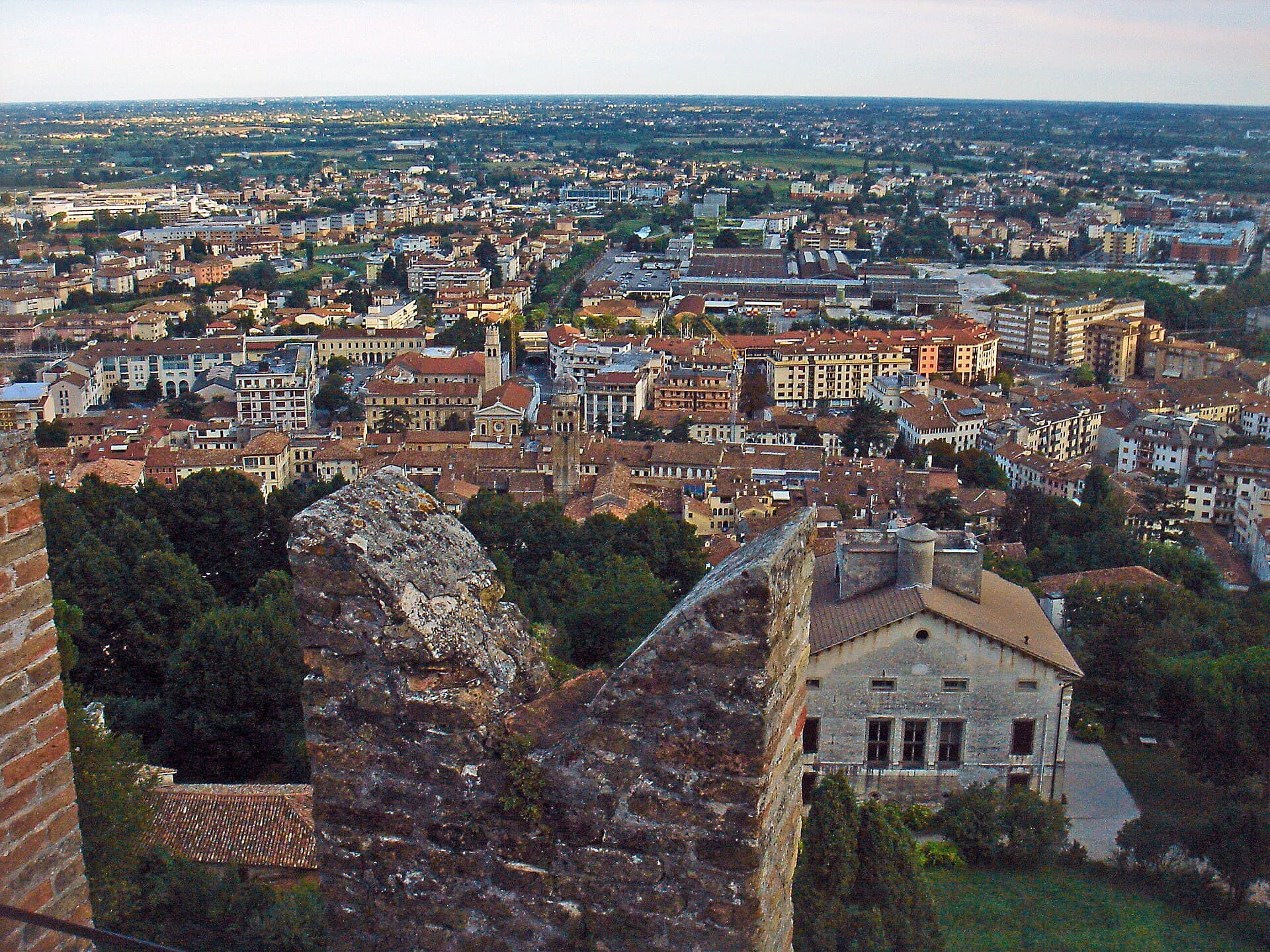
The city serves as an entryway to the Prosecco wine region, home to Italy's oldest enological school, the Cerletti Institute, established in 1876. Beyond its viticultural prominence, Conegliano invites exploration of its historic core, known as Contrada Granda, where Renaissance palaces and medieval architecture line the avenues. From the commanding Castello di Conegliano, visitors can absorb sweeping views that extend across the Prosecco hills, reaching the Dolomites and even the Venice Lagoon on clear days.
Conegliano's population numbers around 35,000, and it lies approximately 50 kilometers north of Venice.
## Ancient Origins and Medieval Authority Conegliano's roots extend to pre-Roman times, with indications pointing to Celtic foundations in the 4th century BC. The town's name first appears in a document from Henry II in 1016, marking its early medieval importance. Around the 12th century, a settlement grew upon a hill surrounding an existing fortress, which became the nucleus of local political, military, and religious power. This castle, initially under the Bishop of Belluno's authority in the 10th century, was later fortified by the Scaligeri from Verona to serve as a stronghold against external threats.
## Venetian Influence and Renaissance Flourishing Under Venetian governance, further efforts were made to reinforce the castle with the addition of moats and ramparts. This era witnessed the construction of numerous palaces, including the Palazzo Comunale (Town Hall). Conegliano thrived during the Renaissance, drawing artists and intellectuals, becoming a center of art and culture. The historic core, particularly the Contrada Granda (now Via XX Settembre and Piazza Cima), displays many Renaissance palaces adorned with sculpted stone decorations and frescoes.
## Wine Culture and Modern Recognition The 19th century brought a significant transformation, with Conegliano increasingly linked to winemaking. Antonio Carpenè played a pivotal role, introducing technical advancements in grape production and establishing the Royal School of Viticulture in 1877, now the Cerletti Institute. This institution stands as the oldest enological school in Italy and Europe. In 1866, Conegliano, along with the Veneto region, became part of the Kingdom of Italy. More recently, in 2019, the Prosecco Hills of Conegliano and Valdobbiadene were designated a UNESCO World Heritage Site, cementing the region's global significance in viticulture. Conegliano is now the second largest town in the province of Treviso.
Begin your exploration at the Castello di Conegliano, a medieval castle offering expansive views of the town and the surrounding Prosecco hills. The castle's enduring bell tower houses the Civic Museum, displaying historical artifacts, artwork, and archaeological discoveries.
Descend into the historic core, known as Contrada Granda, which encompasses Via XX Settembre and Piazza Cima. This area is lined with Renaissance palaces featuring frescoes and carved stone. Key architectural highlights include Palazzo Sarcinelli and Casa Longega. Piazza Cima itself holds the Town Hall and the 19th-century Teatro dell'Accademia.
Adjacent to the historic core is the Duomo di Santa Maria Annunziata e San Leonardo, a 14th-century cathedral with a frescoed apse and an altarpiece by the local Renaissance painter Cima da Conegliano. Next to the Duomo is the Scuola dei Battuti, a 14th-century building with a frescoed facade and interior religious frescoes. For a deeper immersion into the life of Conegliano's most celebrated artist, visit the Casa di Cima, his former home, which now functions as a house museum with reproductions of his works and a small archaeological museum.
The most pleasant times to visit Conegliano are during the spring (April to June) and fall (September to October). During these seasons, the weather is gentle, and the vineyards are at their most picturesque. Late June to late August is ideal for warm-weather activities, with July being the warmest month, averaging 83°F (28°C) highs. Fall is particularly appealing for wine enthusiasts, as it aligns with the grape harvest season in the Prosecco Hills.
Conegliano is readily accessible by train, with regular services from Venice Santa Lucia station, a journey of about one hour. The town is also approximately 30 kilometers from Treviso and 60 kilometers from Venice, with good road connections via the A27 motorway. Treviso and Venice airports are also within reach. The historic core is compact and best explored on foot. A full day is sufficient to experience the main attractions, though an overnight stay allows for more extensive exploration of the Prosecco Wine Road and nearby towns. The local currency is the Euro.
- What is Conegliano known for?
- Conegliano is celebrated for its Prosecco wine production, forming a central part of the UNESCO World Heritage Prosecco Hills. It is also the birthplace of Renaissance painter Cima da Conegliano and home to Italy's oldest enological school.
- How far is Conegliano from Venice?
- Conegliano is approximately 50 to 60 kilometers (30 to 37 miles) north of Venice, easily reached by a one-hour train journey.
- What kind of wine is produced in Conegliano?
- Conegliano is recognized for its Prosecco Superiore DOCG, primarily crafted from the Glera grape. The region also produces other red and white wines, including sweet passito dessert wines.
- Can I visit Cima da Conegliano's house?
- Yes, the former home of Renaissance painter Cima da Conegliano has been transformed into a house museum, where visitors can view reproductions of his works and a small archaeological museum.
- What is the Contrada Granda?
- The Contrada Granda is the traditional name for Conegliano's historic main thoroughfare, encompassing Via XX Settembre, Piazza Cima, and Via Beato Marco Ongaro, characterized by its Renaissance palaces.
- Is Conegliano part of a UNESCO World Heritage site?
- Yes, since 2019, the Prosecco Hills of Conegliano and Valdobbiadene, which include Conegliano, have been designated a UNESCO World Heritage Site.