The central square of Cortona, Piazza della Repubblica, features a lively market scene in the film 'Under the Tuscan Sun.' Yet, the fountain where Katherine dramatically splashes was not always a fixture.
Patrick Denker / CC BY 2.0, via Wikimedia CommonsCortona
“Where ancient stones meet Tuscan dreams.”
Cortona, as no one tells it.
Not the postcards. The stories even locals don't know — whispered in your ear, right where they happened.
The celebrated Villa Bramasole, central to Frances Mayes' memoir and the film 'Under the Tuscan Sun,' presents a different face on screen than in reality.
Cortona's Diocesan Museum holds a renowned Renaissance painting by Fra Angelico, and a closer examination of the Annunciation reveals a subtle, profound message.
Discover every secret of Cortona
Every address, every reveal in full — in your ear, right where it happened.
You pick your stops. You walk. The voice reveals what the others miss.
How long do you have in Cortona?
No tours available yet. Check back soon — we're preparing them.
The story of Cortona
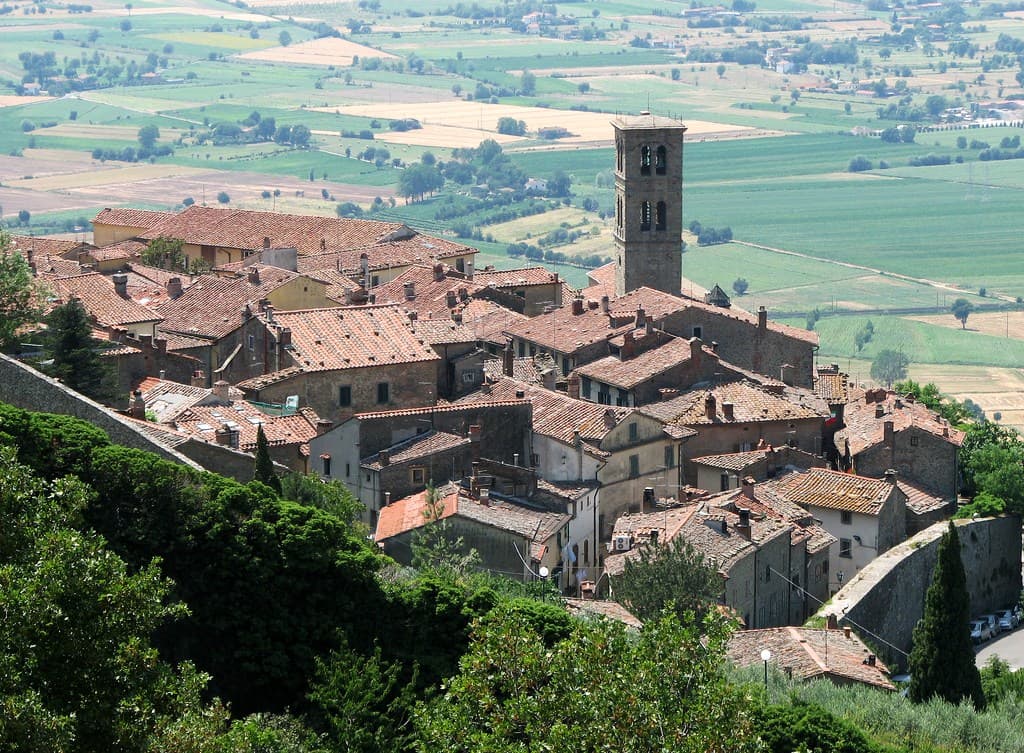
Cortona, a city in the province of Arezzo, is a Tuscan hill town with Etruscan origins and a medieval spirit. It rises from a ridge of Monte Sant'Egidio, granting views of the Val di Chiana and Lake Trasimene. The town's appeal stems from its ancient roots, visible in its formidable stone walls that date back to the 4th and 5th centuries BC. Cortona has drawn visitors for centuries with its allure, historical architecture, and artistic heritage.
While gaining international recognition as the setting for Frances Mayes' memoir and the film Under the Tuscan Sun, Cortona maintains a quieter, more authentic atmosphere compared to some of Tuscany's larger tourist destinations. Its winding, uneven streets, stone houses, and steep alleyways contribute to its timeless character. Cortona serves as a cultural and artistic center for the Val di Chiana.
Cortona's history reaches back to the Etruscans, an ancient civilization that predated the Romans. It is thought to have been established around the 8th century BC, making it one of the oldest continuously inhabited towns in the region. During the Etruscan period, Cortona was a significant hub due to its strategic hilltop placement, which offered defensive advantages and views over the fertile valley below. The Etruscans fortified the town with immense stone walls in the 4th century BC, portions of which remain visible today.
After the decline of the Etruscans, Cortona came under Roman governance, though it lost some of its prominence. It was known as Corito during this era. During the Second Punic War, Hannibal laid siege to Cortona, and the Battle of Trasimene unfolded nearby in 217 BC. Following the collapse of the Western Roman Empire, Cortona experienced a period of quietude until the 12th century when it emerged as a free commune.
In the 13th century, Cortona became a Ghibelline city-state with its own currency. The Ranieri-Casali family governed the town from 1325 to 1409. Cortona was then conquered by Ladislaus of Naples in 1409 and subsequently sold to the Medici family in 1411, bringing it under the influence of the Republic of Florence. This period further shaped its architecture and culture. In 1737, with the extinction of the senior Medici line, Cortona came under the authority of the House of Lorraine. After the Italian Wars of Independence, Cortona, along with the rest of Tuscany, became part of the Kingdom of Italy.
Begin your exploration in the heart of Cortona at Piazza della Repubblica, a lively square where the Palazzo Comunale (Town Hall) stands with its grand clock tower. Nearby, Piazza Signorelli is home to the Museo dell'Accademia Etrusca (MAEC), which houses an extensive collection of Etruscan artifacts, including the bronze Etruscan Chandelier and the Tabula Cortonensis, one of the longest Etruscan inscriptions. The museum also features Roman artifacts and an ancient Egyptian section with two mummies.
A short walk from Piazza della Repubblica leads to the Church of San Francesco, a simple Gothic structure dating back to the 13th century. For art enthusiasts, the Museo Diocesano is a repository of masterpieces, showcasing Renaissance works by artists such as Fra Angelico and Luca Signorelli, a native of Cortona. Continue uphill to the Basilica of Santa Margherita, dedicated to the town's patron saint, which offers expansive views of the surrounding countryside. Further up the hill, you will discover the Girifalco Fortress, a historically layered site. Down the hill, the Parco Archeologico del Sodo features Etruscan tombs, known as 'melons' due to their shape, including a sculpted sacrificial altar.
Beyond the town center, the Convent Le Celle is a historic Franciscan hermitage established by Saint Francis of Assisi around 1211, known for its tranquil atmosphere.
The most pleasant times to visit Cortona are during the spring (April to mid-June) and fall (October to mid-November). During these periods, the weather is mild, the countryside is verdant or adorned with autumn colors, and the crowds are more manageable than in peak summer. July and August bring warmer temperatures and larger gatherings, though Cortona remains quieter than some other major Tuscan towns. For those seeking to avoid crowds entirely, the shoulder season from November to April (excluding December's festive period) is very calm.
Cortona is situated in southern Tuscany, approximately 120 km from Florence (a 1.5-hour drive) and 75 km from Siena (about an hour by car). The closest major city is Arezzo, about 30 km away. While it is possible to reach Cortona by train, a car is strongly recommended for exploring the surrounding area. The closest train stations are Camucia (3 km from the center) and Terontola (7 km away), with bus services connecting to Cortona's Piazza del Mercato.
Parking is available, with a free public parking area called 'Parcheggio del Mercato' on the lower side of town, about a 13-minute walk from Piazza della Repubblica. This lot can be busy, especially from spring to fall, so paid parking options should be considered during busier times. Within Cortona, the historic center is compact and best explored on foot, though many streets are steep. Making dinner reservations is advisable, particularly during busy seasons, as many restaurants operate with limited seating times.
- What is Cortona known for?
- Cortona is known for its well-preserved medieval streets, its deep Etruscan history, and expansive views over the Val di Chiana valley. It also gained international recognition as the setting for Frances Mayes' memoir and the 2003 movie *Under the Tuscan Sun*.
- How much time do I need to visit Cortona?
- For a relaxed walk through the town center, including some shopping and a meal, allow 2 to 3 hours. To fully experience Cortona's allure and explore its treasures, dedicate a full day.
- Can I visit Cortona without a car?
- While a car is strongly recommended for exploring the surrounding Tuscan countryside, Cortona itself is accessible by public transport. You can take a train to Camucia or Terontola stations, and then a bus or taxi into the town center.
- What food is Cortona known for?
- Cortonese cuisine is characterized by its simple yet authentic flavors. Local specialties include handmade pici pasta, Chianina beef, extra virgin olive oil, and aged cheeses. Cortona is also an emerging wine-producing area, particularly recognized for its Syrah wines.
- Is Cortona better than Montepulciano or Siena?
- Cortona is often considered a quieter, less frequented hill town compared to larger destinations like Siena and Montepulciano, making it ideal for those seeking a more relaxed experience. Each town offers a unique character, so the 'best' depends on individual preferences.
- Where was 'Under the Tuscan Sun' filmed?
- The majority of the film 'Under the Tuscan Sun' was shot in Cortona, including scenes in Piazza della Repubblica (for the market) and the villa used for filming, Villa Laura. Other Italian locations included Arezzo, Rome, San Biagio, and the Amalfi Coast.