St. Mary's Basilica
The hourly trumpet call from St. Mary's Basilica is a cherished Krakow tradition, yet the melody always concludes abruptly.
Full story unlocks in the tour
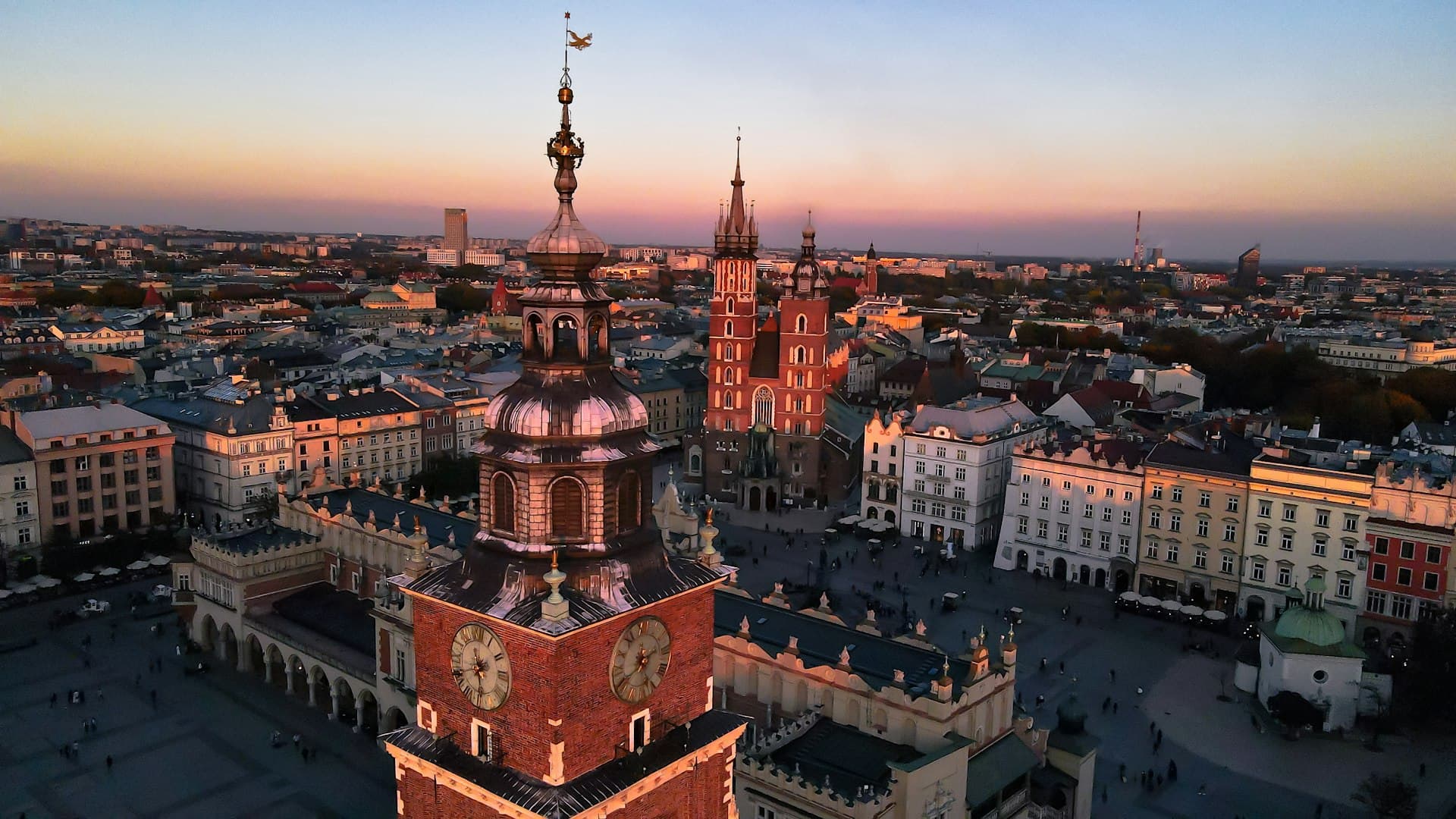 Photo: Kevin Perez Camacho / Unsplash
“Where ancient legends echo through medieval lanes.”
Not the postcards. The stories even locals don't know — whispered in your ear, right where they happened.
The hourly trumpet call from St. Mary's Basilica is a cherished Krakow tradition, yet the melody always concludes abruptly.
Beneath Wawel Castle, a formidable dragon once terrorized Krakow.
A knife hangs prominently in Krakow's Cloth Hall, a relic with a chilling tale of fraternal rivalry.
Discover every secret of Krakow
Every address, every reveal in full — in your ear, right where it happened.
You pick your stops. You walk. The voice reveals what the others miss.
No tours available yet. Check back soon — we're preparing them.
Krakow, Poland's former royal capital, is a city where history breathes, from the grandeur of its medieval Old Town to the poignant narratives held within its Jewish Quarter. Recognized as a UNESCO World Heritage Site, Krakow's Historic Centre encompasses the medieval chartered City of Krakow, the Wawel Hill complex, and the town of Kazimierz. It is a city that remarkably survived World War II largely intact, preserving its architectural splendor and cultural depth.
The city's main square, Rynek Główny, is one of the largest medieval market squares in Europe, a lively center surrounded by historic townhouses, inviting cafes, and significant landmarks. Beyond the main square, a maze of ancient streets leads to a wealth of churches, museums, and quiet courtyards, each offering a glimpse into Krakow's layered past. Whether exploring royal residences or delving into the city's artistic heritage, Krakow offers an immersive experience that blends historical depth with contemporary appeal.
## From Ancient Stronghold to Royal Capital Krakow's origins stretch back to the 7th century, with the first documented reference appearing in a merchant's account from 965 AD, mentioning a vast castle at the crossroads of trade routes. The city was once a stronghold of the Vistulan tribe, and its legendary rulers, Krakus and Princess Wanda, are mentioned in 13th-century chronicles. By the 10th century, Krakow and the Vistulan lands became part of the emerging Polish state.
## The Rise of a Royal City From the 11th to the 17th century, Wawel Castle served as the primary royal residence for Polish monarchs. King Casimir I the Restorer made Wawel Hill his residence in the 11th century, and subsequent rulers expanded and rebuilt the castle, incorporating Gothic, Renaissance, and Baroque architectural styles. Krakow was the capital of Poland from 1038 until 1596, when King Sigismund III Vasa moved his royal court to Warsaw. Even after the capital's relocation, Wawel Hill remained the site for royal coronations and funerals.
## Kazimierz: A Separate City and Jewish Heart Kazimierz, founded by King Casimir the Great in the 14th century, was initially an independent city south of Krakow, separated by a branch of the Vistula River. It was established to protect the southern approaches to the royal capital and quickly developed into a significant urban center. For centuries, Kazimierz was a place where Polish and Jewish cultures coexisted and intertwined. In 1495, Jews were expelled from the main city of Krakow and resettled in Kazimierz, where they established a thriving Jewish quarter known as "Oppidum Judaeorum" (Jewish City), complete with synagogues and renowned scholars. The defensive walls around Kazimierz were eventually demolished in 1822, allowing Jews to settle throughout the district.
## Modern History and Revival During World War II, the Jewish community of Krakow, including those in Kazimierz, faced immense hardship under Nazi occupation. In 1941, Jews were forcibly relocated to the Podgórze ghetto across the Vistula River, and most did not survive the war. After the war, Kazimierz was largely abandoned, and its Jewish heritage was nearly eradicated. However, a resurgence began in the late 1980s, aided in part by the filming of Steven Spielberg's Schindler's List in the district, which brought renewed attention to its historical significance. Today, Kazimierz is a flourishing cultural hub, a testament to the resilience of its history.
Begin your exploration in the Main Market Square (Rynek Główny), one of Europe's largest medieval squares. Here, you'll find the Cloth Hall (Sukiennice), a Renaissance-era market building that still hosts vendors today, with an art gallery on its upper floor. Be sure to visit St. Mary's Basilica, with its distinctive unequal towers and the hourly trumpet call.
Ascend Wawel Hill to discover the Wawel Royal Castle and Wawel Cathedral. The castle, a former royal residence, showcases a mix of architectural styles and houses a museum with royal and military collections. The cathedral is the burial place of many Polish monarchs and national heroes. Below the hill, you can visit the legendary Dragon's Den.
Walk through Planty Park, a green belt that encircles the Old Town, built on the site of former city fortifications. Explore the historic Kazimierz district, the former Jewish Quarter, with its atmospheric streets, synagogues, and lively cafes. The Old Synagogue, now a museum of Jewish history, is a significant site. For a deeper dive into Krakow's past, visit the Rynek Underground Museum beneath the Main Market Square, which reveals archaeological excavations of the medieval city.
The most pleasant time to visit Krakow is from May to September, when the weather is mild, with average temperatures between 15 and 25 degrees Celsius. This period is ideal for walking through the Old Town, visiting historical sites, and relaxing in parks. September and October offer agreeable weather and fewer crowds than the busy summer months, making them excellent for sightseeing. While colder, December is popular for its Christmas markets and festive atmosphere.
Krakow's city center is quite walkable, but an efficient public transportation network of trams and buses covers the entire city. Tickets are interchangeable between trams and buses and operate on a timed basis, allowing for multiple transfers within the validity period. You can purchase tickets at vending machines located at many stops, inside buses and trams (some may be cash-only), or through mobile apps like Jakdojade. Remember to validate your ticket immediately upon boarding. For most tourist activities within the city limits, a Zone I ticket will suffice. Taxis and ride-sharing services like Uber and Bolt are also available. From Krakow Airport, the train (SKA1) is the fastest option to the city center, taking about 17 minutes to Krakow Main Station. Buses are also available from the airport, with lines 208, 209, or the night bus 902.