The revered Black Madonna of Częstochowa bears two distinct slashes on her right cheek.
Jerzy Szota / CC BY-SA 3.0 pl, via Wikimedia CommonsCzęstochowa
“Where devotion and enduring stories converge under the gaze of the Black Madonna.”
Częstochowa, as no one tells it.
Not the postcards. The stories even locals don't know — whispered in your ear, right where they happened.
The Jasna Góra Monastery, a symbol of Polish fortitude, once confronted an overwhelming Swedish invasion.
The city's central artery, Aleja Najświętszej Maryi Panny, serves a purpose beyond daily commerce and urban life.
Discover every secret of Częstochowa
Every address, every reveal in full — in your ear, right where it happened.
You pick your stops. You walk. The voice reveals what the others miss.
How long do you have in Częstochowa?
No tours available yet. Check back soon — we're preparing them.
The story of Częstochowa
Częstochowa, a city in southern Poland, rests on the Warta River and counts over 214,000 inhabitants, making it the country's thirteenth-largest city. While administratively part of the Silesian Voivodeship, it historically belongs to Lesser Poland and is situated within the Kraków-Częstochowa Upland.
The city’s global recognition arises from the Jasna Góra Monastery, a revered sanctuary housing the iconic Black Madonna of Częstochowa. This shrine draws millions of pilgrims annually, establishing Częstochowa's reputation as a significant spiritual center. Beyond its spiritual core, Częstochowa offers a blend of history, culture, and natural splendor, from its main avenues to nearby Jurassic rock formations.
Early Settlements and the Rise of Jasna Góra
Częstochowa's origins trace back to the 11th century, with its first written mention appearing in 1220. The city initially comprised two distinct settlements: Old Częstochowa, established in the 13th century, and Jasna Góra, founded in the 14th century. These two would eventually merge in 1826. The area developed along a busy merchant road connecting Lesser Poland to Greater Poland, ruled by a starosta residing at the Olsztyn Castle.
Intense development began in 1382 with the arrival of the Pauline Order from Hungary, who established a monastery on Jasna Góra hill. Two years later, in 1384, the monastery received the revered Black Madonna painting, which swiftly transformed Jasna Góra into a major pilgrimage destination and spurred the town's expansion. The monastery became a royal foundation in 1393, with King Władysław Jagiełło legitimizing its establishment.
Fortifications, Conflicts, and Industrial Growth
In the first half of the 17th century, the Jasna Góra Monastery was transformed into a modern fortress. This proved vital during the Swedish invasion of Poland in 1655, known as the Deluge, when the monastery became a key point of Polish resistance. The town of Częstochowa, however, suffered significant destruction, losing an estimated 50% of its population and 60% of its houses. Following the Second Partition of Poland, Częstochowa came under Prussian rule, and later, during the Napoleonic Wars, it was incorporated into the Duchy of Warsaw.
The 19th century brought rapid growth, stimulated by the construction of Aleja Najświętszej Maryi Panny (Avenue of St. Virgin Mary) starting in 1819 and the opening of the Warsaw-Vienna railway in 1846. By the early 20th century, Częstochowa was the fourth-largest industrial center in the Polish Kingdom. After World War I, Częstochowa became part of the Second Polish Republic, though local industries faced challenges during the Great Depression. The Roman Catholic Archdiocese of Częstochowa was established in 1925, and the city expanded through the incorporation of several local settlements.
World War II and Modern Times
German troops occupied Częstochowa on September 3, 1939, during World War II, renaming it Tschenstochau. A Jewish ghetto was established in April 1941, leading to the tragic deaths of approximately 45,000 Jewish residents during the Holocaust. The Polish resistance was active in the city, and after the Warsaw Uprising, Częstochowa even served as the capital of the Polish Underground State. The city was liberated by Soviet troops on January 16, 1945.
In the post-war era, the steel mill was expanded, and the city grew rapidly, becoming an important academic center. Częstochowa hosted World Youth Day in 1991 with Pope John Paul II, attracting over 1.5 million pilgrims. Today, with a population of over 214,000, Częstochowa remains a significant economic, cultural, and administrative hub, drawing millions of pilgrims to Jasna Góra annually.
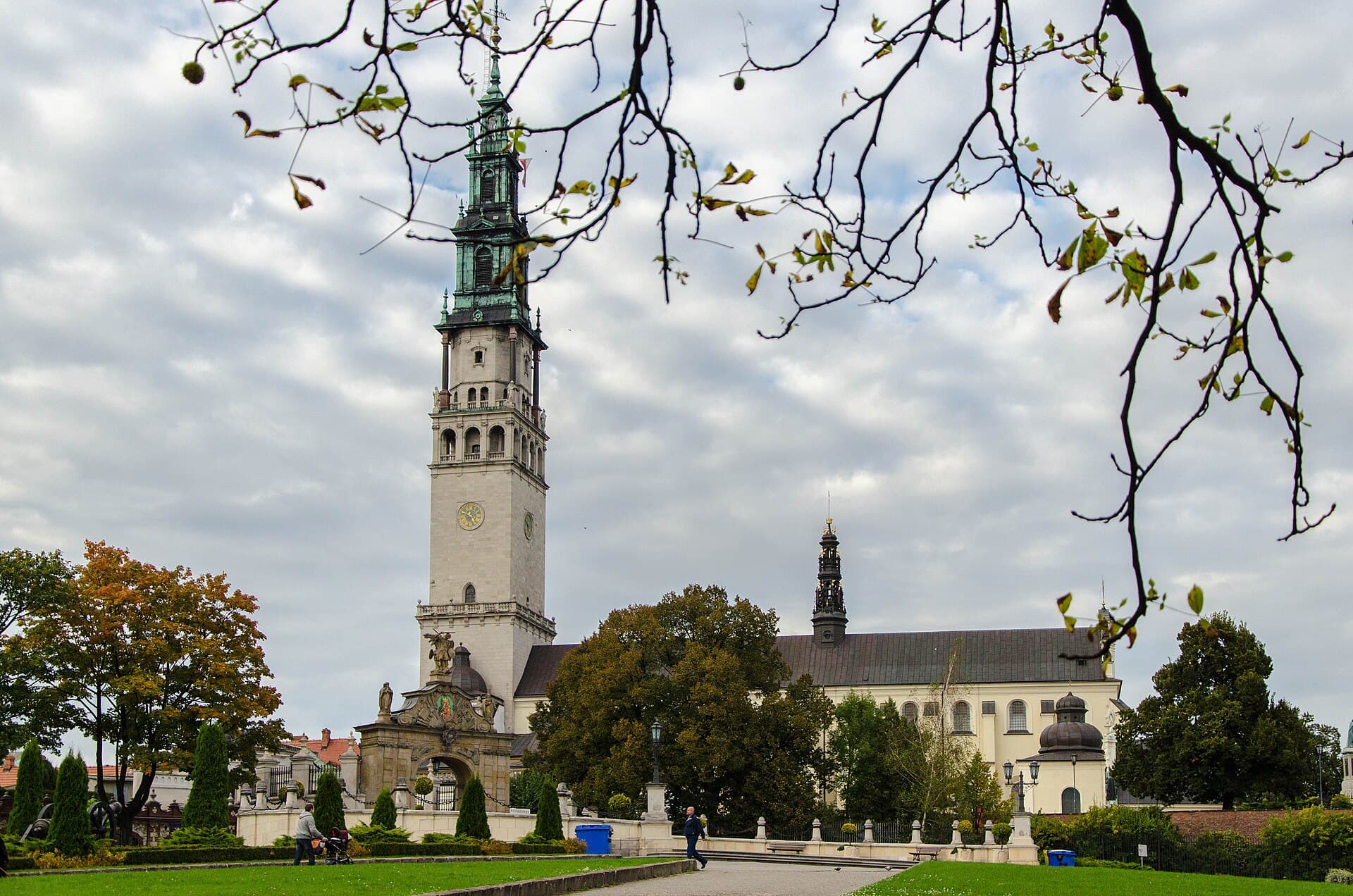
The Jasna Góra Monastery stands as the undeniable heart of Częstochowa, drawing millions of visitors each year to witness the revered Black Madonna. Within the monastery complex, explore the Basilica of the Holy Cross and the Nativity of Mary, the Treasury, the Jasna Góra Tower, and the Knights' Room. The 106-meter bell tower offers sweeping views of the city and surrounding landscape.
Beyond the monastery, wander along Aleja Najświętszej Maryi Panny, the city's main avenue, lined with cafes, restaurants, and shops. This avenue also features the City Hall and various Catholic churches. For a glimpse into local stories and culture, visit the Częstochowa Museum, housed in the neoclassical town hall, which displays the city's past and works by local artists. The Museum of Match Production, located in a former factory, offers a distinctive look at how matches were once made. Another singular attraction is the Museum of Coins and Medals Commemorating Pope John Paul II, which houses a vast collection of memorabilia related to his pontificate.
For those interested in the region's industrial heritage, the Museum of Iron Ore Mining provides insight into Częstochowa's long history as a mining center. The Archaeological Reserve of Lusatian Culture offers a journey into ancient times. Art enthusiasts might appreciate the Municipal Art Gallery and other private galleries along the Avenue of the Blessed Virgin Mary. For a distinctive family-friendly experience, consider the Miniature Park of Sacral Monuments.
Częstochowa experiences a humid continental climate with four distinct seasons. Summers, from June to August, are warm and comfortable, with average temperatures around 19-20°C and highs reaching 24-25°C, making it ideal for sightseeing and outdoor activities. July is typically the warmest month, with an average high of 23-25°C. Spring (March-May) and autumn (September-November) offer milder weather, with temperatures ranging from 9-15°C. Winters (December-February) are cold, with temperatures often dropping below freezing, especially in January, the coldest month, with an average low of -2°C and high of 2-3°C. The best time to visit Częstochowa for warm-weather activities is from mid-June to late August. Pilgrimage season often sees large crowds, particularly between June and August, and around the Feast of the Assumption (August 15th) and the Feast of Our Lady of Częstochowa (August 26th).
Reaching Częstochowa is straightforward, with the closest major international airport being Katowice International Airport (KTW), about 38 km away. Kraków John Paul II International Airport (KRK) is another option, located approximately 120 km away. From these airports, you can reach Częstochowa by taxi or bus.
Within the city, public transportation is well-developed, with buses and trams connecting key areas. Tickets can be purchased at kiosks or machines at stops. Taxis and ride-hailing services like Uber are also available. The city center and many attractions are walkable, especially the 15-minute walk from the main train station to Jasna Góra Monastery.
The local currency is the Polish złoty (PLN), and while card payments are widely accepted in cities, having some cash is advisable for smaller towns or villages. Polish is the official language, but English is often spoken in tourist areas. When interacting with locals, a handshake is customary, and respectful behavior is expected in public places, particularly at the Jasna Góra Monastery. Learning a few basic Polish phrases will be appreciated.
- What is Częstochowa most famous for?
- Częstochowa is most famous for the Jasna Góra Monastery, which houses the Black Madonna of Częstochowa, a revered icon of the Virgin Mary. It is one of the most important pilgrimage sites in the world.
- How far is Częstochowa from major airports?
- The closest major international airport to Częstochowa is Katowice International Airport (KTW), approximately 38 km away. Kraków John Paul II International Airport (KRK) is about 120 km away.
- What is the best way to get around Częstochowa?
- Częstochowa has a well-structured public transportation system of buses and trams. Many central attractions are also accessible on foot, and taxis and ride-hailing services are available.
- What is the local currency in Częstochowa?
- The national currency in Częstochowa, and all of Poland, is the Polish złoty (PLN).
- What are some local etiquette tips for visitors?
- When meeting people, a handshake is customary. In public places, especially religious sites like Jasna Góra, respectful and quiet behavior is expected. Asking permission before photographing locals is also appreciated.
- What kind of climate does Częstochowa have?
- Częstochowa has a humid continental climate with warm summers, cold winters, and transitional spring and autumn periods. The warmest months are typically July and August.