The Crypts of Hathor Temple
Deep beneath the main temple, reliefs depict a curious image that has sparked centuries of debate.
Full story unlocks in the tour
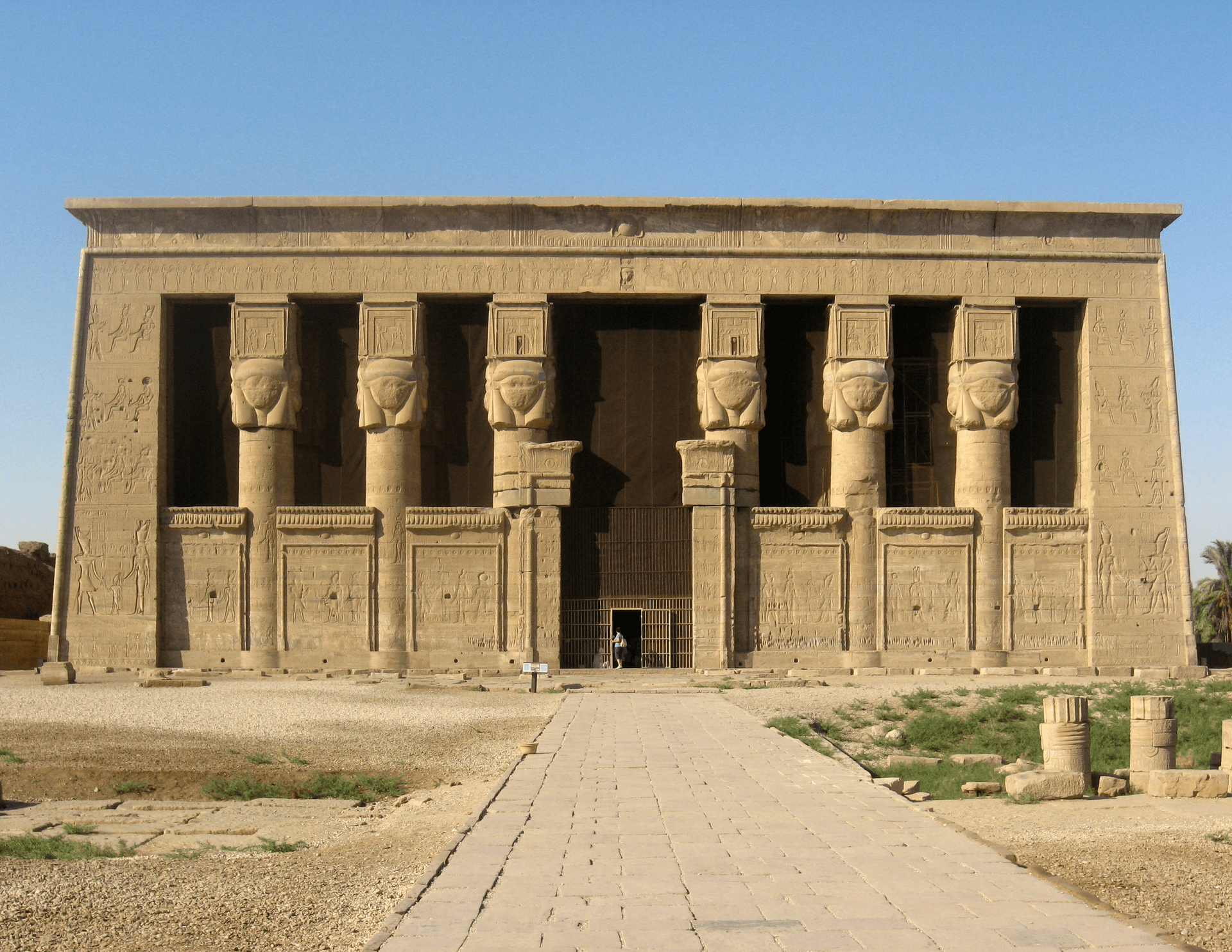 Ijanderson977 / Public domain, via Wikimedia Commons
Self-guided audio walking tour of Dendera — GPS route, offline playback, story-driven narration in 32 languages.
“Where ancient cosmology meets diligent preservation.”
Not the postcards. The stories even locals don't know — whispered in your ear, right where they happened.
Deep beneath the main temple, reliefs depict a curious image that has sparked centuries of debate.
Look up in a specific chapel, and you'll see a celestial map that profoundly influenced early astronomy.
On the outer wall of the main temple, a celebrated queen and her son are immortalized, a testament to a pivotal moment in history.
Discover every secret of Dendera
Every address, every reveal in full — in your ear, right where it happened.
You pick your stops. You walk. The voice reveals what the others miss.


Your self-guided audio tour of Dendera is ready — pick your landmarks, choose your language, and start the moment you arrive.
BuyLume has a built-in augmented-reality guide. Hold your phone up and its camera shows the street ahead of you, with a glowing arrow laid over the real view that always points to your next stop — no map to puzzle over, no wrong turns. Like everything in Lume, it works fully offline.
The Dendera Temple Complex, situated approximately 60 kilometers north of Luxor on the west bank of the Nile, stands as one of Egypt's most remarkably preserved ancient sites. Unlike many other temples that have yielded to the ravages of time, Dendera retains much of its original color and intricate detail, offering a vivid glimpse into ancient Egyptian religious practices and artistic mastery. The complex spans approximately 40,000 square meters and is encircled by a substantial mudbrick wall.
At its heart lies the splendid Temple of Hathor, the primary structure and focal point of the complex. Dedicated to Hathor, the goddess of love, joy, music, healing, and motherhood, the temple drew pilgrims from across the Mediterranean seeking divine intervention and cures. Its exceptional state of preservation, particularly its vivid ceilings and detailed reliefs, makes it a unique and immersive experience, often considered a highlight even among Egypt's more famous archaeological sites.
The sacred ground of Dendera has seen continuous religious activity for millennia, with evidence of structures dating back to the Old Kingdom, around 2250 BCE, under the reign of Pepi I. Remnants of an Eighteenth Dynasty temple (circa 1500 BCE) also exist. However, the impressive structures visible today primarily reflect the Ptolemaic and Roman periods, a testament to a long tradition of worship and construction.
The construction of the current Temple of Hathor began in 54 BCE, during the late Ptolemaic period, under Ptolemy XII Auletes, the father of Cleopatra VII. His daughter, Cleopatra VII, continued the construction after his death, and a celebrated relief on the temple's outer southern wall depicts her and her son, Caesarion, making offerings. This imagery underscores the Ptolemaic rulers' efforts to maintain legitimacy by participating in traditional Egyptian religious practices, even as Greek culture was introduced into Egypt.
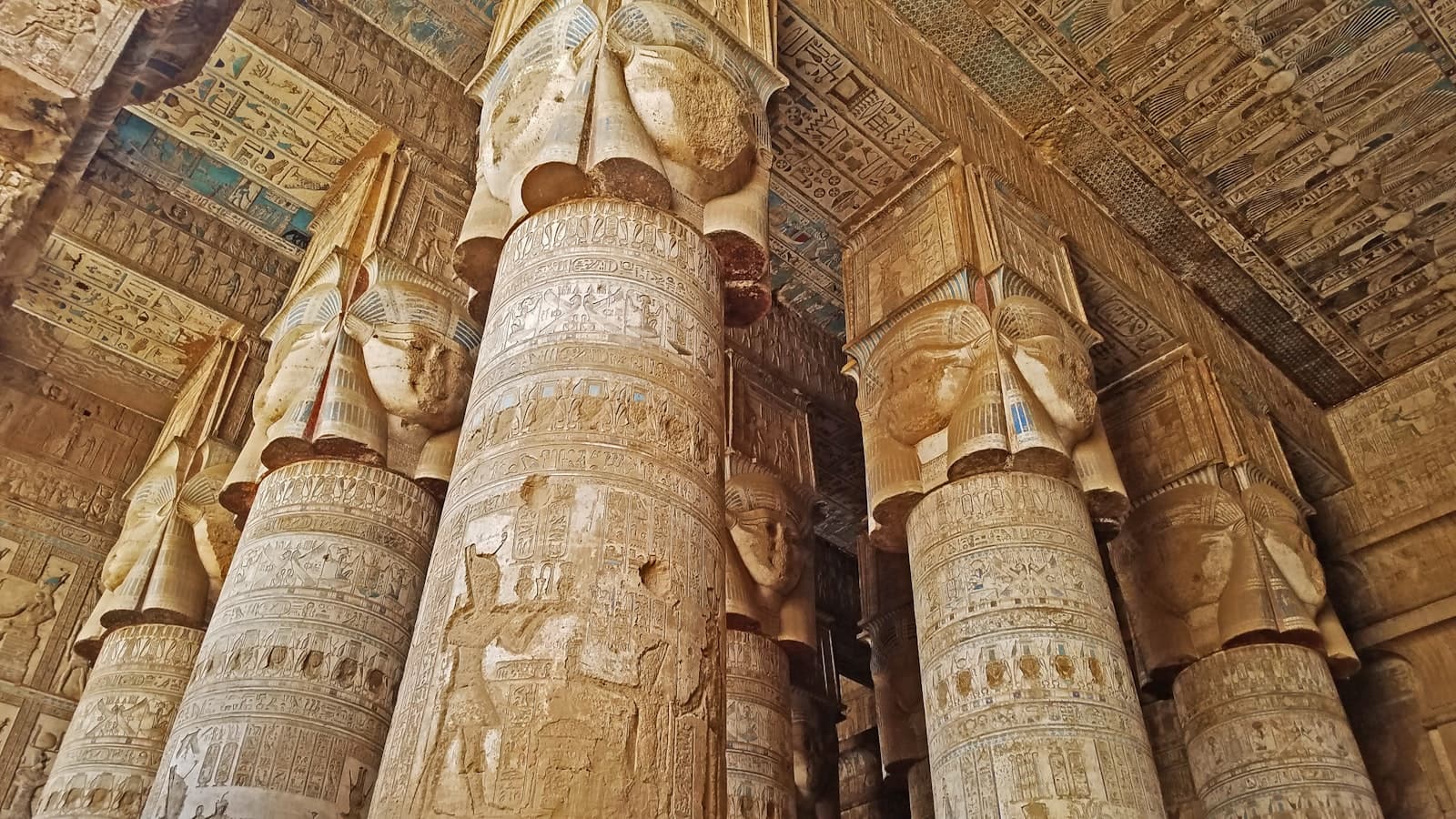
Roman emperors further contributed to the temple's decoration and completion. The expansive hypostyle hall, for instance, was built during the Roman period under Tiberius, and its columns are topped with four-faced Hathor capitals. Roman additions also include a large wall surrounding the complex and chapels dedicated to both Egyptian and Roman deities, showcasing a blend of architectural styles and cultural exchange. Emperors like Marcus Aurelius, Trajan, Domitian, and Nero are depicted in relief carvings, demonstrating their integration into Egyptian religious traditions.
Beyond its religious significance, Dendera also served as an important healing center. The complex included facilities that modern archaeologists describe as an ancient sanatorium, where sick pilgrims sought cures from Hathor's divine power. Sacred waters from underground springs, believed to possess healing properties, were used in conjunction with religious rituals and practical medical care.
The Dendera Temple Complex offers a wealth of details to explore. The main attraction is the Temple of Hathor, renowned for its exceptional preservation and vivid colors.
Enter through the grand gateway, built by Roman Emperors Domitian and Trajan, and step into the Great Hypostyle Hall. Here, 24 massive columns, each approximately 15 meters tall, are crowned with Hathor-headed capitals, depicting the goddess's face on all four sides. The ceiling above is a masterpiece of astronomical art, adorned with intricate paintings of the sky goddess Nut, celestial scenes, constellations, and the sun boat, with colors that have endured for over two millennia.
Ascend to the Roof Sanctuary via a processional staircase. The stairs themselves are decorated with scenes of priests and rituals, making the ascent part of the experience. On the roof, you'll find open chapels used for New Year and solar rituals, and the Chapel of Osiris, which once housed the famous Dendera Zodiac (now a replica). The rooftop also offers expansive views of the surrounding landscape.
Beneath the main temple, a network of crypts served to store sacred objects and religious artifacts. These narrow, subterranean chambers feature unique reliefs, including the debated 'Dendera Light'.
Other notable structures within the complex include the Sacred Lake, used for ritual purification, and two Mammisis (birth houses) celebrating divine births. You can also see the remains of an ancient sanatorium and a 5th-century AD Coptic Christian basilica.
The ideal time to visit the Dendera Temple Complex is during the cooler months, from October to April. During this period, temperatures in Upper Egypt are more comfortable for exploring the expansive site.
Visiting in the early morning or late afternoon is recommended. The softer light during these times is not only better for photography but also enhances the vivid colors of the temple's interior reliefs and ceilings. Early mornings also typically mean fewer visitors, allowing for a more serene and immersive experience.
The Dendera Temple Complex is located approximately 60-70 kilometers north of Luxor, making it a popular day trip from the city. Transportation options typically include private transport or guided tours, which can be arranged from Luxor. Independent travel by taxi is possible, but arranging through a qualified tour guide is often recommended due to government permission requirements for the road.
As of 2025, general admission is approximately 200 EGP, which includes access to the main temple, crypts, and rooftop. Guided tours are available on-site or can be pre-arranged. Remember to bring a flashlight to fully appreciate the detailed carvings in the crypts. The climate in Egypt can be hot and dry, so staying hydrated by drinking plenty of water is essential. Comfortable walking shoes are also advisable for exploring the extensive complex. Photography is generally permitted, though specific restrictions may apply in certain areas.
Dendera in Korean, in Chinese or in Hebrew — and 29 more languages, every stop narrated by a native voice. The widest language range of any self-guided audio tour.
Available in: