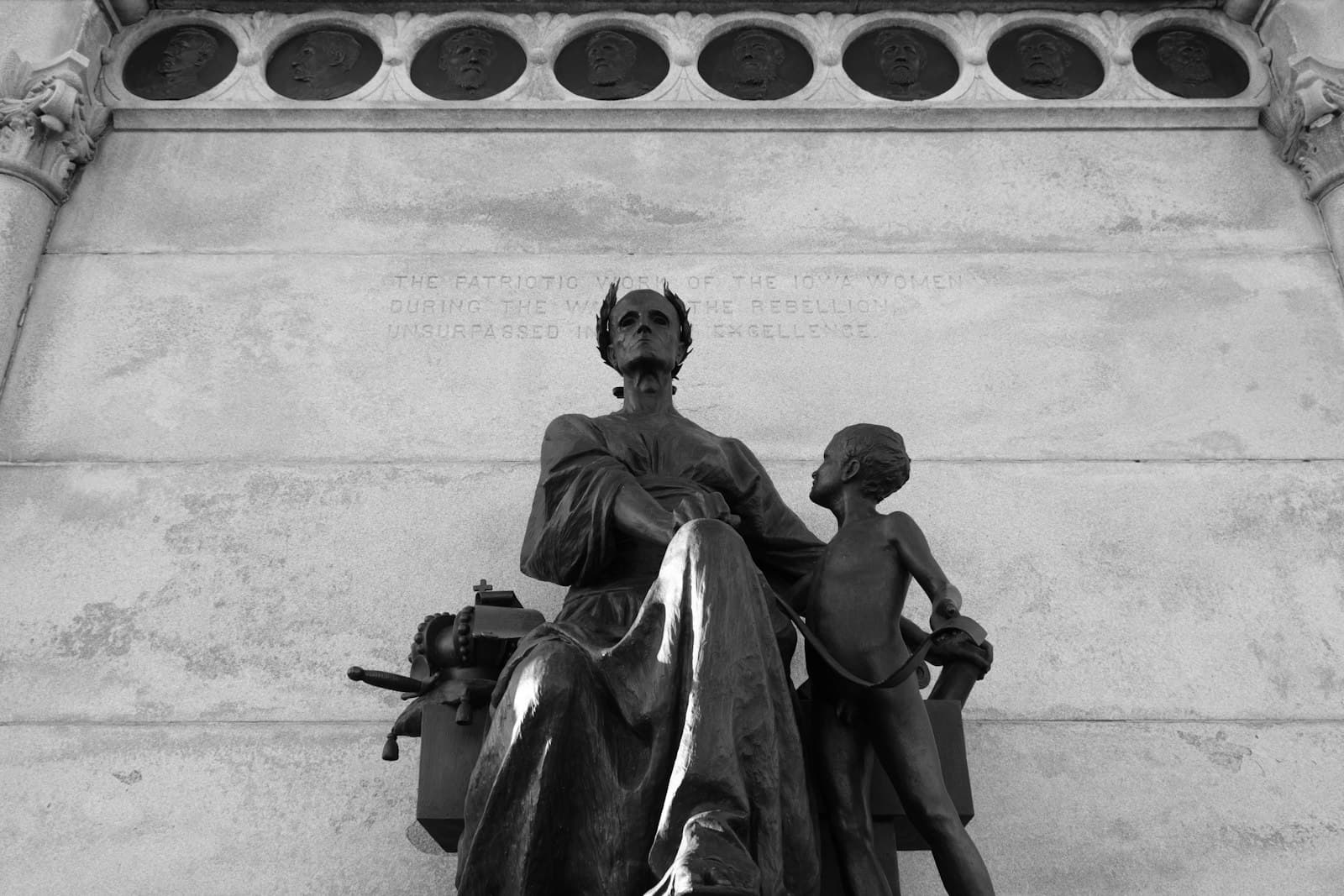
Des MoinesTony Webster from Minneapolis, Minnesota, United States / cc by 2.0, via Wikimedia Commons
US

Des Moines

Self-guided audio walking tour of Des Moines — GPS route, offline playback, story-driven narration in 32 languages.

Beyond the gilded dome, a city where art thrives and history flows through elevated walkways.

The secrets of Des Moines

Des Moines, as no one tells it.

Not the postcards. The stories even locals don't know — whispered in your ear, right where they happened.

3 secrets below. Many more wait inside the tour.
John and Mary Pappajohn Sculpture Park

Before becoming a celebrated public art space, some of the park's most striking sculptures began in a surprisingly personal setting.

Full story unlocks in the tour
Iowa State Capitol Building

The Capitol's brilliant golden dome is more than just a spectacle; it holds a secret about its enduring luster.

Full story unlocks in the tour
Des Moines Skywalk System

Des Moines' extensive skywalks offer a climate-controlled way to traverse downtown, their distinctive design born from a specific lesson learned elsewhere.

Full story unlocks in the tour
The full tour

Discover every secret of Des Moines

Every address, every reveal in full — in your ear, right where it happened.

Get the key to Des Moines

You pick your stops. You walk. The voice reveals what the others miss.

Choose your time

How long do you have in Des Moines?

Your self-guided audio tour of Des Moines is ready — pick your landmarks, choose your language, and start the moment you arrive.

Buy
About Des Moines

The story of Des Moines

Des Moines, the capital and most populous city in Iowa, presents a landscape where Midwestern warmth meets an unexpected urban sophistication. Situated at the convergence of the Des Moines and Raccoon Rivers, the city's origins trace back to a military fort established in 1843. Today, it stands as a central point for insurance and financial services, earning it the moniker 'Hartford of the West.' Yet, beyond its commercial prowess, Des Moines cultivates a lively arts and culture landscape, expansive green spaces, and a welcoming atmosphere that often surprises first-time visitors.

The city's downtown area has undergone significant renewal, transforming into a dynamic district filled with public art, diverse dining establishments, and a distinctive network of elevated walkways. From its recognizable gold-domed State Capitol to the internationally recognized Pappajohn Sculpture Park, Des Moines offers a fusion of historical depth and contemporary appeal. It is a city that invites exploration, whether you are walking along the Principal Riverwalk, discovering local shops in the Historic East Village, or delving into its storied past.

History

From Fort to Flourishing Capital

Des Moines' narrative begins in May 1843 with the construction of Fort Des Moines at the junction of the Des Moines and Raccoon Rivers. Captain James Allen initially desired to name it Fort Raccoon, but the U.S. War Department favored Fort Des Moines. The fort's primary objective was to oversee the Sauk and Meskwaki peoples, who had been relocated to the area. Archaeological discoveries in the downtown area suggest human presence for at least 7,000 years, with evidence of late prehistoric villages dating back to 1300 AD.

The fort was vacated in 1846 after the Sauk and Meskwaki were moved to Indian Territory. Settlers then moved into the abandoned fort, and the town began to expand. Des Moines was incorporated as a city on September 22, 1851, and its name was shortened from 'Fort Des Moines' to 'Des Moines' in 1857, the same year it became the second state capital, succeeding Iowa City. Growth was slow during the Civil War, but the city experienced a significant expansion after a railroad link was completed in 1866. The Des Moines Coal Company was organized in 1864, initiating a period of coal mining in the region until resources were largely depleted around 1908.

At the turn of the 20th century, Des Moines undertook a 'City Beautiful' project, constructing grand Beaux Arts public buildings along the riverfront, many of which remain standing today. The city faced post-industrial decline into the 1980s but has since undergone a significant transformation, evolving into a modern metropolitan area with a focus on finance, insurance, and a burgeoning cultural environment. This rebirth included the development of Western Gateway Park and the establishment of the Pappajohn Sculpture Park in 2009, which played a crucial role in renewing downtown.

What to see

Begin your exploration at the Iowa State Capitol, a magnificent 19th-century architectural achievement crowned with a 23-karat gold dome visible for miles. Free guided tours offer insight into its history and impressive interiors, which feature various types of marble, artwork, and carvings.

Just a short distance away, the John and Mary Pappajohn Sculpture Park is a 4.4-acre outdoor gallery presenting over 30 sculptures by celebrated international artists like Jaume Plensa and Ai Weiwei. It is considered one of the most significant collections of outdoor sculptures in the United States and is free to visit. An audio tour is available via phone to learn about the artworks.

For art enthusiasts, the Des Moines Art Center is a rewarding stop, housing an extensive collection of modern and contemporary art within three architecturally significant buildings designed by Eliel Saarinen, I.M. Pei, and Richard Meier. Admission is free.

Explore the Historic East Village, a lively neighborhood situated between the State Capitol and the Des Moines River. It is home to over 90 locally owned shops, restaurants, and bars, offering a distinct character and a pleasant walking experience.

Do not overlook the Principal Riverwalk, a network of trails and green spaces along the Des Moines River, providing scenic views and recreational opportunities. The Women of Achievement Bridge, part of the Riverwalk, features a glass-sectioned walkway over the river.

When to visit

The ideal time to visit Des Moines is during the late spring and early autumn, particularly from May to September. These months offer comfortable temperatures, abundant sunshine, and lower humidity, creating perfect conditions for exploring outdoor attractions. While summer (June to mid-September) is also popular with pleasant warmth and sunny skies, it can bring more people and higher prices, along with occasional high temperatures and unpredictable rain showers. September is especially noted for its sunshine and cooling weather with changing colors. Winter, from December to February, is cold with freezing temperatures and snow, but offers opportunities for winter sports.

Practical

Des Moines International Airport (DSM) is located about 5 miles from downtown. The quickest way to reach downtown is by taxi, taking around 10 minutes and costing approximately $17. The DART (Des Moines Area Regional Transit Authority) Route 8 bus offers a more economical option, taking about 30 minutes and costing $1.75 for a one-way ticket, running Monday through Friday.

Once downtown, the DART public transit system is the largest in Iowa, serving Des Moines and surrounding communities. A free D-Line Downtown Shuttle operates every 10 minutes along Grand Avenue and Locust Street, connecting the East Village, downtown, and the Western Gateway. Des Moines also maintains an extensive skywalk system, linking approximately 40 city blocks across 4.2 miles. This climate-controlled network allows pedestrian access between many downtown buildings, even after hours.

Good to know
What is Des Moines recognized for?
Des Moines is widely recognized as a significant center for the insurance industry, earning it the nickname 'Hartford of the West.' It is also known for its impressive State Capitol building with a gilded dome, and a flourishing arts environment, particularly the John and Mary Pappajohn Sculpture Park.
Is Des Moines easy to walk around?
Downtown Des Moines is quite walkable, especially with its extensive climate-controlled skywalk system that connects many buildings and attractions. The Historic East Village is also very pedestrian-friendly with numerous shops and eateries.
What is the John and Mary Pappajohn Sculpture Park?
The John and Mary Pappajohn Sculpture Park is a 4.4-acre public park in downtown Des Moines featuring over 30 large-scale sculptures by world-renowned artists. It is free to visit and administered by the Des Moines Art Center.
How do I navigate Des Moines without a car?
The Des Moines Area Regional Transit Authority (DART) provides bus service throughout the city and surrounding areas. There is also a free D-Line Downtown Shuttle, and the skywalk system offers a convenient way to traverse downtown on foot.
What is the Des Moines Art Center?
The Des Moines Art Center is a museum with a significant collection of modern and contemporary art. It is housed in three distinct buildings designed by renowned architects Eliel Saarinen, I.M. Pei, and Richard Meier, and offers free admission.
Is the Iowa State Capitol open to visitors?
Yes, the Iowa State Capitol building is open to visitors. Guided tours are available Monday through Saturday, offering a chance to see its golden dome, legislative chambers, and historical exhibits.
On the map
Des Moines
From€9.90
No booking · activate anytime · 12h to walk it
Get the key to Des Moines