St. George's Minster
Examine a stained-glass window in St. George's Minster, and you will find an unexpected design woven into the intricate patterns.
Full story unlocks in the tour
 Mylius / CC BY-SA 3.0, via Wikimedia Commons
Self-guided audio walking tour of Dinkelsbühl — GPS route, offline playback, story-driven narration in 32 languages.
“Walk through ancient gates into a medieval story made real.”
Not the postcards. The stories even locals don't know — whispered in your ear, right where they happened.
Examine a stained-glass window in St. George's Minster, and you will find an unexpected design woven into the intricate patterns.
Behind the charming facade of one of Dinkelsbühl's medieval gates lies a darker history, a chilling reminder of past fears and beliefs.
Dinkelsbühl's most beloved festival, the Kinderzeche, celebrates a legendary act of bravery by the town's children, but the full story reveals a surprising twist to this tale of salvation.
Discover every secret of Dinkelsbühl
Every address, every reveal in full — in your ear, right where it happened.
You pick your stops. You walk. The voice reveals what the others miss.

Lume has a built-in augmented-reality guide. Hold your phone up and its camera shows the street ahead of you, with a glowing arrow laid over the real view that always points to your next stop — no map to puzzle over, no wrong turns. Like everything in Lume, it works fully offline.
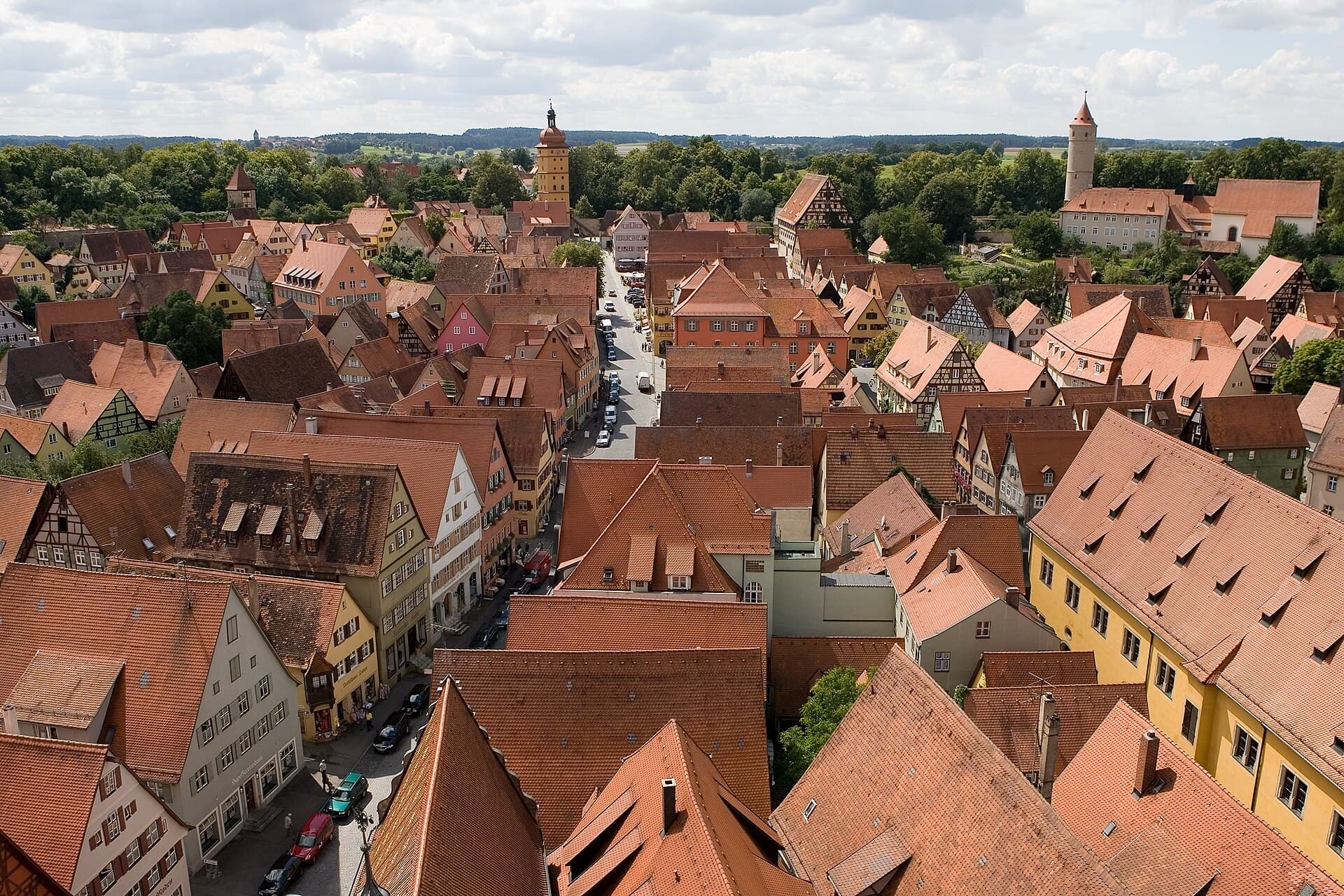
Dinkelsbühl, a former free imperial city in Bavaria, Germany, invites you to step back in time. It is one of only three remaining walled medieval towns in Germany, alongside Rothenburg ob der Tauber and Nördlingen, and stands as a remarkably preserved example of a 15th to early 17th-century German town. Its intact medieval walls, complete with towers and gateways, encircle a historic center where colorful half-timbered houses line narrow streets paved with stone. This authentic atmosphere has earned Dinkelsbühl recognition as one of Europe's most beautiful towns, offering a slower pace and a sense of entering a lived story rather than a reconstructed past.
Situated on the northern part of Germany's Romantic Road, Dinkelsbühl offers a captivating blend of history, culture, and picturesque scenery. The town's enduring appeal is a testament to its fortunate escape from widespread destruction during both the Thirty Years' War and the World Wars, leaving its architectural heritage largely untouched. Visitors can explore at their own pace, discovering historic landmarks, engaging museums, and a calendar of traditional festivals that bring its past to life.
Dinkelsbühl's origins can be traced back to the 8th century, likely as a Frankish royal court and a fortified settlement protecting a ford across the Wörnitz River and important trade routes. The town was first officially mentioned as 'burgus Tinkelspuhel' in 1188. By the 13th century, Dinkelsbühl had gained significant privileges and became a Free Imperial City in 1273. Its strategic location at the junction of major trade routes, including the Germany-Italy route and a path from the Rhine to Eastern Europe, fueled its prosperity, particularly in the 14th and 15th centuries, largely due to its distinctive woolen cloth manufacturing.
The town's impressive fortifications, including its walls, ramparts, and moats, were constructed between 1380 and 1440 and remain remarkably preserved today. During the Protestant Reformation around 1534, the majority of Dinkelsbühl's population became Protestant. Following the Peace of Westphalia in 1649, Dinkelsbühl became one of only a few bi-confessional Imperial Cities, where Protestants and Catholics shared equal rights and governance—a rare arrangement that persisted until its annexation by the Kingdom of Bavaria in 1802.
One of the most defining periods in Dinkelsbühl's history was the Thirty Years' War (1618-1648). The town endured eight sieges, finally falling to Swedish forces in 1632. This event is famously commemorated by the annual Kinderzeche festival. Fortunately, Dinkelsbühl survived both World Wars largely unscathed, preserving its medieval townscape. In 1826, Bavarian King Ludwig I issued a decree prohibiting the destruction of the town walls and towers, ensuring the preservation of its historic character. This foresight proved invaluable when artists from Munich and Berlin "discovered" the picturesque town in 1888, cementing its romantic appeal and paving the way for its enduring tourism.
A stroll through Dinkelsbühl's old town reveals a collection of medieval architecture. The imposing St. George's Minster, built in the late 15th-century Gothic style, is considered one of Germany's finest hall churches. Visitors can climb its 62-meter tower for expansive views over the town and surrounding Franconian countryside. The Deutsches Haus, a magnificent example of German Renaissance wooden architecture, with parts dating back to the 15th century and a facade from 1593/94, is another highlight on the Weinmarkt. It was the ancestral home of the Counts of Drechsel-Deufstetten and now operates as a hotel and restaurant.
Walk the medieval town walls, which are almost completely preserved and offer a unique perspective on the town's defensive past. Explore the various gates, such as the Wörnitz Gate, Rothenburger Gate, Segringer Gate, and Nördlinger Gate. The Museum of History, housed in the 14th-century 'Steinerne Haus' (Stone House), showcases historical discoveries and reconstructions of ancient houses. For a different kind of experience, the Museum of the 3rd Dimension in the former city mill features optical illusions and holographs. Do not overlook the Kinderzech'-Zeughaus (Kinderzeche Armoury), where costumes and props from the famous festival are displayed.
The best time to visit Dinkelsbühl for warm-weather activities is from late June to late August, when average daily high temperatures are above 66°F (19°C) and skies are clearest. July is the warmest month, with an average high of 72°F (22°C). This period also coincides with the renowned Kinderzeche festival in July, a ten-day celebration around the third Monday of the month. Spring offers pleasant weather with blossoming vegetation, while autumn provides colorful foliage for walks along the city walls. In winter, the town transforms into a quiet, fairytale landscape, with a charming Christmas market in the Spitalhof.
Dinkelsbühl is easily accessible by car, with approximately a two-hour drive from both Munich and Frankfurt, and ample parking available just outside the city walls. While Dinkelsbühl does not have its own train station, regular bus services connect to nearby stations in Crailsheim (22 km away) or Ansbach (42 km away). The closest major airports are Nuremberg, Stuttgart, Memmingen, and Munich. When exploring the town, comfortable shoes are recommended for navigating the stone-paved streets. The currency used is the Euro, and the official language is German, though many locals in tourist-facing roles speak English. Guided tours, including evening tours with a Night Watchman, are available from May through October, and on weekends during the colder months.
Dinkelsbühl in Korean, in Chinese or in Hebrew — and 29 more languages, every stop narrated by a native voice. The widest language range of any self-guided audio tour.
Available in: