Ajim
Ce paisible village de pêcheurs a joué un rôle essentiel dans une galaxie lointaine, très lointaine.
L'histoire complète se débloque dans le tour
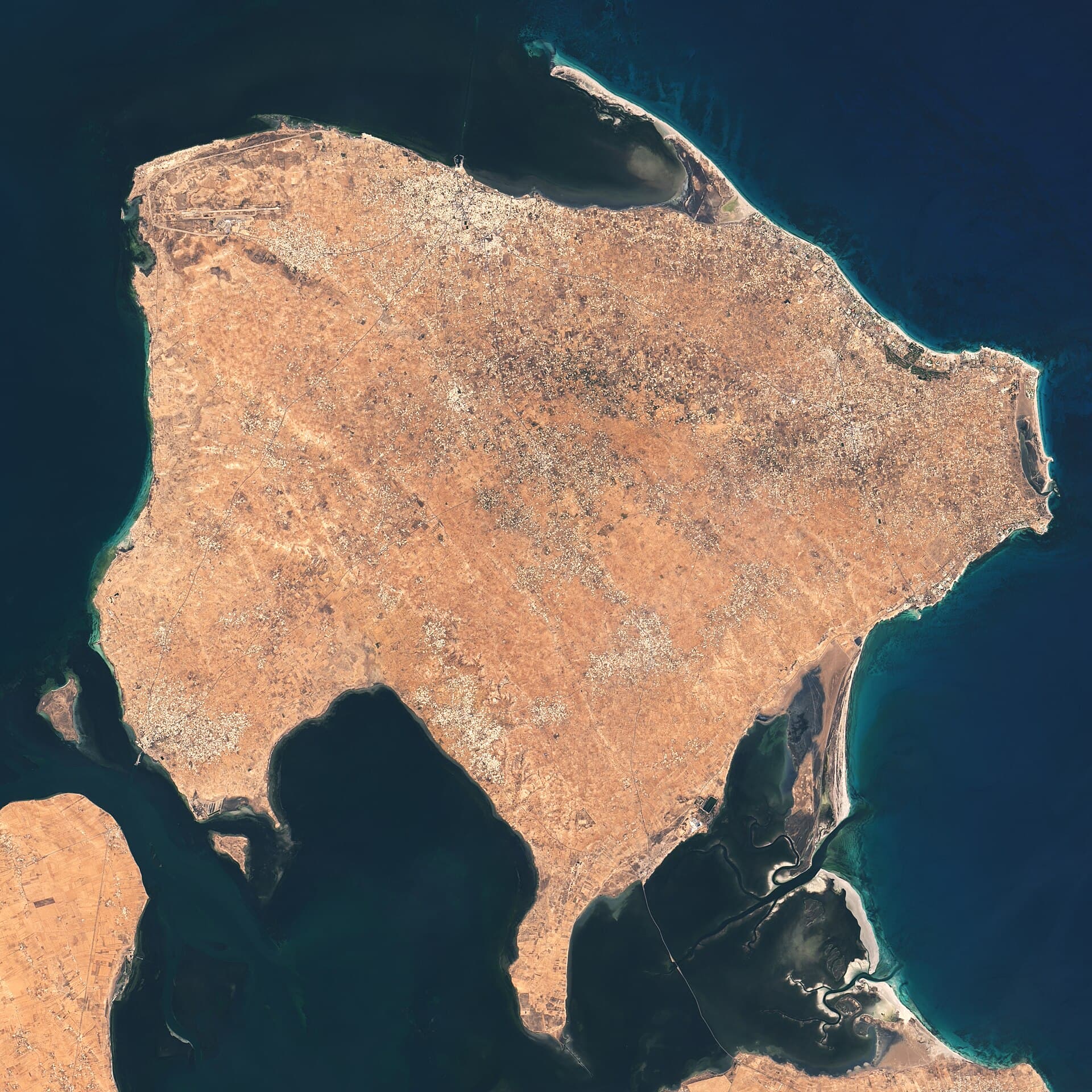 NASA Earth Observatory images by Lauren Dauphin, using Landsat data from the U.S. Geological Survey. Story by Adam Voiland. / Public domain, via Wikimedia Commons
Visite audio autoguidée de Djerba — parcours GPS à pied, lecture hors ligne, narration en 32 langues.
“Là où les mythes anciens persistent sur des rivages baignés de soleil.”
Pas les cartes postales. Les histoires que même les habitants ignorent — soufflées à l'oreille, là où elles se sont passées.
Ce paisible village de pêcheurs a joué un rôle essentiel dans une galaxie lointaine, très lointaine.
Cette synagogue vénérée, la plus ancienne d'Afrique, abriterait une relique sacrée d'un ancien temple détruit.
This revered synagogue, the oldest in Africa, is said to house a sacred relic from a destroyed ancient temple.
Découvrez tous les secrets de Djerba
Chaque adresse, chaque révélation en entier — dans ton oreille, là où elle s'est passée.
Tu choisis tes lieux. Tu marches. La voix te révèle ce que les autres ignorent.
Lume intègre un guide en réalité augmentée. Levez votre téléphone : sa caméra montre la rue devant vous, avec une flèche lumineuse posée sur l'image réelle qui pointe toujours vers votre prochain arrêt — aucune carte à déchiffrer, aucun mauvais virage. Comme tout dans Lume, ça fonctionne entièrement hors-ligne.
Djerba, une île au large de la côte sud de la Tunisie, émerge de la Méditerranée comme un mirage, un paysage de villages blanchis à la chaux et d'anciennes oliveraies. Connue sous le nom d'« Île de l'Oubli » dans l'Odyssée d'Homère, où les séduisants mangeurs de lotus ont failli empêcher les hommes d'Ulysse de poursuivre leur voyage, Djerba continue d'enchanter les voyageurs avec son rythme serein et son charme intemporel. C'est la plus grande île d'Afrique du Nord, une étendue plate de 514 kilomètres carrés, reliée au continent par une chaussée de 6 kilomètres construite sur des fondations romaines.
Au-delà de sa réputation de vastes plages de sable et d'eaux chaudes de la Méditerranée, Djerba offre un riche entrelacement de cultures – traditions berbères, juives et arabes tissées ensemble au fil des millénaires. L'architecture distinctive de l'île, avec ses maisons cubiques et à dôme, ajoute à son attrait visuel unique. Djerba a été officiellement désignée site du patrimoine mondial de l'UNESCO en 2023, reconnaissant sa longue et singulière histoire.
## Racines Antiques et Légendes Mythiques L'histoire de Djerba s'étend sur plus de 6 000 ans, en faisant un véritable carrefour de cultures. Les Phéniciens furent parmi les premiers à établir des relations commerciales ici au VIIIe siècle av. J.-C. Plus tard, les Romains jetèrent les bases d'un important comptoir commercial appelé Meninx au IIe siècle av. J.-C. L'île était également connue sous le nom de Lytos à l'époque des Grecs anciens.
Selon la mythologie grecque, Djerba est la terre légendaire des mangeurs de lotus, un endroit où l'équipage d'Ulysse, après avoir consommé la fleur de lotus, devint si agréablement enivré qu'il en oublia presque son désir de rentrer chez lui. Une autre légende suggère que la nymphe Calypso retint Ulysse captif sur l'île pendant sept ans. Bien qu'aucun fruit de lotus légendaire ne pousse ici, Djerba a captivé les visiteurs pendant des siècles.
## Un Refuge pour Diverses Communautés Après la conquête musulmane, Djerba devint un sanctuaire pour la secte islamique kharidjite, dont une forme existe toujours sur l'île aujourd'hui. Du XIIe au XVIe siècle, les habitants de Djerba ont fréquemment défendu leur foyer contre de puissants souverains méditerranéens, y compris les Espagnols. L'île abrite également l'une des plus anciennes communautés juives du monde, avec une présence remontant à plus de 2 500 ans. La synagogue de la Ghriba, un important site de pèlerinage, témoigne de cet héritage durable.
## Transformations Modernes Aux XIXe et XXe siècles, Djerba a connu des changements significatifs, de nombreux insulaires migrant pour le commerce dans d'autres villes tunisiennes et islamiques. Sous la domination française, qui commença en 1881, la population locale trouva protection contre les ennemis extérieurs. Après l'indépendance de la Tunisie dans les années 1950, Djerba est devenue une destination touristique de premier plan, attirant des visiteurs du monde entier. L'engagement de l'île à préserver son architecture unique est évident dans l'interdiction des immeubles de grande hauteur, la plupart des hôtels étant construits dans le style traditionnel carré, blanc et à dôme des maisons locales.
La capitale de l'île, Houmt Souk, est un centre urbain pittoresque. Son souk regorge d'artisanat, des vêtements traditionnels et couvertures tissées aux bijoux en or et en argent. Le Musée des Arts et Traditions Populaires de Houmt Souk expose des costumes et bijoux traditionnels, offrant un aperçu de la vie djerbienne. Toujours à Houmt Souk se trouve l'historique Borj el Kebir, une forteresse arabe du XVe siècle.
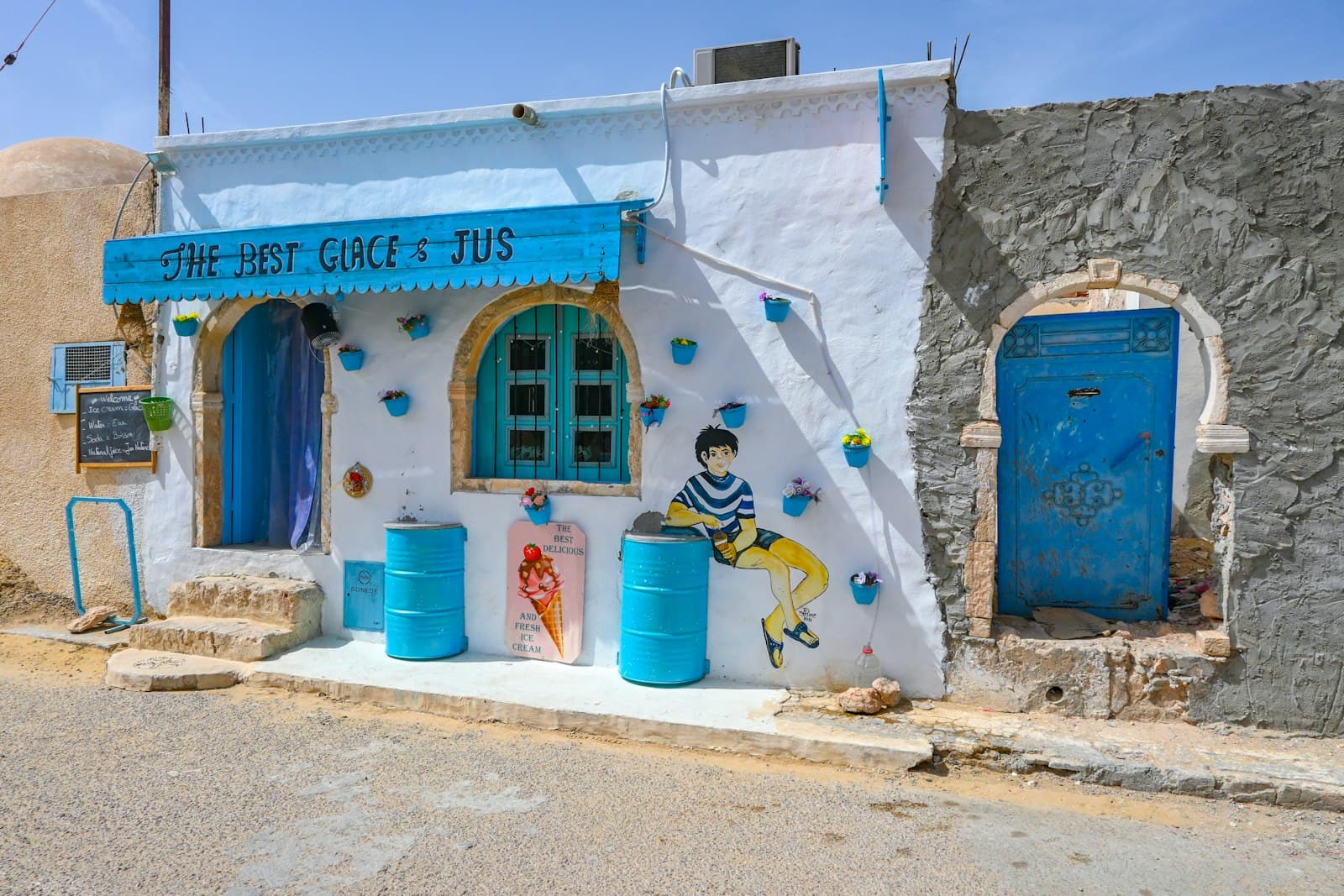
À quelques minutes en voiture de Houmt Souk, le village d'Erriadh abrite Djerbahood, un musée à ciel ouvert où des fresques colorées d'artistes de rue internationaux ornent les bâtiments. Erriadh est également l'endroit où vous trouverez la synagogue de la Ghriba, la plus ancienne synagogue d'Afrique, un site d'une profonde signification historique et religieuse.
Dans le sud de Djerba, la ville de Guellala est réputée pour sa poterie, une tradition qui remonte à l'époque romaine. Le musée ethnographique sur la colline au-dessus de Guellala explore davantage les traditions et coutumes locales. Pour une expérience unique avec la faune, Djerba Explore Park abrite la plus grande ferme de crocodiles d'Afrique du Nord, avec plus de 400 crocodiles. Le parc comprend également le musée Lalla Hadhria, dédié à l'art et à la culture islamiques, et un village djerbien traditionnel reconstitué.
Au-delà des principales villes, envisagez une excursion en bateau à Ras R'mel, souvent appelée l'île aux Flamants roses, une péninsule où vous pourrez observer la nature et, selon la saison, des flamants roses. Pour les fans de Star Wars, le village d'Ajim offre des lieux de tournage reconnaissables de Un nouvel espoir.
Djerba bénéficie de plus de 300 jours d'ensoleillement par an. La meilleure période pour visiter, afin d'équilibrer un temps agréable et moins de foule, est le printemps (mars à mai) ou l'automne (octobre à novembre). Pendant ces saisons, les températures sont chaudes mais pas excessivement élevées, allant de 20°C à 28°C au printemps et de 22°C à 30°C en automne. La mer reste chaude en automne, ce qui la rend idéale pour la baignade. L'été, de juin à septembre, apporte des températures plus chaudes, dépassant souvent les 30°C, et un plus grand nombre de touristes. Les hivers sont doux, avec des températures diurnes entre 15°C et 20°C, offrant une évasion paisible.
L'aéroport international de Djerba-Zarzis (DJE) dessert l'île, situé à environ neuf kilomètres à l'ouest de Houmt Souk. Les taxis sont un mode de transport courant, bien qu'il soit conseillé de négocier les tarifs avant de commencer votre trajet. Louer une voiture est une autre option pour explorer l'île. La monnaie locale est le Dinar tunisien (TND), qui est une monnaie fermée, ce qui signifie que vous ne pouvez ni l'importer ni l'exporter. Vous pouvez échanger les principales devises à votre arrivée à l'aéroport, dans les banques ou les hôtels, et les cartes de crédit sont acceptées dans les grands établissements. L'arabe est la langue officielle, mais le français est largement parlé, et un peu d'anglais est compris dans les zones touristiques. Djerba est considérée comme une destination très sûre pour les touristes, en particulier dans les zones de villégiature établies. Cependant, les précautions générales de voyage, telles que la vigilance dans les zones très fréquentées et le respect des coutumes locales, sont toujours recommandées.
Djerba en coréen, en chinois ou en hébreu — et dans 29 autres langues, chaque étape narrée par une voix native. La plus large gamme de langues de tous les audioguides autoguidés.
Disponible en :