The Roman Theatre
Consider a city of just 5,000 residents constructing a theatre capable of seating 3,500.
Full story unlocks in the tour
 GIRAUD Patrick / CC BY 3.0, via Wikimedia Commons
Self-guided audio walking tour of Dougga — GPS route, offline playback, story-driven narration in 32 languages.
“Where ancient stones recount empires, and time idles on a Tunisian rise.”
Not the postcards. The stories even locals don't know — whispered in your ear, right where they happened.
Consider a city of just 5,000 residents constructing a theatre capable of seating 3,500.
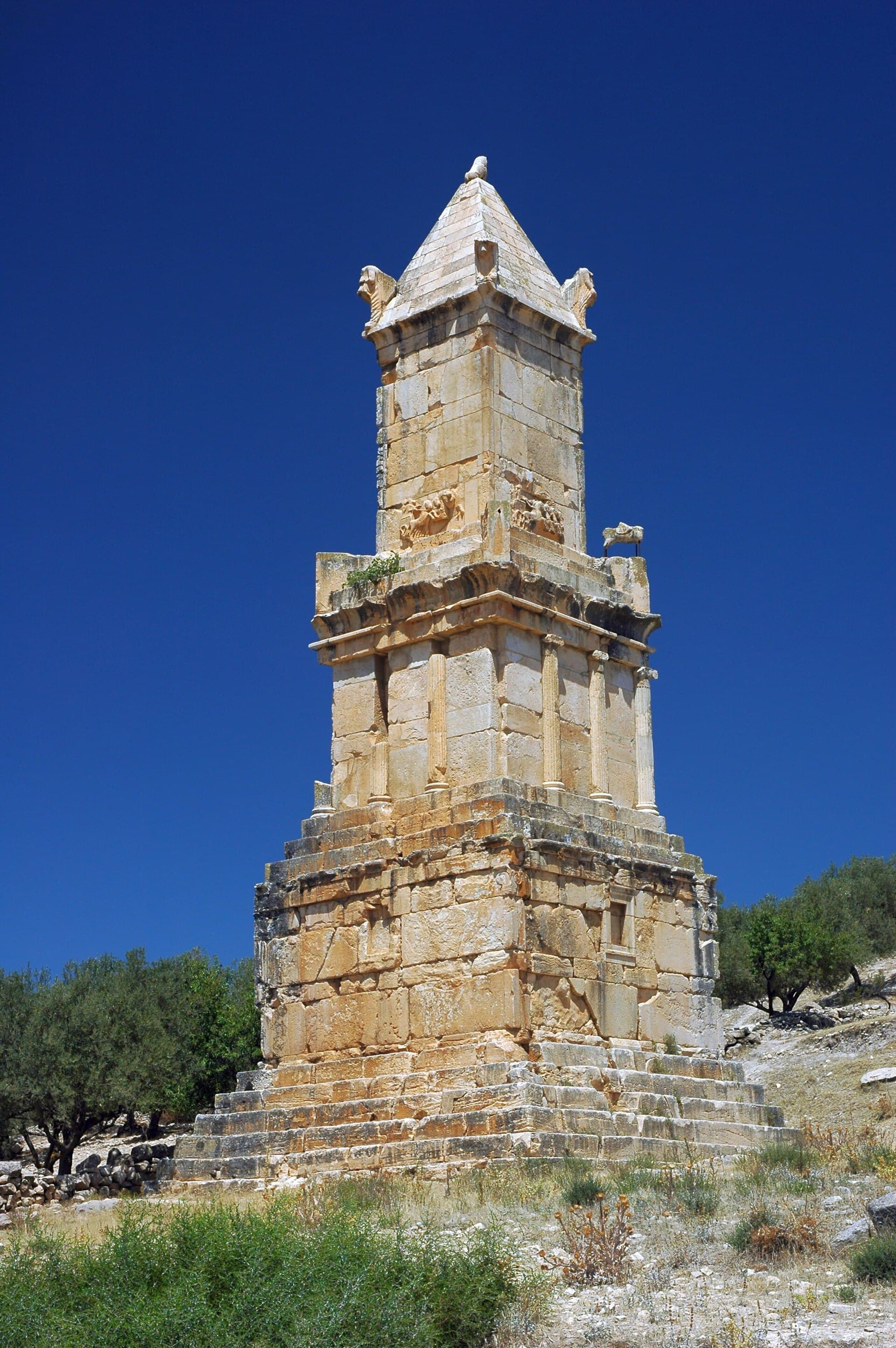
This soaring tomb holds a secret that helped unlock an ancient tongue.
This grand temple, dedicated to Rome's foremost gods, owes its remarkable state to an unforeseen guardian.
Discover every secret of Dougga
Every address, every reveal in full — in your ear, right where it happened.
You pick your stops. You walk. The voice reveals what the others miss.


Your self-guided audio tour of Dougga is ready — pick your landmarks, choose your language, and start the moment you arrive.
BuyLume has a built-in augmented-reality guide. Hold your phone up and its camera shows the street ahead of you, with a glowing arrow laid over the real view that always points to your next stop — no map to puzzle over, no wrong turns. Like everything in Lume, it works fully offline.
Dougga, or Thugga as it was known in antiquity, is an extraordinarily preserved archaeological site in northern Tunisia, recognized by UNESCO as a World Heritage Site in 1997. Spanning 75 hectares, it offers an unparalleled window into the urban planning, architecture, and daily rhythms of bygone civilizations. Unlike many other ancient cities that have been built over or extensively plundered, Dougga's distant hilltop location shielded it from modern encroachment, allowing its structures to endure largely intact.
This ancient settlement reflects a rich layering of Numidian-Berber, Punic, Roman, and Byzantine influences, displaying a unique synthesis of cultures. From its imposing Capitol and a theatre still in use, to public baths and meandering streets, Dougga invites visitors to wander through its stones and envision the lives lived within its walls over seventeen centuries.
Dougga's narrative reaches back to at least the 6th century BC, with evidence of human presence from the Bronze Age, marked by the discovery of dolmens. It began as a well-established outpost of the Numidian Kingdom in the 4th century BC, known as Thugga. The thick stone walls surrounding the lower part of the site are remnants of this early Numidian era. Around the 2nd century BC, authority shifted to the Punic Kingdom.
The Roman Empire arrived in the 1st century AD, but rather than dismantling the existing civilization, they gradually integrated with the established town. For generations, Dougga functioned as two distinct communities: a pagus of Roman settlers and a civitas of Numidians, each with their own governance, coexisting on the same elevation. This blending of cultures over centuries is a defining characteristic of Dougga. The city experienced extensive Romanization, with significant building projects in the 2nd and 3rd centuries AD.
Dougga was elevated to a municipium under Emperor Septimius Severus in 205 AD, and later became a full colonia during the mid-3rd century under Gallienus. During the Byzantine period, the area around the forum was repurposed into a fort, using materials from nearby structures. Even in the Muslim era, Dougga remained inhabited, with evidence of a mosque found at the site. In 1991, the site was designated a national archaeological park, and in 1997, it earned its UNESCO World Heritage status, acknowledged as the "best-preserved Roman small town in North Africa." The final residents were relocated to a new village, New Dougga, in the plain below, securing the ancient site's preservation.
The architectural remains at Dougga reveal this long and layered history. The Libyco-Punic Mausoleum, a striking three-tiered structure, dates back to the 2nd century BC and combines Punic, Egyptian, and Greek styles. The Roman period brought grand public buildings like the Capitol, dedicated to the Capitoline Triad (Jupiter, Juno, and Minerva), built between 166 and 167 AD. The Roman theatre, constructed in 168 or 169 AD, is another testament to Roman engineering and civic pride, capable of seating 3,500 spectators. The city also features two triumphal arches: one for Septimius Severus, erected in 205 AD, and a relatively well-preserved arch for Alexander Severus, dating from 222 to 235 AD. Religious edifices include the Temple of Saturn, built over an earlier Punic sanctuary dedicated to Ba'al Hammon, and the Temple of Juno Caelestis, dedicated to the Roman goddess associated with the Punic Tanit. Beyond these grand monuments, Dougga's infrastructure reveals the practicalities of ancient life, with public baths like the Licinian Baths and the Aïn Doura Baths, as well as an intricate system of cisterns and aqueducts that supplied the city with water. The remains of markets, residential villas like the House of Trifolium, and even communal latrines offer a comprehensive picture of a flourishing ancient town.
Dougga offers a sprawling landscape of ancient ruins, best explored over several hours. Begin at the Roman Theatre, a remarkably intact structure from 168-169 AD that once seated 3,500 people and still hosts performances today. From its upper tiers, take in wide views of the surrounding valley.
Next, head to the Capitol, a grand temple dedicated to Jupiter, Juno, and Minerva, dating to 166-167 AD. Its six Corinthian columns and well-preserved pediment, depicting the deification of Emperor Antoninus Pius, are particularly striking. Nearby is the Forum, the city's central public square.
Do not overlook the Libyco-Punic Mausoleum, a unique three-tiered funerary monument from the 2nd century BC, displaying a blend of architectural styles. Explore the Temple of Juno Caelestis, located at the city's outer edges, recognizable by its crescent-shaped temenos, a traditional symbol of Juno. The Temple of Saturn, built on the site of an earlier Punic sanctuary, also offers a look into the city's religious past.
Wander through the residential areas to find the House of Trifolium, a patrician villa with surviving mosaics, and the Licinian Baths or Aïn Doura Baths, which feature intricate mosaics and provide insight into Roman daily life. Seek out the Arch of Alexander Severus and the more damaged Arch of Septimius Severus, marking ancient routes. Notice the Square of the Winds, with its paving engraved with a twelve-point compass rose.
The ideal time to experience Dougga is during spring (March to May) or autumn (September to October). In spring, the winter rains transform the countryside into a verdant landscape dotted with wildflowers, and temperatures are pleasant, ranging from the mid-60s to low 70s°F (16-20°C). Autumn also offers comfortable weather, with average high temperatures above 25°C. Visiting during these seasons helps avoid the intense North African summer heat and the busiest tourist periods.
Dougga is situated on a rise in northern Tunisia, approximately 110 kilometers southwest of Tunis, near the town of Téboursouk. The most common way to arrive is by car, a comfortable two-hour drive from Tunis. Alternatively, you can take a louage (shared minivan) from Tunis' Bab Saadoun station to Téboursouk, which takes about 80 minutes to two hours, and then a short 7-8 km taxi ride uphill to Dougga. Some tour operators also offer guided excursions.
Allow at least two to three hours to explore the extensive site. Wear comfortable shoes, as you will be walking on uneven ancient terrain and slopes. Bring ample water, especially outside of winter and spring, as the site can become very warm. Licensed guides are often available at the entrance and can deepen your understanding of the ruins. Entry costs a few Tunisian dinars, typically paid in cash at the ticket kiosk.
Dougga in Korean, in Chinese or in Hebrew — and 29 more languages, every stop narrated by a native voice. The widest language range of any self-guided audio tour.
Available in: