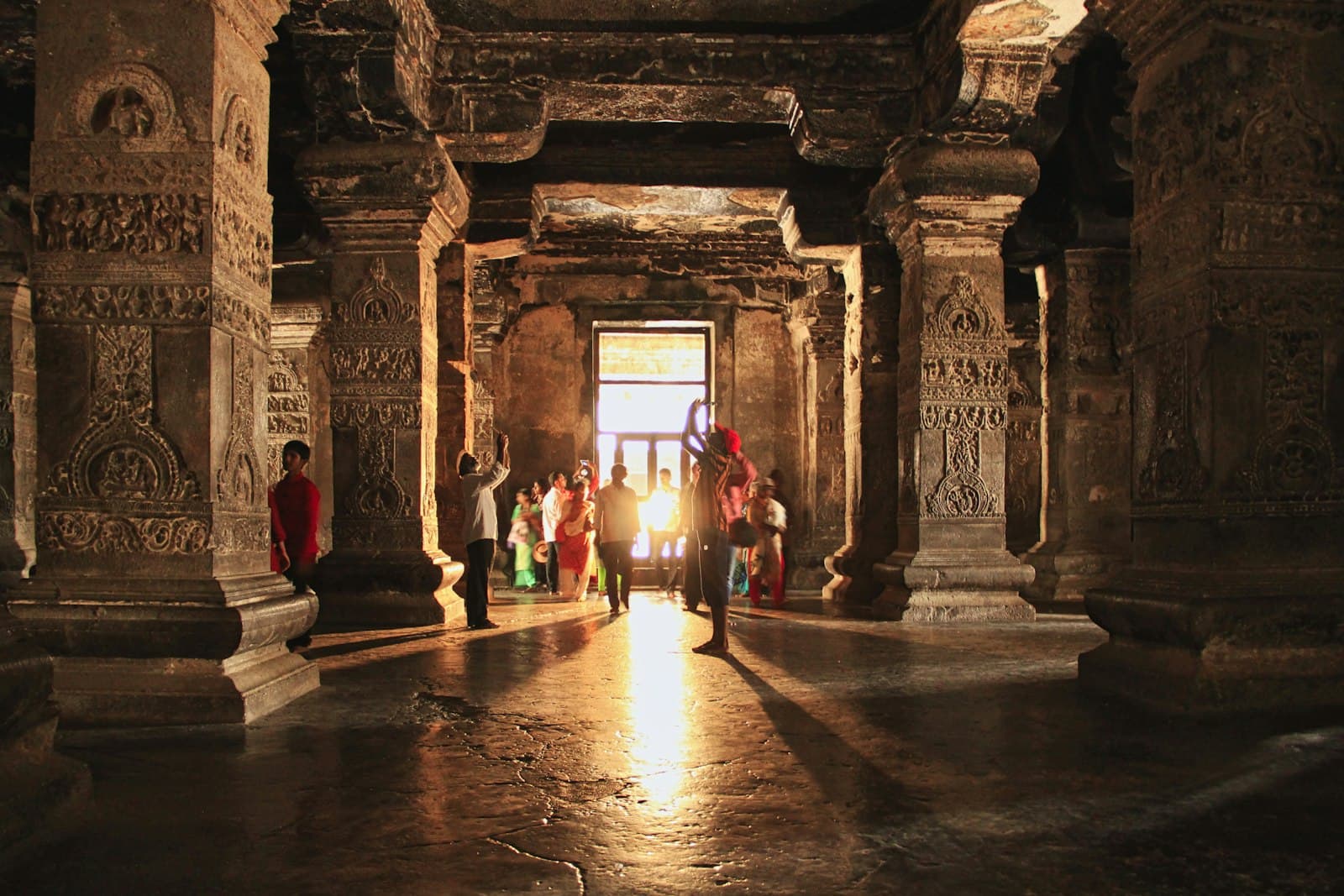
The Kailasa Temple is known as the world's largest monolithic structure, carved from a single rock, beginning from the top. Yet, how swiftly was this monumental feat accomplished?
Ellora
“Where mountains were sculpted into sanctuaries of faith.”
Ellora, as no one tells it.
Not the postcards. The stories even locals don't know — whispered in your ear, right where they happened.
Beyond the grand facades, certain caves at Ellora contain intriguing, narrow passages and small, distinctive perforations.
This Buddhist prayer hall, also known as the 'Carpenter's Cave,' features a ceiling that appears to be crafted from timber.
Discover every secret of Ellora
Every address, every reveal in full — in your ear, right where it happened.
You pick your stops. You walk. The voice reveals what the others miss.
How long do you have in Ellora?
No tours available yet. Check back soon — we're preparing them.
The story of Ellora
Ellora, in Maharashtra, India, is a UNESCO World Heritage Site presenting a remarkable collection of rock-cut caves. These 34 caves, carved into the Charanandri Hills, demonstrate the artistic and architectural brilliance of ancient India, with artwork dating from approximately 600 to 1000 CE. The complex offers a unique convergence of three major religions: Buddhism, Hinduism, and Jainism, with monasteries, temples, and prayer halls carved side-by-side.
Spanning two kilometers, the caves offer a tangible narrative of religious harmony and coexistence that flourished in ancient India. From the serene Buddhist viharas to the dramatic Hindu temples and the intricately detailed Jain shrines, Ellora stands as a testament to human ingenuity and devotion. The site's location on an ancient South Asian trade route also suggests its historical importance as a commercial center.
Carving Through Centuries: A Chronicle of Faiths
The Ellora Caves were excavated from the basalt cliffs of the Charanandri Hills over approximately four centuries, from the 6th to the 10th centuries CE. The earliest caves are primarily Buddhist, dating from around 600 to 730 CE. These include large, multi-storied monasteries (viharas) with living quarters, sleeping cells, kitchens, and shrines featuring sculptures of Buddha and Bodhisattvas. Cave 10, the Vishvakarma Cave, stands out as a significant Buddhist prayer hall with a 15-foot Buddha statue.
The Hindu caves, numbering 13 to 29, represent a later and more elaborate phase of construction, primarily between the 7th and 9th centuries CE, under the patronage of the Rashtrakuta dynasty. These caves are larger and more ornate than their Buddhist counterparts, featuring intricate carvings that depict scenes from Hindu mythology, particularly stories related to Shiva and Vishnu. Cave 29, also known as Dhumar Lena, is one of the earliest and largest Hindu excavations, integrating a natural waterfall into its design.
The Jain caves, caves 30 to 34, were excavated in the 9th and early 10th centuries, likely under the Yadava dynasty. While smaller than the Hindu and Buddhist caves, they are characterized by highly detailed carvings that emphasize the depiction of the twenty-four Tirthankaras. Cave 33, the Jagannatha Sabha, is the second-largest Jain cave, featuring two stories and intricate pillar carvings. The presence of monuments from these three distinct religious traditions in close proximity reflects the spirit of religious tolerance and coexistence that was prevalent in ancient India.
Ellora's 34 open caves are broadly categorized by religion: 12 Buddhist (Caves 1-12), 17 Hindu (Caves 13-29), and 5 Jain (Caves 30-34).
The undisputed highlight is Kailasa Temple (Cave 16), a monumental, monolithic structure dedicated to Shiva. Carved entirely from a single piece of rock, it is considered one of the greatest achievements of Indian rock-cut architecture. This chariot-shaped temple is larger than the Parthenon in Athens and features ornate pillars, detailed sculptures, and massive courtyards, with carvings depicting Hindu epics like the Ramayana and Mahabharata. Allow at least 90 minutes for Cave 16 alone.
Among the Buddhist caves, Cave 10, the Vishvakarma Cave, is a significant prayer hall with a 15-foot statue of Buddha in a preaching pose. Its ceiling is carved to resemble wooden beams, a unique architectural detail. Caves 11 and 12 are three-storied Mahayana monastery caves with intricate iconography.
For the Hindu caves, Cave 15, Dashavatara, showcases detailed carvings of Vishnu's ten avatars. Cave 21, Rameshwara, is dedicated to Lord Shiva and features richly carved pillars and a Nandi platform.
The Jain caves, though smaller, are exquisitely detailed. Cave 32, Indra Sabha, is considered the finest of the Jain caves, with intricate carvings of lotus flowers and other ornaments, and niches featuring Mahavir and Jain deities.
The ideal time to visit Ellora Caves is during the cooler, drier months from October to March. Temperatures during this period range from approximately 10°C to 30°C, providing comfortable conditions for exploring the extensive complex. While November to February is the peak tourist season, leading to larger crowds, visiting during weekdays or early mornings can help avoid the rush. The monsoon season, from July to September, brings lush greenery to the surrounding landscape, but heavy rainfall can sometimes disrupt travel plans. Summers, from April to May, are extremely hot, with temperatures potentially exceeding 40°C, making outdoor exploration challenging.
The Ellora Caves are located approximately 30 kilometers northwest of Aurangabad in Maharashtra. They are open from Tuesday to Sunday, typically from 6:00 AM to 6:00 PM, though actual opening times can be fluid. The site is closed on Tuesdays.
Entry fees are ₹40 for Indian nationals and ₹600 for foreign visitors, with free entry for children under 15. Still photography is generally free, while videography may incur a small fee. Allow a minimum of five to six hours to thoroughly explore all three religious sections. Comfortable walking shoes are essential, as the complex involves considerable walking and climbing steps. Hiring a certified local guide at the entrance can provide detailed historical and architectural insights. E-carts are available to transport visitors between different sections of the sprawling complex.
- What are the Ellora Caves?
- The Ellora Caves are a UNESCO World Heritage Site in Maharashtra, India, comprising 34 rock-cut caves that served as monasteries, temples, and prayer halls for Buddhists, Hindus, and Jains.
- What is the most famous cave at Ellora?
- The most famous cave is Kailasa Temple (Cave 16), a colossal monolithic temple dedicated to Lord Shiva, carved entirely from a single rock.
- What religions are represented at Ellora Caves?
- Ellora Caves uniquely features monuments from three major Indian religions: Buddhism (Caves 1-12), Hinduism (Caves 13-29), and Jainism (Caves 30-34).
- How were the Ellora Caves constructed?
- The caves were excavated directly from solid basalt rock, with the Kailasa Temple notably carved from the top down, a complex and precise method.
- What are the opening hours and entry fees for Ellora Caves?
- The caves are open Tuesday to Sunday, typically from 6:00 AM to 6:00 PM. Entry costs ₹40 for Indian nationals and ₹600 for foreigners.
- What is the best way to get to Ellora Caves?
- Ellora Caves are about 30 km from Aurangabad. You can reach them by bus, private taxi, or rental car from Aurangabad.