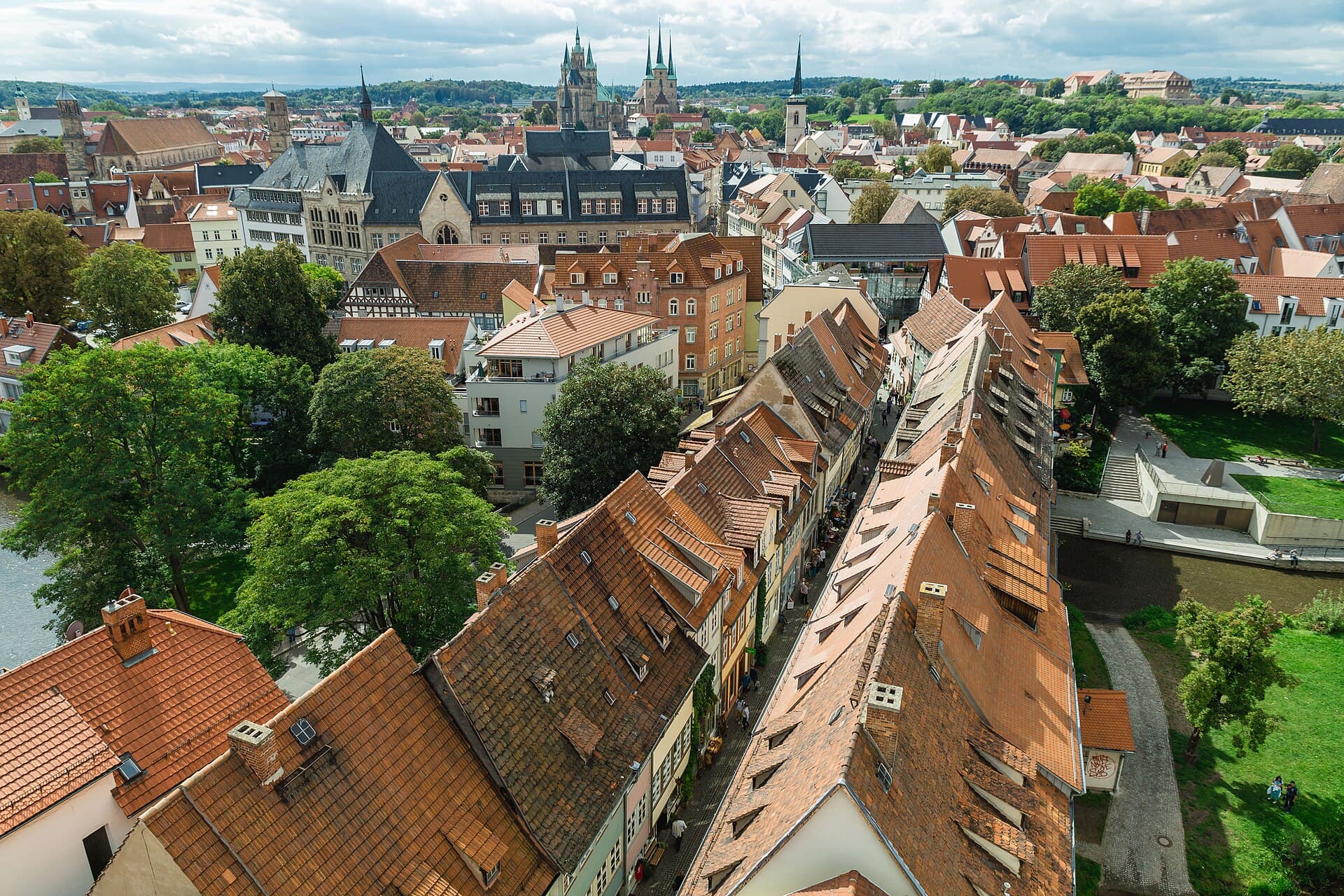
Erfurt, GermanyEremeev / CC BY-SA 3.0, via Wikimedia Commons
DE

Erfurt

Where ancient lanes echo with stories and history breathes through half-timbered walls.

The secrets of Erfurt

Erfurt, as no one tells it.

Not the postcards. The stories even locals don't know — whispered in your ear, right where they happened.

3 secrets below. Many more wait inside the tour.
Krämerbrücke (Merchants' Bridge)

This bridge is more than a crossing; it's a thoroughfare where lives have unfolded for centuries. Yet, a closer look at its foundations reveals a concealed route to the river.

Full story unlocks in the tour
Old Synagogue

Erfurt's Old Synagogue stands as one of Europe's most ancient, though for centuries, its true nature remained obscured, present but unacknowledged.

Full story unlocks in the tour
Augustinian Monastery

Martin Luther's monastic period here was marked by profound spiritual struggle. A specific detail from his vows ceremony offers an intriguing historical resonance.

Full story unlocks in the tour
The full tour

Discover every secret of Erfurt

Every address, every reveal in full — in your ear, right where it happened.

Get the key to Erfurt

You pick your stops. You walk. The voice reveals what the others miss.

Choose your time

How long do you have in Erfurt?

No tours available yet. Check back soon — we're preparing them.

About Erfurt

The story of Erfurt

Erfurt, the capital of Thuringia, is a city where the past is not merely preserved, but vibrantly experienced. Its medieval old town, among Germany's most complete, presents an inviting blend of paved lanes, half-timbered constructions, and a calm atmosphere that feels far removed from larger, more crowded urban centers. This central German city, with foundations laid over 1,200 years ago, invites visitors to stroll through centuries of architectural heritage, from its distinctive Merchants' Bridge to its soaring Gothic cathedral.

Recognized for its deep historical roots and a significant cultural and religious legacy, Erfurt played a central role in the life of Martin Luther, who pursued his studies and lived as a monk within its confines before igniting the Protestant Reformation. Beyond its historical importance, Erfurt pulses with contemporary life, offering a walkable environment, a lively student population, and verdant spaces along the Gera River. It is a destination for those seeking evocative architecture, distinctive museums, and authentic Thuringian culture.

History

## From Ancient Crossing to Medieval Center Erfurt's narrative commences as 'Erpesfurt,' first recorded in 724 as the location of an abbey and a royal residence at a crossing point on the Gera River. By 805, it had developed into a military stronghold and a commercial nexus on the eastern frontier of the Frankish empire. The city's strategic placement on the Via Regia, an important East-West trade route, fueled its expansion and prosperity throughout the Middle Ages. Erfurt received municipal rights around 1250 and grew into a significant regional power, joining the Hanseatic League in 1430.

By the 15th century, Erfurt was a primary commercial center, known as Europe's 'woad capital' for its production of the blue dye, which brought considerable wealth to its merchants. This prosperity allowed for the establishment of the University of Erfurt in 1392, one of Germany's oldest, drawing students from across Europe, including the young Martin Luther. Luther's period in Erfurt, from his studies to his entry into the Augustinian Monastery in 1505, marked a pivotal time that would ultimately lead to the Protestant Reformation.

## Shifting Powers and Modern Care After losing its autonomy and falling under the administration of the Electorate of Mainz in 1664, Erfurt became part of the Kingdom of Prussia in 1802. The city also hosted the Congress of Erfurt in 1808, a historic encounter between Napoleon Bonaparte and Tsar Alexander I. Unlike many German cities, Erfurt's Old Town emerged from World War II relatively undamaged, preserving its medieval character. Following the war, it became part of East Germany until reunification in 1990. Today, Erfurt is celebrated for its remarkably preserved medieval city center, a testament to its enduring past and a dedicated effort to maintain its architectural legacy.

What to see

Erfurt offers a profusion of sights, many concentrated within its accessible medieval core. The Krämerbrücke (Merchants' Bridge) is the city's most recognizable landmark, a distinctive medieval bridge entirely covered with 32 half-timbered structures housing artisan workshops, galleries, and cafés. It holds the distinction of being Europe's longest continuously inhabited bridge. At one end of the Krämerbrücke, you can ascend the Ägidienkirche tower for expansive views of the old town.

Dominating the skyline is the impressive pairing of Erfurt Cathedral (Dom St. Marien) and St. Severus Church, standing side-by-side on Cathedral Hill. The Gothic cathedral contains the immense Gloriosa bell, the world's largest free-swinging medieval bell, and remarkable stained-glass windows. Below, Domplatz (Cathedral Square) is a vast historic space, hosting markets and events.

The Old Synagogue, dating from the 11th century, is one of Europe's oldest and now a museum displaying the Erfurt Treasure—a collection of medieval Jewish artifacts. Explore the Augustinian Monastery, where Martin Luther lived as a monk, offering insights into monastic life and the Reformation. For a different perspective, climb to the Petersberg Citadel, one of Europe's largest and best-preserved Baroque fortresses, for sweeping city views and subterranean tours.

When to visit

The most pleasant time to visit Erfurt for outdoor activities is from late June to early September. During these summer months, daytime temperatures typically range from 22.9°C to 24.2°C, providing comfortable conditions for exploration. Evenings bring a refreshing coolness, with temperatures falling to an average of 12.8°C to 14.3°C, so a light jacket may be useful for evening walks. While precipitation occurs throughout the year, summer can see thunderstorms, and July is typically the month with the most rainfall. Alternatively, December offers a magical experience with Erfurt's celebrated Christmas market.

Practical

Erfurt is centrally positioned in Germany and readily accessible by train, with connections from major cities like Berlin, Frankfurt, and Munich typically taking two to three hours. The city center is compact and best explored on foot. For greater distances, an efficient tram system is available. The closest international airports are in Leipzig and Frankfurt. While Erfurt-Weimar Airport serves the region, it offers a limited range of commercial passenger services.

Accommodation options in Erfurt's Old Town include appealing hotels in historic buildings, self-catering apartments, and family-run guesthouses. Booking in advance is advisable, especially during peak seasons or festivals. When dining, be sure to sample a genuine Thuringian Bratwurst, a local specialty with a specific length requirement (15-20 cm) and traditionally served with local Born brand mustard.

Good to know
What is Erfurt primarily recognized for?
Erfurt is primarily recognized for its beautifully preserved medieval Old Town, the Krämerbrücke (Merchants' Bridge)—Europe's longest inhabited bridge—and its significant connection to Martin Luther.
Is Erfurt a city that can be explored on foot?
Yes, Erfurt's city center is compact and ideal for walking, allowing visitors to comfortably explore its historic streets and main attractions by foot.
What historical figure holds a close association with Erfurt?
Martin Luther is closely associated with Erfurt, as he pursued his studies at the University of Erfurt and lived as a monk in the Augustinian Monastery from 1505 to 1511.
What is the Krämerbrücke?
The Krämerbrücke, or Merchants' Bridge, is a distinctive medieval bridge in Erfurt lined with 32 half-timbered houses that are still inhabited and contain artisan shops and cafés, making it Europe's longest continuously inhabited bridge.
What is the 'Erfurt Treasure'?
The 'Erfurt Treasure' is an extraordinary collection of medieval Jewish coins, jewelry, and artifacts unearthed in 1998 during excavations in the old Jewish Quarter, now exhibited in the Old Synagogue museum.
How can I reach Erfurt?
Erfurt is easily accessible by train from major German cities such as Berlin, Frankfurt, and Munich. The city also has regional bus connections and a local airport, Erfurt-Weimar Airport, though larger international airports are in Leipzig and Frankfurt.
Erfurt
From€9.00
No booking · activate anytime · 12h to walk it
Get the key to Erfurt