Palazzo Vecchio
Observe the exterior wall of Palazzo Vecchio, near its grand entrance, for a subtle, almost imperceptible carving.
Full story unlocks in the tour
 Hagai Agmon-Snir حچاي اچمون-سنير חגי אגמון-שניר / CC BY-SA 4.0, via Wikimedia Commons
“Where every stone tells a story of rebirth and genius.”
Not the postcards. The stories even locals don't know — whispered in your ear, right where they happened.
Observe the exterior wall of Palazzo Vecchio, near its grand entrance, for a subtle, almost imperceptible carving.
On the side facade of this church, a peculiar marble head juts from the stone wall.
In Piazza Santissima Annunziata, a single window on this palazzo has remained open for centuries.
Discover every secret of Florence
Every address, every reveal in full — in your ear, right where it happened.
You pick your stops. You walk. The voice reveals what the others miss.
No tours available yet. Check back soon — we're preparing them.
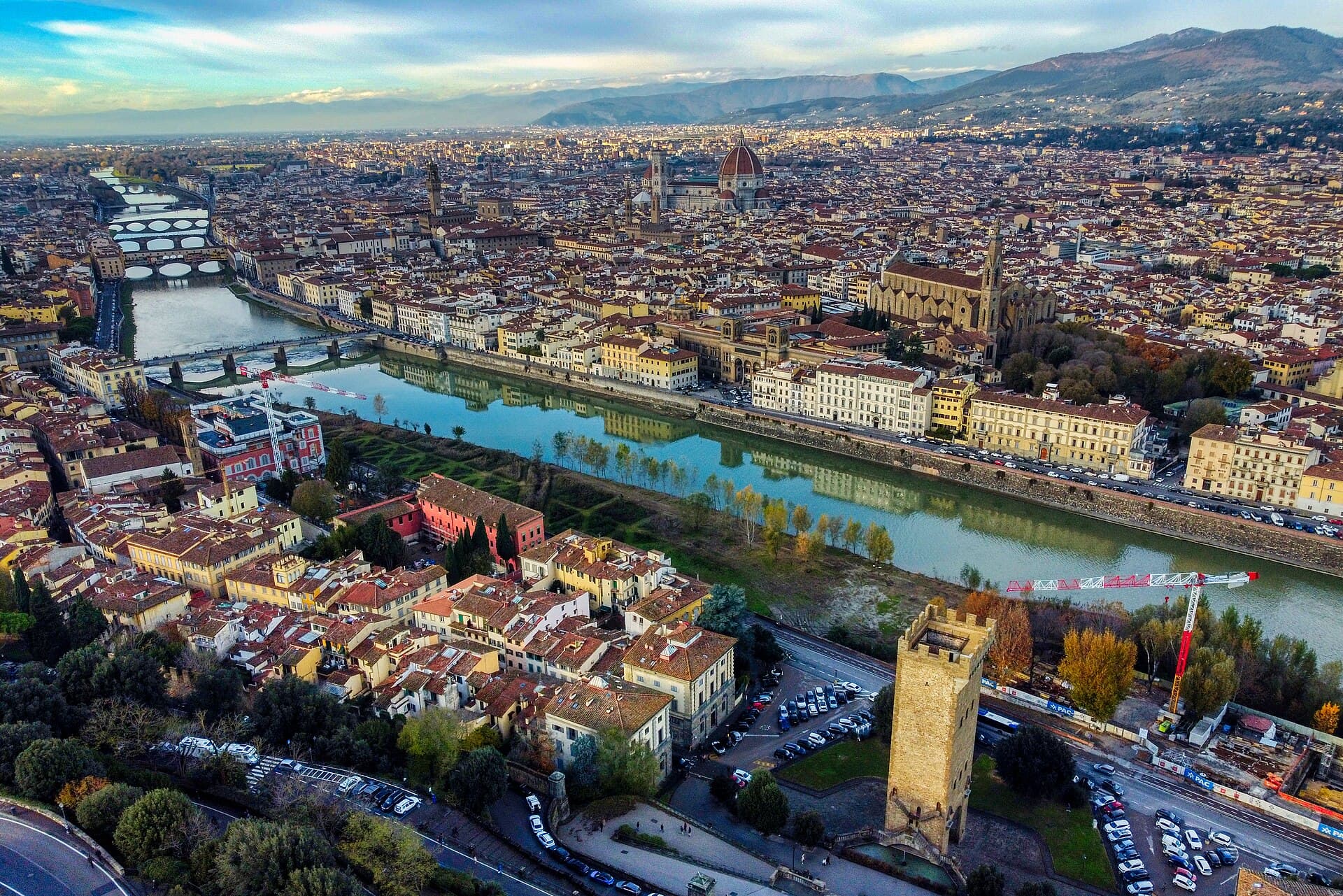
Florence, or Firenze in Italian, serves as the capital of Tuscany, a city that has profoundly shaped Western civilization. It rests along the Arno River, embraced by rolling hills adorned with vineyards and olive groves. Florence is a living museum, a place where the past feels remarkably present. It is widely recognized as the birthplace of the Italian Renaissance, a period of unparalleled artistic, cultural, and intellectual flourishing.
Millions of visitors journey to Florence each year, seeking to immerse themselves in its rich array of art, history, and culinary delights. The city's compact historic center, a UNESCO World Heritage Site, makes it exceptionally walkable, allowing for serendipitous discoveries around every corner. From grand piazzas to intimate lanes, Florence offers a unique blend of celebrated landmarks and intriguing lesser-known spots, promising an unforgettable journey through time.
Florence's story begins as a Roman military colony, established by Julius Caesar in 59 BCE. Initially named Florentia, meaning 'the flourishing town,' its strategic location near the Arno River and the Via Flaminia, an ancient road connecting Rome to northern Italy, contributed to its early prosperity.
After the decline of the Western Roman Empire, Florence endured a period of hardship, including barbarian invasions and the Gotho-Byzantine War. However, it experienced a significant civic revival starting in the 10th century, evolving into an autonomous medieval commune by 1115. During the Middle Ages, Florence emerged as a powerful center of European trade and finance, becoming one of the wealthiest cities of its era. This economic strength laid the groundwork for the artistic and intellectual explosion that was to come.
The 14th to 16th centuries marked Florence's golden age, as it became the undisputed birthplace of the Italian Renaissance. This era saw an unprecedented flourishing of art, architecture, and learning, with Florentine artists pioneering concepts like linear perspective. The city became home to cultural giants such as Leonardo da Vinci, Michelangelo, and Dante Alighieri, whose works were often supported by influential patrons like the Medici family. The Medici, one of Europe's most influential noble families, dominated Florence for centuries, commissioning much of the art and architecture that defines the city today. Their turbulent rule saw periods of both immense cultural advancement and political upheaval, including republican revolutions.
Florence's influence extended beyond art and politics. The Florentine dialect, particularly through the works of Dante, Petrarch, and Boccaccio, became the foundation for the modern Italian language. The city even served as the capital of the Kingdom of Italy from 1865 to 1871. This period saw significant urban modernization, including the demolition of the old market in Piazza del Mercato Vecchio to create a more formal street plan, now known as Piazza della Repubblica. Today, Florence remains a testament to its extraordinary past, with its historic center recognized as a UNESCO World Heritage Site since 1982.
Florence offers an abundance of iconic sights. The Duomo complex, featuring the Cathedral of Santa Maria del Fiore, Brunelleschi's Dome, Giotto's Bell Tower, and the Baptistery of San Giovanni, is an essential starting point. Ascending the dome or bell tower provides sweeping views of the city. The Uffizi Gallery and the Galleria dell'Accademia house world-renowned masterpieces, including Botticelli's Birth of Venus and Michelangelo's David, respectively. Securing tickets in advance for these popular attractions is highly recommended.
Walk across the Ponte Vecchio, the celebrated bridge lined with jewelry shops, or explore Piazza della Signoria, the political heart of Florence, with its replica of David and the Palazzo Vecchio. For a different perspective, wander through the Oltrarno district, known for its artisan workshops and authentic local atmosphere. Find respite from the crowds at the Boboli Gardens or the equally impressive, though less frequented, Bardini Gardens, offering beautiful landscapes and city views. Consider a visit to the Basilica di Santa Croce, a veritable art gallery and the final resting place of many celebrated Florentines.
The most pleasant times to visit Florence are during the spring (mid-March to mid-May) and autumn (late September through October). These shoulder seasons offer agreeable weather and fewer crowds compared to the peak summer months. Spring brings blossoming gardens and cultural events, while autumn is ideal for experiencing Tuscany's harvest season and wine festivals. Summers (July and August) can be very hot and crowded, with many locals leaving the city. Winter (December to February), outside of the Christmas season, offers the fewest visitors and lower prices, though it can be cooler and rainier.
Florence's city center is very walkable, making it the best way to explore its many sights. Public transportation is available, but many key areas are pedestrianized. When visiting churches and religious sites, remember to dress respectfully, covering shoulders and knees. Booking major attractions like the Uffizi Gallery, Accademia, and the Duomo complex in advance is crucial, especially during peak season, to avoid long queues.
Florence uses a dual street numbering system (red and blue/black numbers), which can sometimes be confusing when locating addresses. While credit cards are widely accepted, it's useful to have some cash for smaller expenses. Be aware of pickpockets in crowded areas. When dining, many restaurants do not begin serving dinner until after 7 PM, and popular spots often require reservations. For better value and authenticity, seek out restaurants beyond the main tourist squares.