Freiburg Minster
Examine the gargoyles on the Freiburg Minster, and you might discover one making a rather impolite gesture.
Full story unlocks in the tour
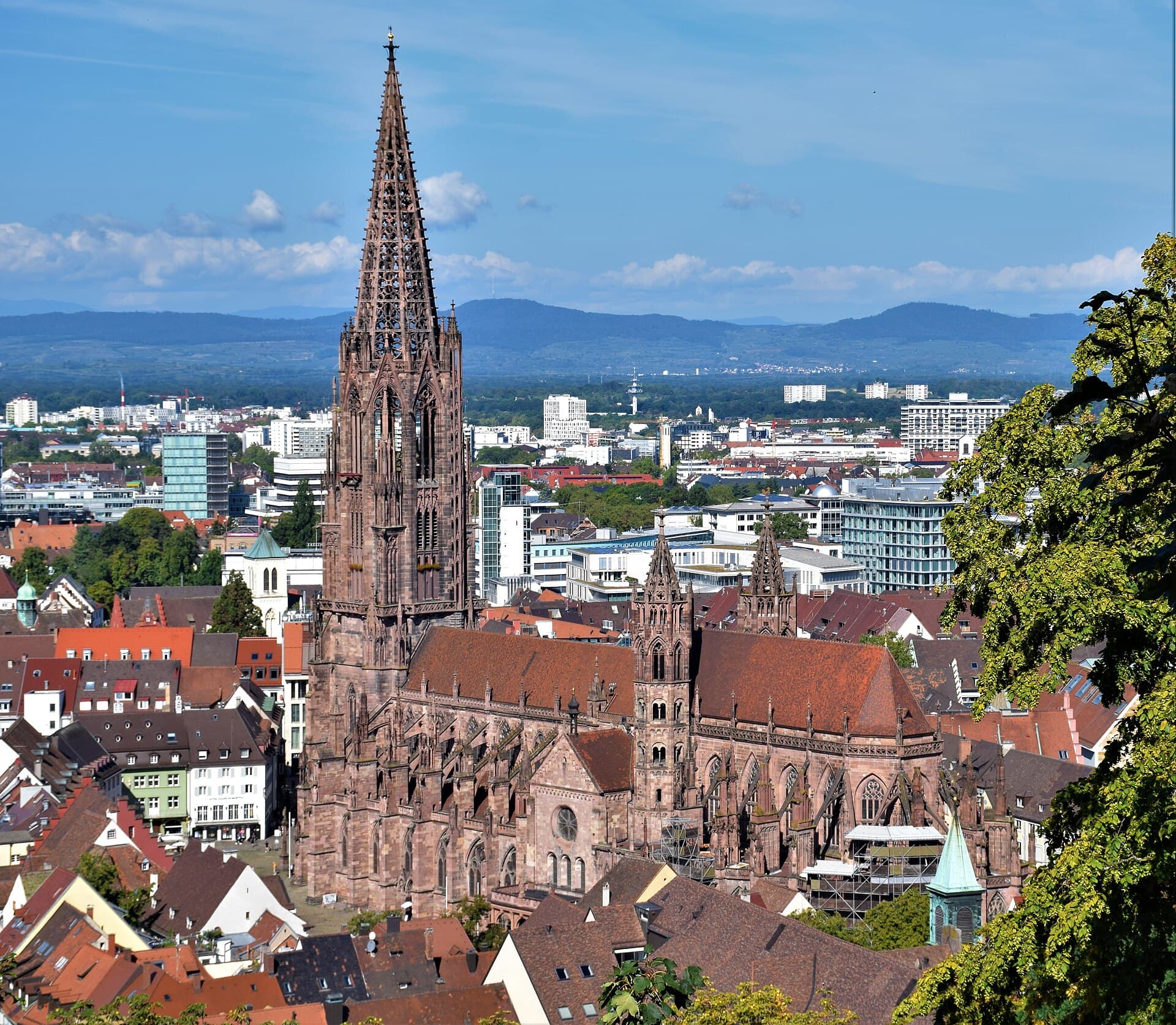 C. M. / CC BY-SA 4.0, via Wikimedia Commons
“Where medieval stone meets forward-thinking green innovation.”
Not the postcards. The stories even locals don't know — whispered in your ear, right where they happened.
Examine the gargoyles on the Freiburg Minster, and you might discover one making a rather impolite gesture.
The city's narrow water channels, or Bächle, carry a whimsical superstition for those yet to marry.
On the Martinstor, one of Freiburg's ancient city gates, a stark plaque recounts a chilling episode from the city's past.
Discover every secret of Fribourg-en-Brisgau
Every address, every reveal in full — in your ear, right where it happened.
You pick your stops. You walk. The voice reveals what the others miss.
No tours available yet. Check back soon — we're preparing them.
Freiburg im Breisgau, often simply called Freiburg, is a university city in southwestern Germany, resting on the western slopes of the Black Forest. Recognized as one of Germany's warmest and sunniest cities, it offers an engaging blend of medieval history and pioneering environmental initiatives. The Dreisam River flows through the city, and its Old Town, with its stone-paved passages and historic architecture, invites thoughtful exploration.
Freiburg holds a reputation as Germany's "green city," celebrated for its dedication to sustainability and eco-conscious practices. The city's lively atmosphere stems partly from its significant student population from the University of Freiburg, an institution established in 1457. This fusion of historical depth and youthful energy makes Freiburg a distinctive and engaging destination.
Freiburg's origins trace back to 1091 when Duke Berthold II of the House of Zähringen constructed a castle on Schlossberg hill. A settlement of artisans and merchants soon formed at the base of the mountain. The city was officially founded and chartered in 1120 by Konrad and Duke Berthold III of Zähringen as a "free market town," earning it the name "Freiburg," meaning "free town." Its strategic placement at the intersection of trade routes linking the Mediterranean and North Seas, as well as the Rhine and Danube rivers, fueled its early prosperity. By 1200, the population reached approximately 6,000 people.
The construction of the Freiburg Minster cathedral began around 1200, initially in the Romanesque style and completed as a Gothic marvel by 1513. After the Zähringen line concluded in 1218, the city passed to the Counts of Urach. However, in 1368, the citizens, weary of conflicts, purchased their freedom and sought the protection of the powerful Habsburg dynasty, remaining under their governance for several centuries. In 1457, the Albert-Ludwigs-Universität was established, solidifying Freiburg's standing as a significant intellectual center.
Freiburg's history is shaped by numerous conflicts, including occupation by the French, Swedes, and Bavarians during the Thirty Years' War. From 1648 to 1805, it served as the administrative heart for Further Austria, the Habsburg territories in southwest Germany. In 1805, the city became part of Baden. The city endured substantial damage during World War II, particularly from a massive bombing raid in November 1944. Remarkably, the Freiburg Minster remained largely intact. The Old Town was painstakingly reconstructed, with many historic buildings restored to their original appearance.
In the post-war era, Freiburg has emerged as a leader in sustainability and environmental protection. It is often recognized as one of the most eco-conscious cities in Germany, with initiatives like the Vauban district, an exemplary eco-friendly neighborhood emphasizing car-free living and renewable energy. Today, Freiburg continues to interweave its historical narrative with a forward-thinking approach to urban life and environmental responsibility.
Begin your exploration at the Freiburg Minster (Freiburger Münster), a Gothic architectural achievement with a 116-meter spire. You can ascend its tower for expansive city views. Surrounding the Minster is Münsterplatz, a lively pedestrian square that hosts a daily market (except Sundays) offering local produce, crafts, and food stalls. Consider trying a "Lange Rote" sausage here.
Wander through the Old Town and discover the Freiburg Bächle, small water channels flowing along many streets. These medieval waterways are a distinct feature of the city. Admire the Historisches Kaufhaus (Historical Merchants' Hall), a striking red Late Gothic building on Münsterplatz, adorned with statues and coats of arms. Visit the Augustinermuseum, housed in a former Augustinian monastery, displaying art from the Middle Ages to the 19th century, including original sculptures and stained-glass windows from the Minster.
For sweeping views, take the Schlossbergbahn funicular up Schlossberg hill, where you can explore forest paths and ascend the Schlossbergturm observation tower. The city also offers two medieval city gates, the Martinstor and Schwabentor, remnants of its ancient fortifications.
The most pleasant time to visit Freiburg is from May to September, when the weather is at its warmest and sunniest. Summer temperatures typically range from 25-30°C (77-86°F), ideal for enjoying outdoor cafes and excursions into the Black Forest. June and September are particularly agreeable, offering warm weather with fewer crowds than July and August. Spring and autumn also provide comfortable weather and fewer tourists, with blooming flowers in spring and vivid foliage in the Black Forest during autumn. For winter sports and festive markets, December to February brings colder temperatures but a delightful Christmas market.
Freiburg is well-connected and easy to navigate. The EuroAirport Basel Mulhouse Freiburg is approximately 50 kilometers away, across the border in France, while Zurich in Switzerland offers another significant international airport option. The city lies on a major north-south rail link between Basel and Karlsruhe, with train connections extending into the Black Forest. Drivers can readily access Freiburg via the A5 motorway.
Once within the city, Freiburg's Old Town is quite walkable. The city is also bicycle-friendly, with numerous bike paths. Public transportation, including trams, operates efficiently; day or 24-hour tickets can be economical if you plan to use them frequently. While German is the official language, English is often understood in areas frequented by visitors. The local currency is the Euro.