Jet d'Eau
Geneva's iconic Jet d'Eau, a powerful stream of water shooting 140 meters into the sky, wasn't originally conceived as a tourist attraction.
Full story unlocks in the tour
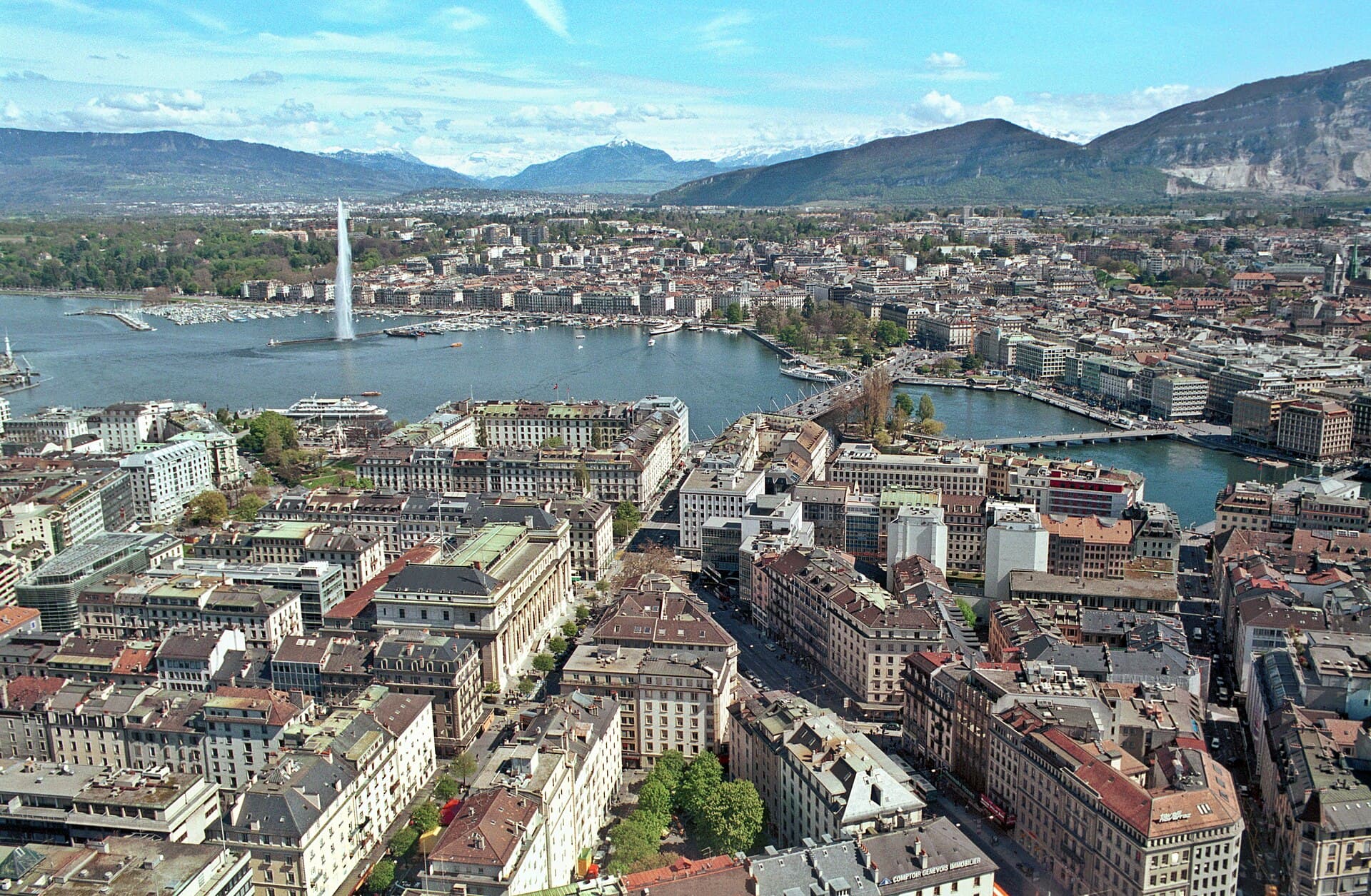 fr:Utilisateur:Stéphane_Pecorini / CC BY-SA 2.0 fr, via Wikimedia Commons
Self-guided audio walking tour of Geneva — GPS route, offline playback, story-driven narration in 32 languages.
“Where diplomacy meets natural grandeur, and history flows as freely as the Rhône.”
Not the postcards. The stories even locals don't know — whispered in your ear, right where they happened.
Geneva's iconic Jet d'Eau, a powerful stream of water shooting 140 meters into the sky, wasn't originally conceived as a tourist attraction.
On a hill in Geneva's Old Town, you'll find the longest wooden bench in the world, but it's not just a place to rest.
Just outside Geneva lies the world's largest research center, a place where scientists delve into the fundamental forces that shape our universe.
Discover every secret of Geneva
Every address, every reveal in full — in your ear, right where it happened.
You pick your stops. You walk. The voice reveals what the others miss.


Your self-guided audio tour of Geneva is ready — pick your landmarks, choose your language, and start the moment you arrive.
BuyLume has a built-in augmented-reality guide. Hold your phone up and its camera shows the street ahead of you, with a glowing arrow laid over the real view that always points to your next stop — no map to puzzle over, no wrong turns. Like everything in Lume, it works fully offline.
Geneva, Switzerland's second-most populous city, rests at the southwestern tip of expansive Lake Geneva, where the Rhône River begins its journey from the lake. Framed by the Jura mountains and the distant Alps, the city offers a blend of natural beauty and urban sophistication. Often called the 'Peace Capital of the World,' Geneva is a global hub for diplomacy and humanitarian efforts, hosting the European headquarters of the United Nations and the International Committee of the Red Cross.
Beyond its international significance, Geneva invites exploration of its engaging Old Town, with its cobbled streets and historic architecture. The city's landscape is defined by Lake Geneva, Europe's largest Alpine lake, and the dramatic Jet d'Eau, a powerful fountain that has become a symbol of the city. From lakeside strolls to cultural institutions, Geneva presents a multifaceted experience where history, innovation, and scenic vistas converge.
Geneva's history stretches back over two millennia, originating as a fortified border town of the Allobroges, a Celtic tribe, strategically located where the Rhône exits Lake Geneva. Julius Caesar mentioned Geneva in 58 BC, noting its importance as a Roman settlement and trade center. Under Roman rule, the town, then known as Genava, prospered with the development of temples, baths, and a harbor. Archaeological excavations beneath St. Pierre Cathedral have revealed Roman remains, including a 4th-century baptistery, offering a tangible connection to the city's ancient past.
In the Middle Ages, Geneva was governed by a count under the Holy Roman Empire until the late 14th century, when it gained a degree of self-governance. The 16th century marked a pivotal period with the arrival of the Protestant Reformation. John Calvin became the city's spiritual leader in 1541, transforming Geneva into a 'Protestant Rome' and a significant center for Protestant thought and a refuge for reformers. This era also saw the development of welfare and education systems under Calvin's influence.
Geneva maintained its independence as a city-state until the end of the 18th century. A notable event in its history is L'Escalade, a failed surprise attack by the Duke of Savoy's troops in 1602, which is still celebrated today. In 1815, following the Napoleonic Wars, Geneva joined the Swiss Confederation. The 19th and 20th centuries saw Geneva flourish, becoming a major banking hub and a seat for numerous international organizations. Henry Dunant, a Genevan citizen, founded the International Committee of the Red Cross (ICRC) in 1863, inspired by the suffering he witnessed. The first Geneva Convention, establishing international humanitarian law, was signed here in 1864. In 1920, the League of Nations chose Geneva as its headquarters, followed by the United Nations establishing its European headquarters in 1946, solidifying Geneva's role as a global center for diplomacy and humanitarianism.
Begin your exploration in Geneva's Old Town (Vieille Ville), a labyrinth of cobbled streets and historic buildings. Ascend to St. Pierre Cathedral (Cathédrale Saint-Pierre Genève) for expansive views of the city and Lake Geneva from its towers, and explore the archaeological site beneath. Nearby, discover Maison Tavel, the oldest house in Geneva, which now serves as a museum detailing the city's history. Don't miss the Reformation Wall in Parc des Bastions, a monumental tribute to the leaders of the Protestant Reformation.
Along the shores of Lake Geneva, admire the iconic Jet d'Eau, a fountain propelling water 140 meters skyward. Stroll through the English Garden (Jardin Anglais) and marvel at the Flower Clock (L'Horloge Fleurie), a working clock crafted from thousands of flowers, symbolizing Geneva's watchmaking heritage. For a glimpse into international affairs, visit the Palais des Nations, the European headquarters of the United Nations, and the International Red Cross and Red Crescent Museum. For a unique natural spectacle, head to La Jonction, where the clear waters of the Rhône meet the sediment-rich currents of the Arve River.
The best times to visit Geneva are during spring (April to June) and early autumn (September to October). During these months, the weather is pleasantly mild, with temperatures ranging from 10°C to 21°C, ideal for outdoor activities and sightseeing. Spring brings blooming flowers and moderate crowds, while autumn offers comfortable temperatures and fewer crowds than summer. Summer (June to August) is also popular, with warm temperatures (14-28°C) perfect for lake activities and festivals, though it is the busiest and most expensive season. Winter (December to February) is colder (around 0-5°C) and quieter, with opportunities for winter sports in nearby areas and festive Christmas markets in December.
The currency used in Geneva, and throughout Switzerland, is the Swiss Franc (CHF). While some establishments, particularly those catering to tourists, may accept Euros, it is not universally practiced, and change will typically be given in Swiss Francs. Credit and debit cards are widely accepted.
French is the official language in Geneva. While many residents, especially in tourist areas, also speak English, knowing some basic French phrases can be helpful. Geneva has an efficient public transportation system, UNIRESO, which includes trams, buses (TPG), trains (CFF), and 'mouettes' (yellow taxi boats). Guests staying in hotels, hostels, or campsites in Geneva often receive a free Geneva Transport Card, allowing unlimited use of public transport within Zone 10, including transfers from the airport to the city center.
Geneva in Korean, in Chinese or in Hebrew — and 29 more languages, every stop narrated by a native voice. The widest language range of any self-guided audio tour.
Available in: