Look closely at the Kaiserworth Hotel on the Market Square, and you'll spot a rather unusual figure.
Tilman2007 / CC BY-SA 4.0, via Wikimedia CommonsGoslar
“Where emperors held court and silver shaped a city.”
Goslar, as no one tells it.
Not the postcards. The stories even locals don't know — whispered in your ear, right where they happened.
The Rammelsberg Mine operated for over a thousand years, but its discovery might have been thanks to a restless horse.
Deep within the Imperial Palace, a relic of an emperor remains, not in a grand tomb, but in a small chapel.
Discover every secret of Goslar
Every address, every reveal in full — in your ear, right where it happened.
You pick your stops. You walk. The voice reveals what the others miss.
How long do you have in Goslar?
No tours available yet. Check back soon — we're preparing them.
The story of Goslar
Goslar, a city at the northern edge of the Harz Mountains in Lower Saxony, Germany, feels like a journey back in time. Its medieval center, remarkably preserved after surviving World War II, features over 1,500 half-timbered houses lining narrow, winding streets. This architectural marvel, along with the Rammelsberg Mine and the Upper Harz Water Management System, earned Goslar its UNESCO World Heritage status in 1992, with an extension in 2010.
Beyond its visual appeal, Goslar offers a concentrated dose of history, making it an ideal destination for those seeking a deeper understanding of medieval Germany without the overwhelming crowds of larger tourist hubs. It served as a favored residence for Holy Roman Emperors for centuries, its prosperity fueled by the substantial ore deposits of the Rammelsberg Mountain. Today, the city is a living museum where daily life continues amidst ancient buildings and historical landmarks.
## From Silver to Imperial Power Goslar's story began in the 10th century with the discovery of abundant silver ore in the Rammelsberg Mountain. This transformed the small settlement into a significant medieval German town. Recognizing the economic and strategic value, Emperor Otto I established an imperial palace around 1005, a complex later expanded by Henry II, solidifying Goslar's role as a preferred residence for Holy Roman Emperors.
### A Free Imperial City The mineral wealth from Rammelsberg, which produced silver, copper, lead, and zinc, propelled Goslar's prosperity, making it one of the wealthiest towns in the empire by the 12th century. Emperors frequently held court here, and the Imperial Diet convened multiple times. As imperial power waned in the 13th century, Goslar sought greater autonomy, becoming a Free Imperial City in 1290, directly accountable to the Emperor rather than regional nobles. This status granted significant self-governance and trading privileges, leading to the growth of powerful guilds and affluent merchant families.
### Decline and Preservation The 16th century brought religious upheaval and economic challenges. Mining production declined, and Goslar's economic prominence lessened. The Thirty Years' War further devastated the region, causing population loss and economic disruption. In 1802, Goslar lost its Free Imperial City status and was transferred to Prussia, marking the end of its centuries-long independence. Despite these shifts, the town's medieval center largely survived World War II intact, partly due to the presence of a POW hospital. The Rammelsberg mines finally closed in 1988 after over a thousand years of continuous operation. In 1992, Goslar's historic town and the Rammelsberg Mine were designated a UNESCO World Heritage Site, a recognition expanded in 2010 to include the Upper Harz Water Management System.
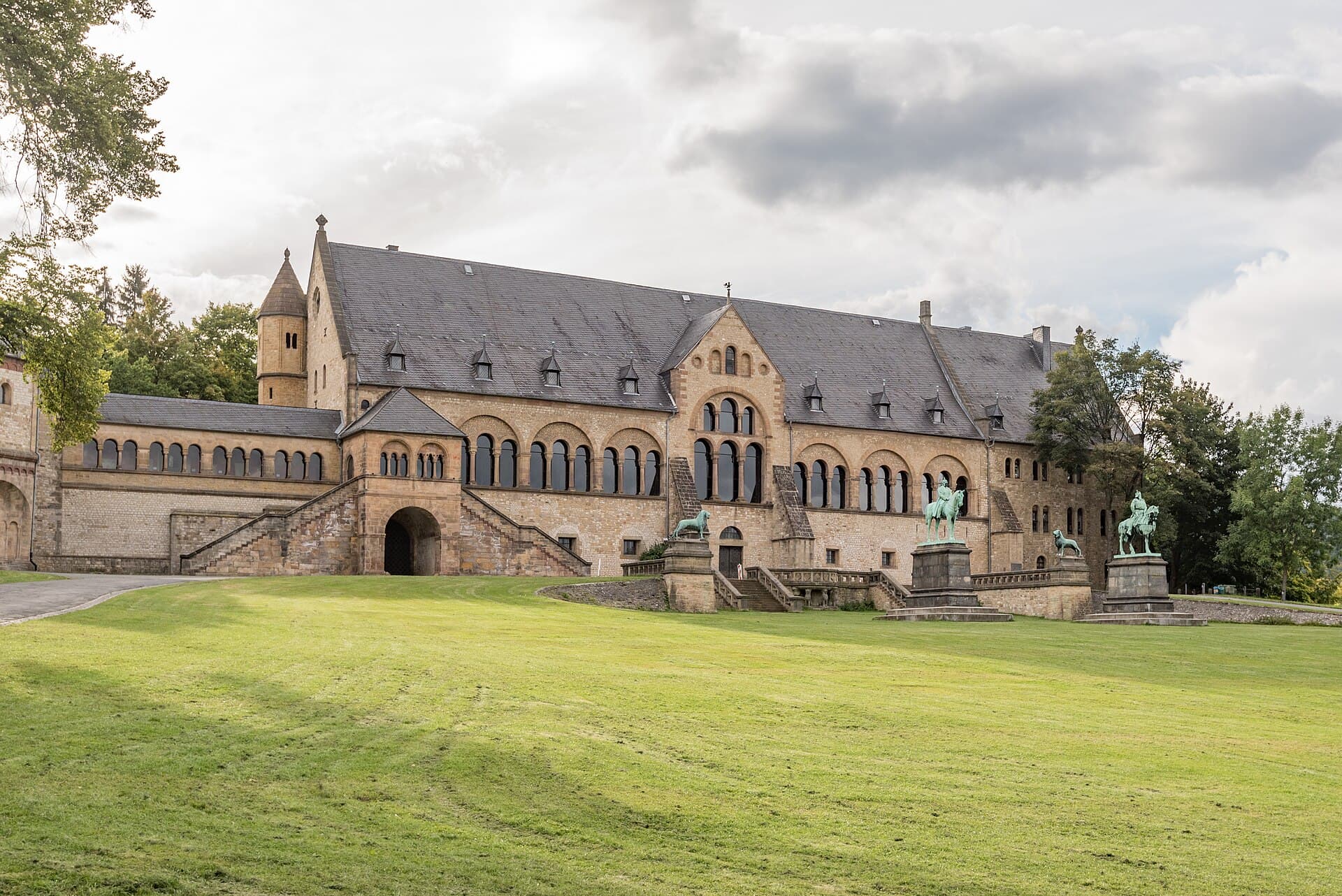
Begin your exploration at the Kaiserpfalz (Imperial Palace), an 11th-century Romanesque structure that once hosted emperors and political assemblies. Inside, grand halls feature murals depicting Goslar's imperial past, and the adjacent St. Ulrich's Chapel contains the heart of Emperor Henry III. From the Kaiserpfalz, views extend over the old town.
Next, wander to the Marktplatz (Market Square), the central hub of the old town. Here, you will find the ornate, gilded Market Fountain topped with a golden imperial eagle, symbolizing the town's allegiance to the Holy Roman Empire. The Marktkirche St. Cosmas und Damian, with its twin spires, dominates the square. Ascend its clock tower for sweeping views of Goslar, the Rammelsberg Mountain, and the Harz countryside.
One of Goslar's most compelling attractions is the Rammelsberg Mining Museum, located on the mountain's lower slopes. The museum offers guided tours into original mine shafts, allowing visitors to experience centuries-old mining techniques. Consider the train ride used by miners for a unique underground perspective. Do not miss the Siemens House, one of the oldest preserved half-timbered houses and the ancestral home of the Siemens industrial family. While not open to the public, its detailed exterior carvings are worth seeing.
Goslar is a year-round destination, each season offering a different appeal. Spring (March to May) and autumn (September to November) provide mild weather, ideal for exploring the town and hiking in the Harz Mountains, with fewer crowds. Summer (June to August) is warmer, with temperatures peaking around 25°C (77°F), creating a festive atmosphere with outdoor events. Winter (December to February) transforms Goslar into a picturesque scene, especially during the Christmas Market, when snow often dusts the rooftops.
Goslar is well-connected by train and road. Hanover Airport (HAJ) is the closest, about 90 kilometers north. Regional trains connect Goslar to major hubs like Hanover, Brunswick, and Göttingen. From Hanover, the journey is about 90 minutes. If driving, Goslar is accessible via the A7 and B6 roads, and the drive through the Harz foothills is scenic. The town center is largely pedestrianized, so it is best to use designated parking areas.
Accommodation options range from hotels to guesthouses. The Goslar tourist information office on the main Market Square is open seven days a week from April to October and in December, offering assistance and guided tours. Visitors staying overnight in Goslar pay a guest tax, which includes a guest card providing discounts on attractions and free public bus travel within the city and the wider Harz region.
- What are Goslar's UNESCO World Heritage Sites?
- Goslar's UNESCO World Heritage Sites include the Historic Town of Goslar, the Rammelsberg Mine, and the Upper Harz Water Management System.
- What is the Kaiserpfalz?
- The Kaiserpfalz is the Imperial Palace of Goslar, an 11th-century Romanesque palace that served as a favored residence for Holy Roman Emperors and a significant political center.
- Can I go inside the Rammelsberg Mine?
- Yes, the Rammelsberg Mining Museum offers guided tours into the original mine shafts, allowing visitors to explore the historical mining operations.
- Is Goslar suitable for hiking?
- Yes, Goslar is an ideal base for exploring the Harz Mountains, with hiking trails leading directly from the edge of town into the mountains.
- How do I get around Goslar?
- The old town of Goslar is easily walkable. Public bus services operate within the municipal boundaries, and if you have a guest card from your accommodation, bus travel is free.
- What is the Goslar Christmas Market like?
- The Goslar Christmas Market is considered one of Germany's most appealing, transforming the historic market square into a winter wonderland with lights, mulled wine, crafts, and a 'Christmas Forest' of fir trees.