Imagine stepping inside the mouth of a blue whale.
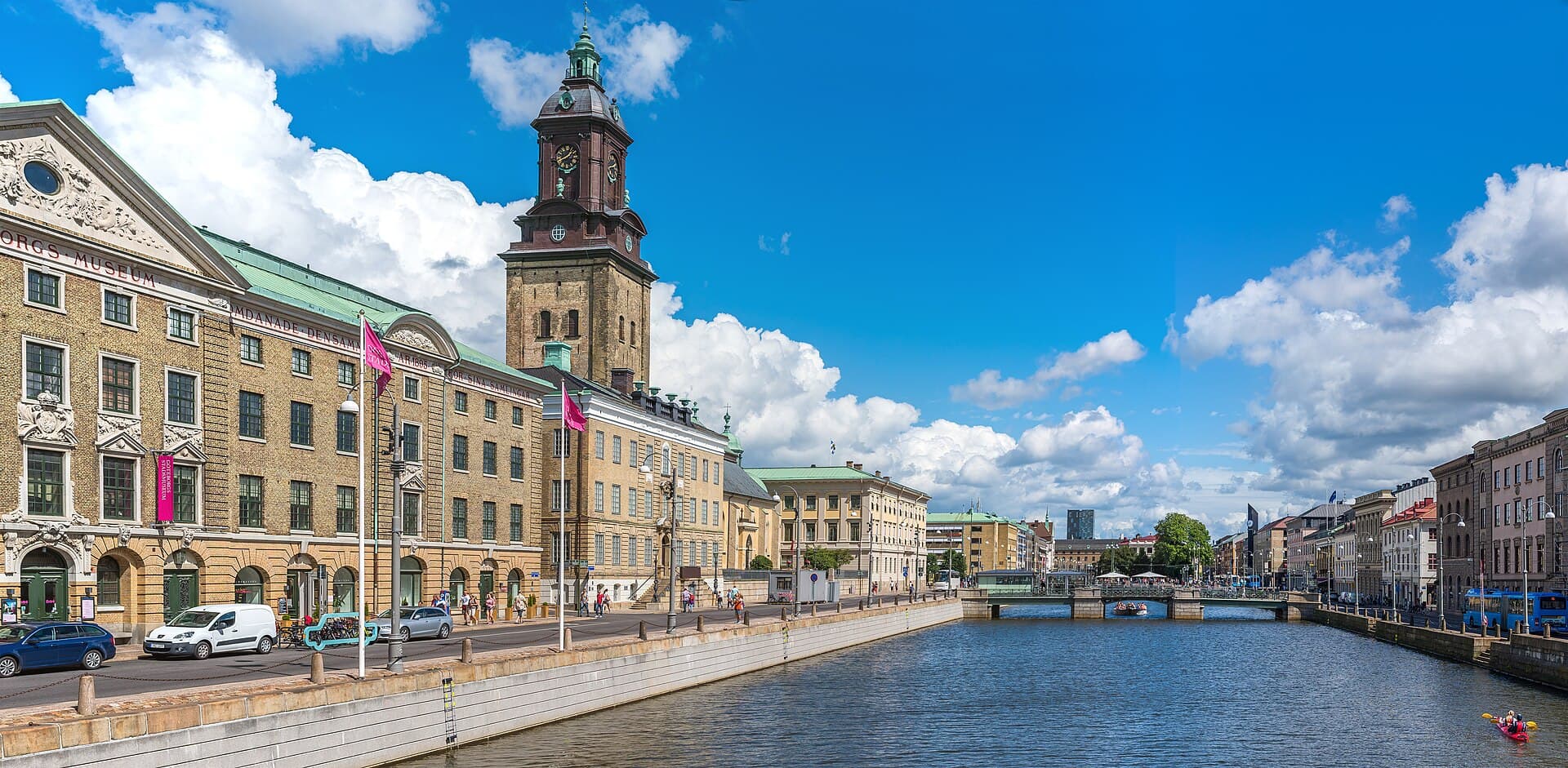
Bengt Nyman from Vaxholm, Sweden / CC BY 2.0, via Wikimedia CommonsGothenburg
Self-guided audio walking tour of Gothenburg — GPS route, offline playback, story-driven narration in 32 languages.
“Where the Göta River meets the sea, a city of canals and quiet innovation unfolds.”
Gothenburg, as no one tells it.
Not the postcards. The stories even locals don't know — whispered in your ear, right where they happened.
This building, dedicated to seafood, is not a typical house of worship.
The city's founder has a rather pointed legend.
Discover every secret of Gothenburg
Every address, every reveal in full — in your ear, right where it happened.
You pick your stops. You walk. The voice reveals what the others miss.


How long do you have in Gothenburg?
No tours available yet. Check back soon — we're preparing them.
The story of Gothenburg
Göteborg, often known as Gothenburg in English, is Sweden's second-largest city, a coastal center that gracefully marries its maritime past with a forward-looking, sustainable present. Situated on the country's west coast, where the Göta River empties into the sea, it stands as Scandinavia's largest port and a significant gateway to the North Sea. The city projects a relaxed atmosphere, offering a compelling contrast to the energetic capital of Stockholm, yet it holds its own as a major urban center in the Nordic region.
With a metropolitan area home to over a million people, Gothenburg is distinguished by its inviting canals, plentiful green spaces, and a youthful energy nurtured by its prominent universities. It is a city that champions sustainability, having been recognized multiple times as the world's most sustainable destination. From its venerable streets to cutting-edge design studios, and from traditional seafood markets to innovative transport initiatives, Gothenburg invites thorough exploration and promises a singular Scandinavian experience.
From Lödöse to a Dutch-Inspired Port
Gothenburg's story stretches back further than its official founding in 1621. The area has been inhabited for millennia, with an earlier settlement called Lödöse emerging in the late Viking Age, about 40 kilometers upstream on the Göta River. Lödöse flourished as a trade center in the Middle Ages, serving as a crucial point for transferring goods between the Swedish and Norwegian coasts. However, its significance waned, and by the early 17th century, King Gustav II Adolf sought a more strategic location for a modern port.
In 1621, King Gustav II Adolf officially founded Gothenburg by royal charter. The city's strategic position at the mouth of the Göta River was paramount, providing Sweden with direct access to the North Sea, bypassing Danish-controlled straits. To design and build this new city, Dutch engineers were brought in, and their influence is still clearly visible in Gothenburg's layout. The city's initial design mirrored Dutch cities like Amsterdam, featuring a network of canals for both defense and drainage, and straight streets within its fortified walls. Early city councils were notably multicultural, comprising Swedish, Dutch, German, and Scottish members, reflecting its origins as a trading colony.
A Flourishing Trade Hub and Industrial Powerhouse
The 18th century marked a period of significant economic growth for Gothenburg. Its port became increasingly vital, especially with the establishment of the Swedish East India Company in 1731. This company transformed Gothenburg into a major hub for international trade, particularly with China, and exports of iron and wood further boosted its prosperity. Wealthy merchants of this era constructed grand log houses along the city's canals, many of which can still be admired today.
The 19th century saw Gothenburg evolve into a modern industrial city. Its population surged tenfold, from 13,000 in 1800 to 130,000 by 1900. Key boulevards like Avenyn and Vasagatan were developed around the old city, alongside working-class districts. The 20th century continued this industrial expansion, with major companies like SKF (founded 1907) and Volvo (founded 1927) emerging and becoming integral to the city's identity. Volvo, in particular, became the region's largest employer. In recent decades, while industry remains important, Gothenburg has diversified, fostering new sectors in merchandising, tourism, and cultural and educational institutions.
Begin your exploration in the charming Haga district, known for its inviting cafes and historic wooden houses. Here, you can enjoy a traditional Swedish fika with one of Café Husaren's famous large cinnamon buns. For expansive views of the city, ascend to Skansen Kronan, a 17th-century fortress. The city's main boulevard, Avenyn, leads to Götaplatsen, a cultural center featuring the iconic Poseidon statue, the Gothenburg Museum of Art, the City Theatre, and the Concert Hall.
Those who appreciate nature will find enjoyment in Slottsskogen, a vast city park with walking trails, a natural history museum, and a children's zoo. Nearby, the Gothenburg Botanical Garden is one of Europe's largest, displaying over 20,000 plant species. For a maritime experience, visit the Port of Gothenburg, the largest in the Nordic countries, or explore Maritiman, the world's largest floating museum. Do not overlook the Feskekôrka, a distinctive indoor fish market resembling a church, offering fresh seafood. For family enjoyment, Liseberg is Sweden's largest amusement park, open across three seasons with rides, concerts, and seasonal markets.
The best time to visit Gothenburg is between May and September, when the weather is mild and pleasant for outdoor activities. Summer, from June to August, is peak season, offering warm temperatures (17-22°C), long daylight hours, and a lively atmosphere with many festivals and outdoor events. May and September are considered shoulder seasons, providing agreeable weather with fewer crowds and potentially better value. Autumn brings crisp air and bright foliage, ideal for cultural pursuits like museum visits and the Göteborg Book Fair. While winter is colder and wetter, December offers the festive Liseberg Christmas market.
Gothenburg is well-connected and easy to navigate. The main airport, Landvetter, is a 30-minute bus ride from the city center. Public transportation, operated by Västtrafik, includes an extensive network of trams, buses, and ferries, making it easy to explore without a car. The tram network, with over 150 km of tracks, is the largest light rail network in Scandinavia. You can purchase tickets through their homepage or at tourist information points.
The city is also very walkable and bicycle-friendly, with many paths and rental options. For comprehensive sightseeing, consider the Göteborg City Card, which often includes public transport and attraction admissions. Sweden uses the Swedish Kronor (SEK) as its currency. While generally a very safe city, it is always wise to be mindful of your belongings, especially in crowded areas like the central station and on public transport.
- What is Gothenburg's original name?
- In Swedish, the city is named Göteborg, pronounced roughly "yaw-ta-bore(g)."
- Is Gothenburg a good city for sustainability?
- Yes, Gothenburg has been recognized multiple times as the world's most sustainable destination.
- What is Gothenburg known for?
- Gothenburg is known for its maritime heritage, its extensive canal system, being home to Volvo, and Liseberg, Sweden's largest amusement park.
- Can I explore Gothenburg on foot?
- Yes, Gothenburg has a compact downtown and is easy to explore on foot or by bicycle.
- What is the Port of Gothenburg known for?
- The Port of Gothenburg is the largest port in the Nordic countries and has been crucial to Sweden's trade and maritime history.
- What is the best way to get around Gothenburg?
- Public transportation, including trams, buses, and ferries operated by Västtrafik, is an efficient way to get around. The city also has an extensive network of bicycle paths.