Gänseliesel Fountain
The most celebrated figure in the city isn't a person at all, but a bronze statue.
Full story unlocks in the tour
 Daniel Schwen / CC BY 2.5, via Wikimedia Commons
Self-guided audio walking tour of Göttingen — GPS route, offline playback, story-driven narration in 32 languages.
“Where intellect and tradition intertwine along ancient lanes.”
Not the postcards. The stories even locals don't know — whispered in your ear, right where they happened.
The most celebrated figure in the city isn't a person at all, but a bronze statue.
An unassuming door can lead to one of Germany's earliest botanical treasures.
A bus ride beyond the city limits leads to a structure housing the world's oldest functional seismograph.
Discover every secret of Göttingen
Every address, every reveal in full — in your ear, right where it happened.
You pick your stops. You walk. The voice reveals what the others miss.

Your self-guided audio tour of Göttingen is ready — pick your landmarks, choose your language, and start the moment you arrive.
BuyLume has a built-in augmented-reality guide. Hold your phone up and its camera shows the street ahead of you, with a glowing arrow laid over the real view that always points to your next stop — no map to puzzle over, no wrong turns. Like everything in Lume, it works fully offline.
Göttingen, a city in Lower Saxony, Germany, is widely recognized for its distinguished Georg-August University, an institution that shapes much of the city's rhythm and cultural life. Situated in the Leine River valley, between the Harz Mountains and the Weser Uplands, Göttingen offers a blend of enduring character and youthful energy.
The city's well-preserved medieval fortifications encircle an old town filled with half-timbered houses and significant architectural landmarks. Göttingen's intellectual legacy is profound, with over 40 Nobel laureates having studied or worked here, earning it the designation "City that creates knowledge." This academic focus, combined with a lively cultural scene, makes Göttingen a distinctive destination for those interested in history, science, and a spirited student atmosphere.
The origins of Göttingen trace back to a village named Gutingi, first documented in 953 AD. The city itself was founded between 1150 and 1200 AD, adopting the name of the original settlement. Otto IV granted Göttingen city rights around 1200, a pivotal moment that set the stage for its expansion and prosperity. During the late Middle Ages, Göttingen became a member of the influential Hanseatic League, a confederation of merchant towns that significantly shaped Northern European trade. While its relationship with the League was somewhat distant as an inland town, Göttingen's merchants benefited from extensive trade routes, contributing to the city's wealth.
Göttingen found its true calling in the 18th century with the founding of the Georg-August-Universität in 1734 by George II, Elector of Hanover and King of Great Britain. This institution quickly became a beacon of knowledge, drawing scholars and students from across Europe. Celebrated figures like the Brothers Grimm and Carl Friedrich Gauss walked its streets, shaping the intellectual landscape. The university's early years saw a strong focus on law, attracting students like Otto von Bismarck.
The 19th century brought both challenges and triumphs. In 1837, seven courageous professors, known as the "Göttingen Seven," protested against the abolition of the liberal constitution, solidifying the city's reputation as a center for critical thinking and freedom. Despite the dark days of World War II, Göttingen was largely spared from bombing and surrendered to American troops in 1945 without a conflict. This preservation allowed for swift reconstruction and renewed prosperity in the post-war years. The latter half of the 20th century saw the university expand further, new research institutes established, and in 1993, the impressive new State Library opened its doors, reaffirming Göttingen's status as a leading center for science and research in Germany. Today, the city continues its legacy of innovation, with local companies and universities forming "Measurement Valley," concentrating on optical and precision-engineered machinery.
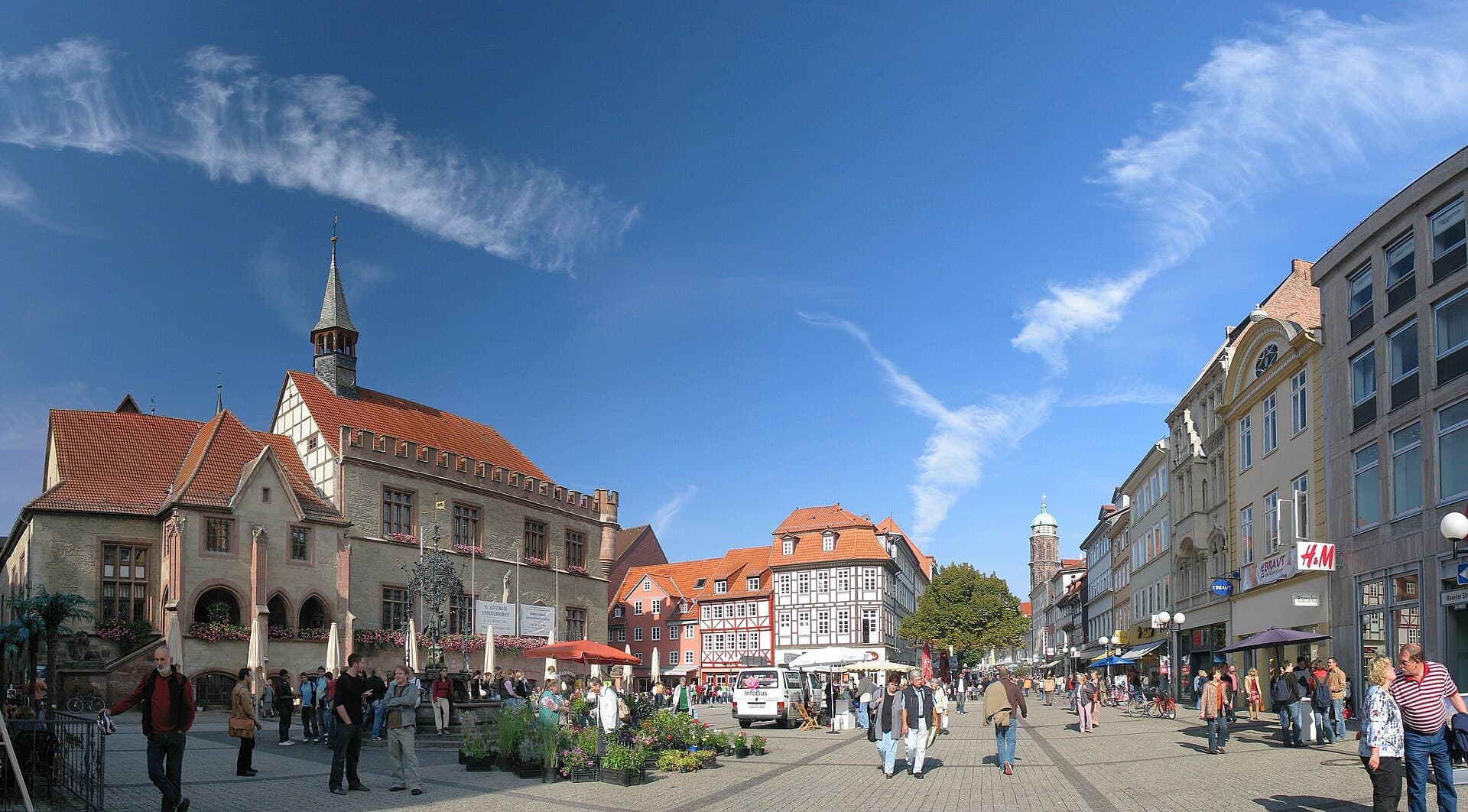
Göttingen's compact city center, embraced by medieval ramparts, allows for easy exploration on foot. The iconic Gänseliesel fountain in the Marktplatz, before the Old Town Hall (Altes Rathaus), is a primary point of interest. The Gothic Old Town Hall, constructed between 1369 and 1444, exemplifies North German Gothic architecture and displays coats of arms of other Hanseatic League members painted on its walls.
Walk along the well-preserved medieval city wall, which offers perspectives over the old town's red roofs. Explore the Old Botanical Garden, one of Germany's earliest, established in 1736, with its collection of over 10,000 plant species. For cultural insights, the Städtisches Museum chronicles the history and culture of southern Lower Saxony, including an honest look at the city's Nazi past. The Gothic St. Johannis Church from the 14th century provides expansive city views from its tower. The Historic Observatory, where Carl Friedrich Gauss taught, is also notable.
The most favorable time to visit Göttingen for pleasant weather and outdoor activities generally spans from May to October. During these months, the weather is typically mild to warm, with July being the warmest month, averaging around 73°F (23°C). Long summer days offer ample opportunity to explore historical sights and enjoy the city's convivial atmosphere. This period also hosts many cultural events, including the annual International Händel Festival in June. While rain is possible year-round, June and July typically see the highest precipitation.
Göttingen is readily accessible by car via the A7 motorway and federal roads B3 and B27, and by train with direct connections to major German cities like Hamburg, Hanover, Berlin, Frankfurt, and Munich. The city center is largely pedestrian-friendly with ancient lanes, so comfortable flat shoes are highly recommended for walking. The local bus network provides convenient transportation within the city, with single rides and day tickets available. The municipal Tourist Office, located in the Old Town Hall, is a valuable resource for maps, information, and accommodation bookings. While German is the primary language, the university environment means English is often understood.
Göttingen in Korean, in Chinese or in Hebrew — and 29 more languages, every stop narrated by a native voice. The widest language range of any self-guided audio tour.
Available in: