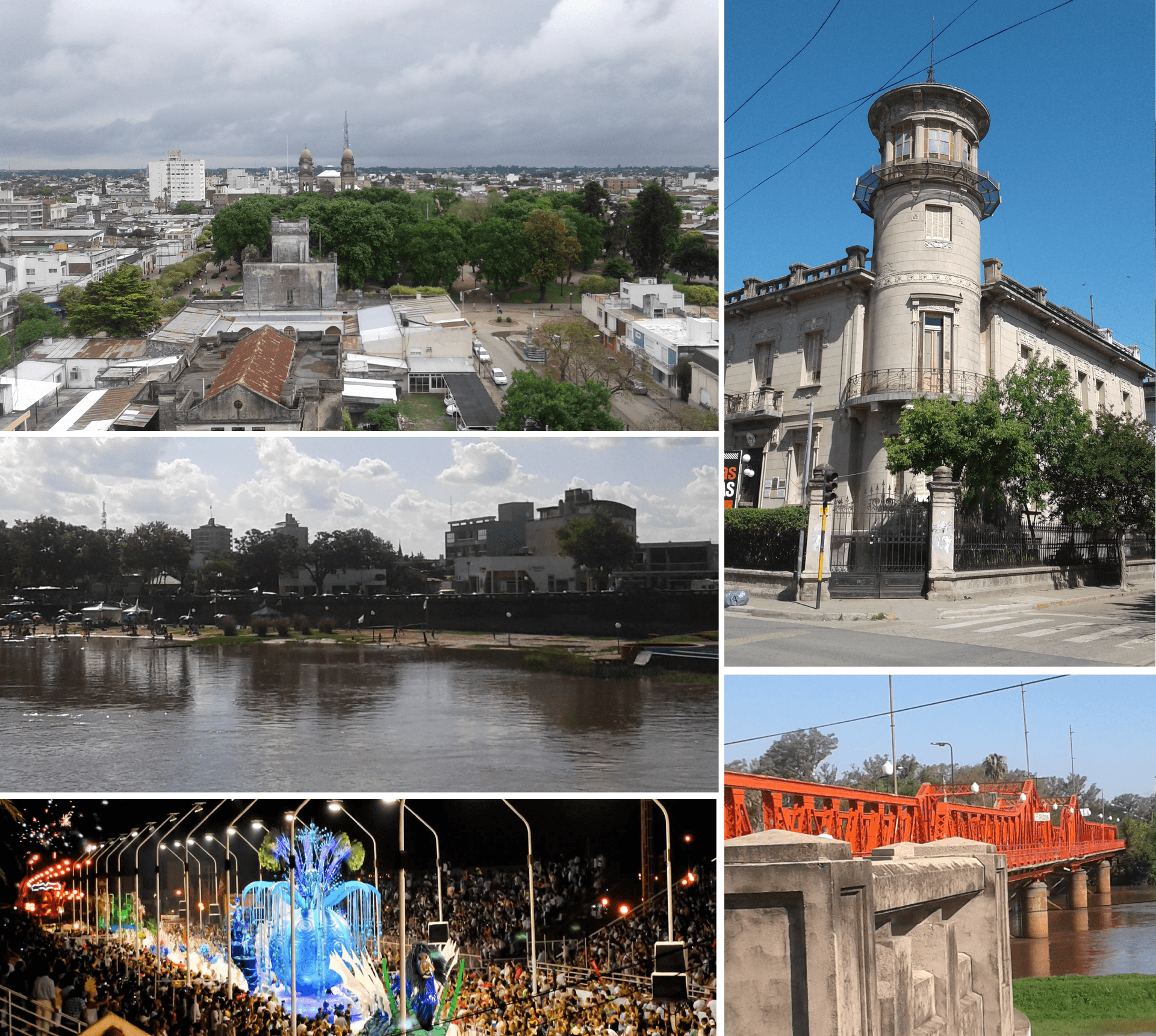
Imagine a city that builds a stadium just for its biggest party.
GranRevolucionario / CC0, via Wikimedia CommonsGualeguaychú
“Where the Gualeguaychú River meets the rhythm of celebration.”
Gualeguaychú, as no one tells it.
Not the postcards. The stories even locals don't know — whispered in your ear, right where they happened.
One house tells the story of an entire city's beginnings.
The city's name itself holds a secret about its waters.
Discover every secret of Gualeguaychú
Every address, every reveal in full — in your ear, right where it happened.
You pick your stops. You walk. The voice reveals what the others miss.
How long do you have in Gualeguaychú?
No tours available yet. Check back soon — we're preparing them.
The story of Gualeguaychú
Gualeguaychú, situated in Argentina's Entre Ríos province, offers a singular blend of spirited cultural festivities and tranquil natural splendor. The city rests on the left bank of the Gualeguaychú River, a tributary of the Uruguay River, approximately 230 kilometers northwest of Buenos Aires. Known as Argentina's "Carnival Capital," it draws thousands of visitors annually for its elaborate parades and animated atmosphere.
Beyond the pulsating rhythms of Carnival, Gualeguaychú extends a peaceful escape with its thermal complexes, white sand beaches, and expansive green spaces. The city balances its role as a lively center with the calm ambiance of a riverside resort, making it a destination that caters to both those seeking excitement and those desiring repose. Its strategic location near the Argentina-Uruguay border has also fostered a distinct regional identity, blending Argentine traditions with influences from across the river.
Whether you are exploring its historical sites, enjoying water activities on the river, or simply savoring the local gastronomy, Gualeguaychú presents an authentic Argentine experience. The city's dedication to preserving its natural environment alongside its cultural development makes it a compelling stop for any traveler.
From Colonial Outpost to Carnival Capital
The story of Gualeguaychú commences in the late 18th century, during Spain's endeavors to expand and consolidate its presence in the Río de la Plata region. In 1782, Viceroy Juan José de Vértiz y Salcedo entrusted Sergeant Major Tomás de Rocamora with organizing the dispersed villagers in the area to reinforce the Spanish presence against Portuguese incursions. On October 18, 1783, Rocamora officially founded the settlement, naming it Villa de San José de Gualeguaychú. He recognized that the initial chosen location was prone to flooding and judiciously relocated the settlement northward, across from what is now Libertad Island. Rocamora cleared the land, measured it, assigned public spaces, distributed 85 plots, and appointed the members of the first town council, designating San José as the patron saint.
During its initial decades, Gualeguaychú's economy was primarily shaped by cattle ranching, which provided leather, tallow, and jerked meat as primary sources of income. Its strategic river access also made it an important hub for shipping goods. The city was officially elevated to full city status on November 4, 1851, by a decree from General Justo José de Urquiza, who would later become Argentina's first constitutional president. This marked a significant transformation from a frontier settlement to a regional center.
In the final decades of the 18th century, the area saw an increase in inhabitants from Buenos Aires and Santa Fe, including Jesuit missionaries. These early inhabitants developed a subsistence economy, sometimes clashing with established landowners. The 1970s saw the creation of one of the province's first industrial parks, further diversifying the economy. However, it was at the turn of the 21st century that Gualeguaychú truly found its modern identity as a tourism capital. The construction of the Libertador General San Martín Bridge connected the city with Uruguay, ending its transport isolation, and the professionalization of the carnival movement solidified its unique brand. Today, Gualeguaychú stands as a testament to successful urban planning, respecting both its historical heritage and natural environment.
The Carnival's Evolution
The Gualeguaychú Carnival, often called "El Carnaval del País" (The Country's Carnival), has roots dating back nearly four decades, though its formal development took off with the construction of the Corsódromo in 1997. Inspired by Brazilian carnivals, it has evolved into a unique celebration that blends Argentine passion with Brazilian flair. What began as a small-town festival has grown into an internationally renowned event, attracting thousands of visitors from across Argentina and beyond.
Gualeguaychú extends a diverse range of attractions, from spirited cultural sites to peaceful natural retreats. The Corsódromo José Luis Hestro is the heart of the city's celebrated Carnival, a purpose-built venue that hosts the elaborate parades of competing comparsas (samba schools) every Saturday during January and February. Visitors can also explore the Carnival Museum to see costumes from past years and learn about the history of the carnival clubs.
For those seeking relaxation, Gualeguaychú offers several thermal complexes with therapeutic waters, providing a tranquil escape. The city's riverside location presents numerous beaches along the Gualeguaychú and Uruguay Rivers, such as Playa Papaya, Playa Solar del Este, and Balneario Ñandubaysal, perfect for swimming, sunbathing, and water sports. The Gualeguaychú Waterfront (Costanera) is a favored spot for leisurely strolls, enjoying sunsets, and dining at restaurants overlooking the water.
Nature enthusiasts will appreciate Unzué Park, an expansive green area on the left bank of the Gualeguaychú River, accessible via the Méndez Casariego Bridge. This park, covering over 100 hectares, is ideal for picnics, jogging, and observing local wildlife around its lagoon. Other notable sites include San José Cathedral and the Railway Museum, an open-air museum showcasing steam locomotives and artifacts at the historic Gualeguaychú railway station. The Museo Casa de Haedo, the city's first brick house, provides a glimpse into 19th-century life.
The best time to experience Gualeguaychú is during the summer months, from December to March. This period is characterized by hot, humid weather, with average daytime temperatures in January reaching around 30.7°C (87°F), ideal for enjoying the river beaches and outdoor activities. Most importantly, this is when the renowned Gualeguaychú Carnival takes place, transforming the city into a lively celebration. While summer is peak season, spring and autumn (late January to late April and early October to late December) offer balanced conditions with average temperatures around 18-22°C, suitable for excursions. Winters (June to August) are mild and cool, with average temperatures around 12-13°C, and are the driest months.
Gualeguaychú is approximately 230 km northwest of Buenos Aires. The most convenient way to reach Gualeguaychú from Buenos Aires is by car, a journey of about three hours via National Route 12 and Provincial Route 14. Several bus companies also offer daily services from Buenos Aires' Retiro bus terminal, with the trip taking approximately 3-4 hours. The city does not have its own airport, so travelers typically fly into Buenos Aires' Jorge Newbery Airfield (AEP) or Ezeiza International Airport (EZE), then continue by ground transport. There are no car rental services in Gualeguaychú, so renting a car in Buenos Aires is advisable if you plan to drive.
Public transportation within Gualeguaychú is infrequent at night; taxis or remises (private cars with fixed rates) are recommended for evening travel. The city center is compact and walkable. Accommodation options range from hotels and inns to cabins and campsites, with advance booking highly recommended during Carnival season and long weekends. While Spanish is the main language, some tourism professionals may speak basic English. Tipping around 10% in restaurants is customary. It is advisable to drink bottled water.
- What is Gualeguaychú best known for?
- Gualeguaychú is best known for its annual Carnival, often called "El Carnaval del País" (The Country's Carnival), which is considered one of the largest and most spirited carnivals in Argentina and South America.
- How far is Gualeguaychú from Buenos Aires?
- Gualeguaychú is approximately 230 kilometers (about 143 miles) northwest of Buenos Aires. The drive or bus ride typically takes around 3-4 hours.
- What can I do in Gualeguaychú besides Carnival?
- Beyond Carnival, visitors can enjoy thermal spas, relax on river beaches, explore Unzué Park, stroll along the Costanera (waterfront), visit the San José Cathedral, and discover local museums like the Railway Museum and Museo Casa de Haedo.
- Is Gualeguaychú safe for tourists?
- Gualeguaychú is generally considered a safe city for tourists. However, as with any destination, it is always wise to be aware of your surroundings and take standard safety precautions, especially in crowded areas during events like Carnival.
- What local dishes should I try in Gualeguaychú?
- When visiting Gualeguaychú, you should try traditional Argentine dishes such as *asado* (barbecue), *empanadas*, and various river fish preparations. Local wines and craft beers are also recommended.
- Are there any airports in Gualeguaychú?
- Gualeguaychú does not have its own commercial airport. Travelers typically fly into major airports in Buenos Aires, such as Jorge Newbery Airfield (AEP) or Ezeiza International Airport (EZE), and then travel to Gualeguaychú by bus or car.