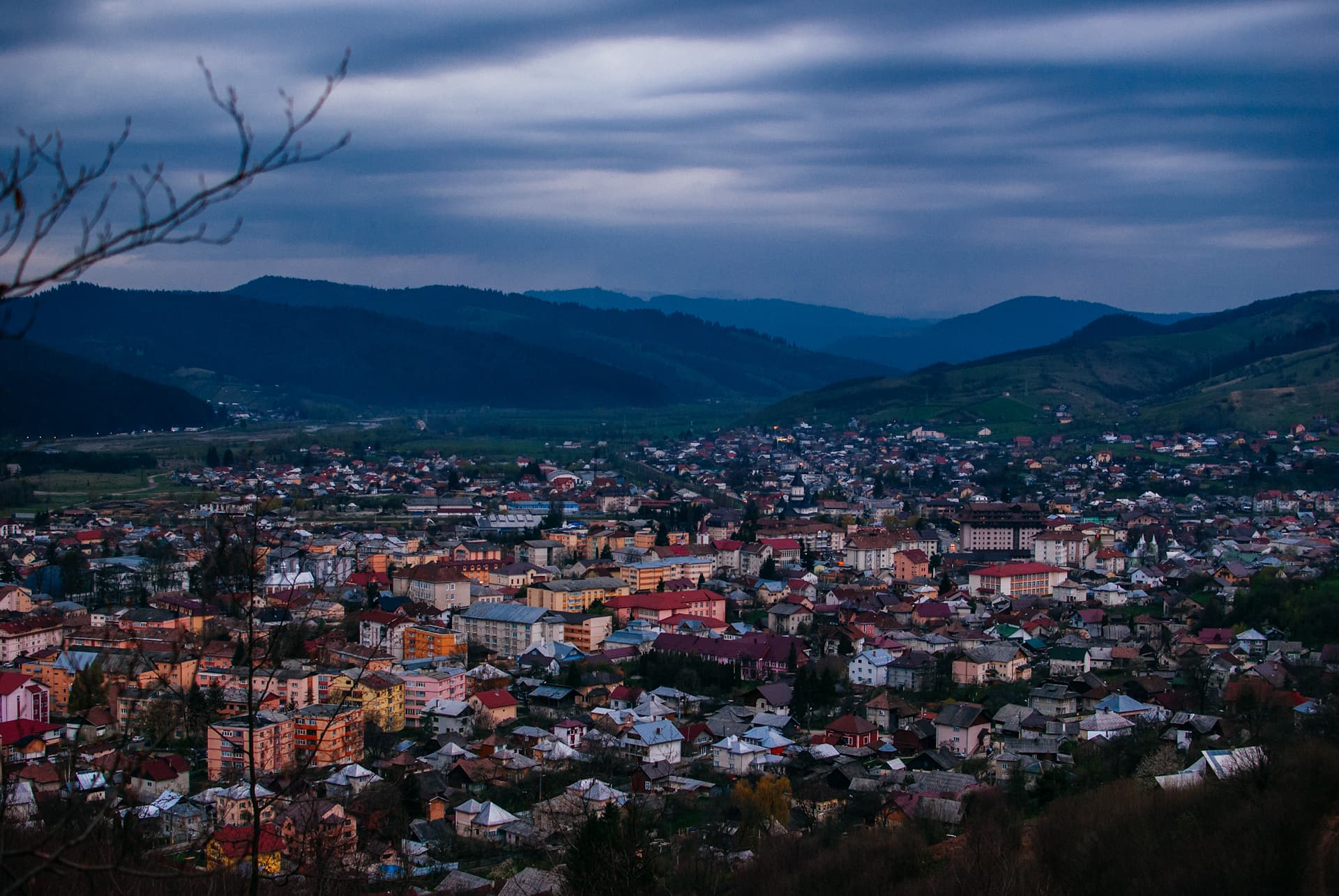
Gura Humorului, RomaniaMihai Burlacu / CC BY-SA 3.0, via Wikimedia Commons
RO

Gura Humorului

Where frescoes endure through centuries and forests invite exploration.

The secrets of Gura Humorului

Gura Humorului, as no one tells it.

Not the postcards. The stories even locals don't know — whispered in your ear, right where they happened.

3 secrets below. Many more wait inside the tour.
Voroneț Monastery

The striking blue adorning Voroneț Monastery is so distinctive, it earned a nickname. Yet, the true marvel lies in how this color has defied centuries of weather.

Full story unlocks in the tour
The Humor River

Gura Humorului's name translates to 'Mouth of Humor River.' However, the river's original designation carried no humorous intent.

Full story unlocks in the tour
Piatra Șoimului

This rock formation near Gura Humorului is said to have provided an unlikely sanctuary for a revered hermit.

Full story unlocks in the tour
The full tour

Discover every secret of Gura Humorului

Every address, every reveal in full — in your ear, right where it happened.

Get the key to Gura Humorului

You pick your stops. You walk. The voice reveals what the others miss.

Choose your time

How long do you have in Gura Humorului?

No tours available yet. Check back soon — we're preparing them.

About Gura Humorului

The story of Gura Humorului

Gura Humorului, a resort town in Romania's historical Bukovina region, presents a compelling fusion of cultural legacy and natural splendor. Situated where the Moldova and Humor rivers meet, the town is encircled by gentle, forest-clad hills, part of the Eastern Carpathians. This scenic environment offers a tranquil escape, making it an excellent destination for unwinding and engaging in outdoor pursuits.

The town serves as an ideal point from which to explore the celebrated Painted Monasteries of Bucovina, UNESCO World Heritage sites recognized for their vivid exterior frescoes. Beyond its historical treasures, Gura Humorului offers contemporary attractions such as adventure parks, a dancing fountain, and chances for hiking and winter sports. Its inviting atmosphere and varied offerings cater to travelers seeking both cultural immersion and active engagement.

Gura Humorului was recognized as a resort town in 2005, building on a history that saw it declared a town in 1904. The area's pleasant climate, with its calming properties, has drawn visitors since the latter half of the 19th century.

History

Early Settlements and Austrian Rule

Gura Humorului's documented history reaches back to November 26, 1490. For centuries, however, the area remained sparsely populated. In 1775, when the Habsburg Empire took control of Bukovina, Gura Humorului was still a modest settlement. To encourage growth, Austrian emperors subsidized immigration, leading to a diverse influx of ethnic groups including Germans, Armenians, Hungarians, Ukrainians, Poles, Romanians, and Jews. In 1780, Gura Humorului administratively separated from Voroneț, becoming a small market town, and by 1880, it was elevated to the status of a market town.

Jewish settlement in Gura Humorului began around 1835, with five families joining other ethnic groups. This community expanded, establishing its first synagogue in 1869 and a Great Synagogue in 1871. By the late 19th century, Jewish residents played a significant part in the town's industrialization, particularly in wood processing and lumber mills.

Disasters and World Wars

A significant event in the town's history was the devastating fire of May 11, 1899, which destroyed over 400 houses and businesses, reducing much of Gura Humorului to ashes. The town was rebuilt with the assistance of American-Jewish donations. In 1893, Gura Humorului became a county capital, and in 1904, it was officially declared a city.

Between 1774 and 1918, Gura Humorului was part of the Habsburg monarchy. During World War I, Bukovina became a battlefield, with conflicts between Austrian, Russian, and Romanian troops. Although Russian forces were eventually driven out in 1917, Austria ceded Bukovina to Romania through the Treaty of Saint-Germain in 1919.

World War II and Modern Development

During World War II, the Jewish community of Gura Humorului faced severe persecution. On October 10, 1941, nearly all 2,945 Jewish residents were deported to Transnistria. While some were allowed to return in 1944, the vast majority of survivors emigrated to Israel in the years following the war.

In more recent history, Gura Humorului was designated a tourist resort in 2005. The town continues to develop its tourism infrastructure, offering a range of attractions and accommodations for visitors.

What to see

Gura Humorului serves as an entry point to the renowned Painted Monasteries of Bucovina. The Voroneț Monastery, often referred to as the "Sistine Chapel of the East" for its electrifying blue frescoes depicting the Last Judgment, is a UNESCO World Heritage site and a symbol of the city, located just 5 kilometers away. The Humor Monastery, another painted church, also displays lively exterior artwork and offers a quiet space for contemplation.

For those who enjoy the outdoors, Ariniș Adventure Park provides zip-lining, tree climbing, and other exhilarating activities amidst verdant surroundings. The Parc Fântâna Arteziană (Artesian Fountain Park) offers a captivating display of water jets synchronized with music and colored lights, particularly impressive in the evenings. Visitors can also take a chairlift to the Soimul Observation Tower for expansive views of Gura Humorului and the surrounding mountains. Hiking and mountain biking trails abound in the nearby forests and hills.

The Museum of Popular Customs from Bukovina offers insight into the region's traditions. Further afield, the Vama Egg Museum, located about 18 km away, houses an extensive collection of over 11,000 decorated eggs from 82 countries.

When to visit

Gura Humorului is a destination for all seasons, with each period offering distinct experiences. For warm-weather activities like hiking and exploration, the ideal time to visit is from early July to late August, when temperatures are comfortable, averaging highs of 25°C (77°F). June is the wettest month, while January is the driest. If winter sports like skiing and snowboarding are your interest, December to February provides excellent conditions. Spring, particularly around April, is a good time to experience local traditions and Easter preparations.

Practical

Gura Humorului is readily accessible by both car and train, with bus and train stations situated near the town center. The town is compact enough to navigate on foot, and taxis offer an inexpensive option for longer distances. Electric buses also connect various attractions. For accommodation, Gura Humorului presents a range of hotels and guesthouses, with many options in the town center and mountainous areas. Popular choices include Best Western Bucovina, Casa Humor, and Pension La Roata. Dining options extend from traditional Romanian cuisine at places like Restaurantul Moldova and Casa Humor to pizzerias and cafes. The local food is known for its delicious flavors, so prepare to savor the experience.

Good to know
What are the primary attractions in Gura Humorului?
The primary attractions include the UNESCO-listed Voroneț and Humor Monasteries, Ariniș Adventure Park, Parc Fântâna Arteziană (Dancing Fountain Park), and the Soimul Observation Tower.
Is Gura Humorului suitable for families?
Yes, Gura Humorului is a family-friendly destination, offering activities like the Ariniș Adventure Park and the dancing fountain, as well as opportunities for outdoor recreation.
How many days should I plan for a visit to Gura Humorului?
It is recommended to spend at least four days in Gura Humorului to fully enjoy all the resort has to offer, including nearby monasteries and outdoor activities.
What kind of food can I expect in Gura Humorului?
You can expect delicious traditional Romanian and Bucovinian cuisine, with many restaurants offering authentic dishes.
Is it easy to get around Gura Humorului without a car?
Yes, Gura Humorului is a small town, and many attractions are walkable. Taxis and newly introduced electric buses are also available for getting around.
What are some unique local experiences in Gura Humorului?
Beyond the monasteries, consider visiting the Vama Egg Museum, exploring hiking trails, or experiencing the International Festival of Satirical Graphics and Humoristic Literature "Humor in… Gura Humorului" if your visit aligns.
Gura Humorului
From€9.00
No booking · activate anytime · 12h to walk it
Get the key to Gura Humorului