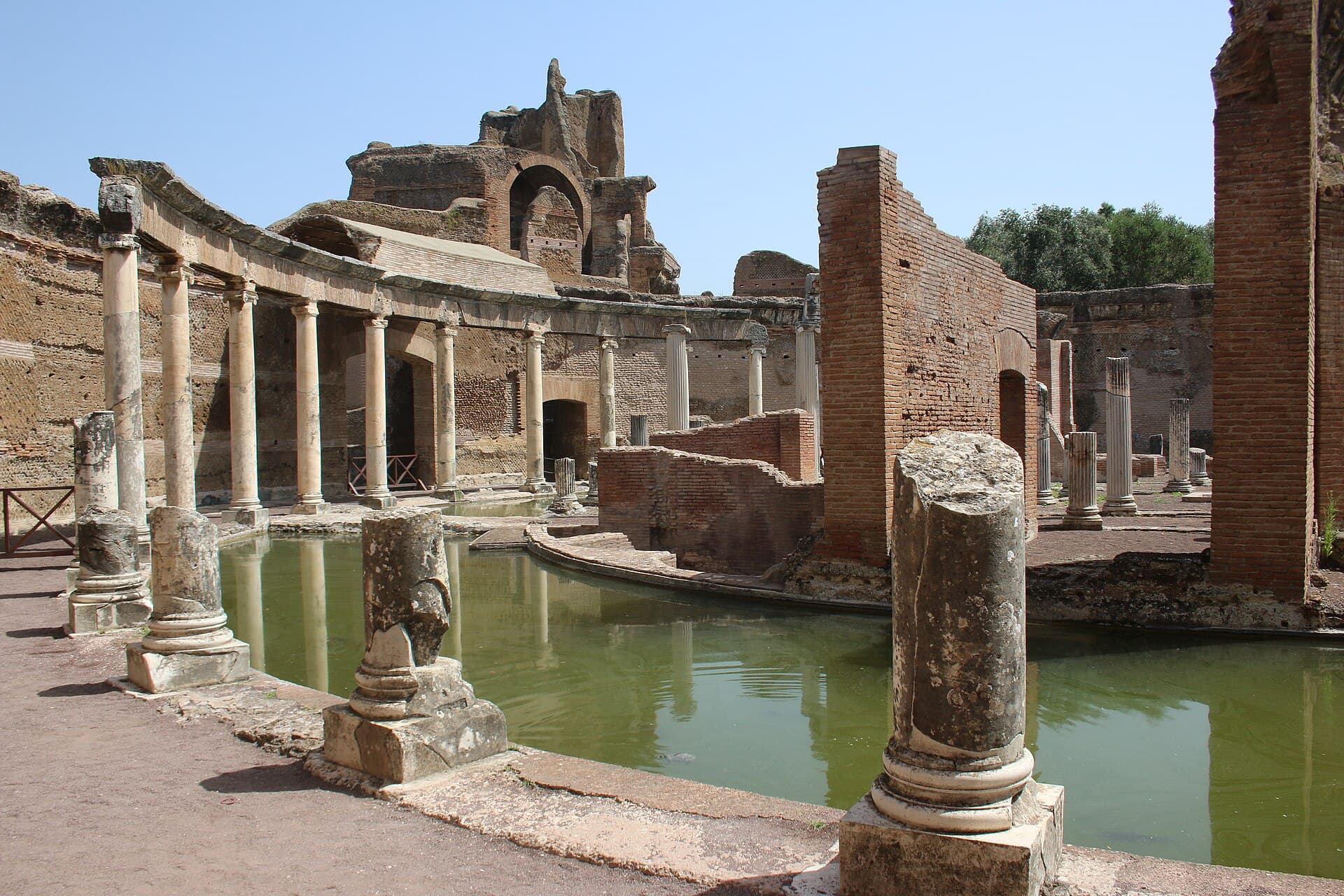
The Maritime Theatre
This seemingly conventional name conceals a space designed for profound solitude.
Full story unlocks in the tour
 FrDr / CC BY-SA 4.0, via Wikimedia Commons
Self-guided audio walking tour of Hadrian's Villa — GPS route, offline playback, story-driven narration in 32 languages.
“Step into the emperor's mind: a sprawling retreat where Hadrian recreated the world.”
Not the postcards. The stories even locals don't know — whispered in your ear, right where they happened.
This seemingly conventional name conceals a space designed for profound solitude.
Hadrian's love for a lost companion is etched into the very landscape of his villa.
Even the most humble facilities at Hadrian's Villa held a secret to Roman engineering.
Discover every secret of Hadrian's Villa
Every address, every reveal in full — in your ear, right where it happened.
You pick your stops. You walk. The voice reveals what the others miss.
Your self-guided audio tour of Hadrian's Villa is ready — pick your landmarks, choose your language, and start the moment you arrive.
BuyHadrian's Villa, or Villa Adriana, stands as a testament to the vision and architectural ambition of Emperor Hadrian. Constructed between 118 and 138 AD, this monumental complex near Tivoli, approximately 20 kilometers from Rome, served as a luxurious escape from the political pressures of the capital. Spanning an area of at least 120 hectares, the villa was larger than the city of Pompeii and was inscribed as a UNESCO World Heritage Site in 1999.
The villa was conceived as an "ideal city," incorporating architectural styles and elements from the various provinces Hadrian had encountered during his extensive travels across the Roman Empire. This unique blend of Roman, Greek, and Egyptian influences is evident in its diverse structures, from grand baths and libraries to elaborate gardens and nymphaea. Today, approximately 40 hectares of the site are open to visitors, offering a sprawling open-air museum that continues to reveal the ingenuity and personal interests of one of Rome's most cultured emperors.
Emperor Hadrian, known for his cultural sophistication and extensive travels, began construction on his villa shortly after his ascension to power in 117 AD. While initial building efforts started around 118-119 AD, Hadrian's first documented presence at the villa was in 125 AD, after his initial travels. The villa expanded significantly after his first journey, with much of the construction occurring while he was away on subsequent trips, allowing him to return to completed sections around 130 AD.
Hadrian's Villa was more than just a residence; it was a physical manifestation of the emperor's experiences and intellectual pursuits. He sought to recreate the places and monuments that had impressed him most during his journeys, leading to a complex that integrated architectural traditions from Greece, Egypt, and Asia Minor. This fusion of styles is a hallmark of the villa, showcasing Hadrian's appreciation for diverse cultures. The site's location was chosen for its abundant water sources, supplied by several aqueducts feeding Rome, which were essential for the villa's numerous fountains, pools, and gardens.
After Hadrian's death in 138 AD, the villa continued to be used by subsequent emperors, including Antoninus Pius and Marcus Aurelius. Wall paintings indicate its use into the early 3rd century. However, by the time of Constantine, the villa began to be stripped of its artworks and valuables. Over the centuries, it fell into disrepair and was systematically plundered for its precious materials, with many of its statues and marble adorning collections across Europe. Despite this extensive looting, scientific excavations began after the unification of Italy and continue to this day, constantly unearthing new insights into this extraordinary imperial complex.
Exploring Hadrian's Villa is a journey through Hadrian's world, offering a glimpse into the emperor's architectural vision and personal tastes. The site covers a vast area, so comfortable footwear is essential. A good starting point is the Pecile, a large portico that once enclosed a garden with a long central pool, inspired by the Stoa Poikile in Athens. From there, you can proceed to the iconic Maritime Theatre, a circular island villa surrounded by a moat, which served as Hadrian's private retreat.
The Canopus is another highlight, a long, reflective pool adorned with columns and statues, culminating in the Serapeum, a semi-circular grotto that functioned as a summer dining area. This area pays homage to Egyptian culture and is believed to commemorate Antinous. The villa also features several bath complexes, including the Great Baths and Small Baths, showcasing the Roman bathing ritual and varying levels of luxury. Do not miss the Hospitalia, which housed elaborate guest quarters with remarkably well-preserved mosaic floors. While much of the Imperial Palace is in ruins, its foundations still convey a sense of its original grandeur. The site also includes the remains of Greek and Latin Libraries, a Greek Theatre, and various nymphaea and fountains.
The best times to visit Hadrian's Villa are during the spring and fall, when the weather is mild and pleasant for walking around the expansive outdoor site. Summers can be very hot, making early morning visits advisable to avoid the peak heat. The villa is open daily, with closing times varying seasonally. Winter visits are possible, but be prepared for colder temperatures.
Hadrian's Villa is located near Tivoli, approximately 20 km from Rome. It can be reached by public transport from Rome by taking Metro Line B to Ponte Mammolo, then a Cotral bus towards Tivoli or Villa Adriana. Some buses stop directly at the villa's entrance, while others require a short walk. Guided tours from Rome are also a convenient option, often combining a visit with nearby Villa d'Este.
Admission tickets can be purchased online or at the ticket office. Free admission is offered on the first Sunday of each month and on specific Italian national holidays. The site is largely outdoors, so wear comfortable shoes and dress appropriately for the weather. Facilities on-site include restrooms, drinking water fountains, and a small refreshment area. Audio guides are available for rent, and guided tours can be booked. The site is partially accessible for people with disabilities.