Along the Wall's path
Hadrian's Wall was not merely a military barrier; it was a lively crossroads of diverse cultures.
Full story unlocks in the tour
Self-guided audio walking tour of Hadrian's Wall — GPS route, offline playback, story-driven narration in 32 languages.
“Walk the edge of an empire, where Roman legions stood guard against the 'barbarians.'”
Not the postcards. The stories even locals don't know — whispered in your ear, right where they happened.
Hadrian's Wall was not merely a military barrier; it was a lively crossroads of diverse cultures.
Beneath the earth near Hadrian's Wall, archaeologists unearthed Britain's most ancient handwritten documents.
While the Wall was constructed to define the Roman frontier, it was not impenetrable.
Discover every secret of Hadrian's Wall
Every address, every reveal in full — in your ear, right where it happened.
You pick your stops. You walk. The voice reveals what the others miss.
Your self-guided audio tour of Hadrian's Wall is ready — pick your landmarks, choose your language, and start the moment you arrive.
BuyHadrian's Wall, a UNESCO World Heritage Site, stretches 73 modern miles (117 km) across northern England, from Wallsend on the River Tyne in the east to Bowness-on-Solway in the west. Commissioned by Emperor Hadrian in 122 AD, this monumental undertaking defined the northwestern frontier of the Roman Empire for nearly 300 years. It was a complex system of defenses, featuring a continuous curtain wall of stone or turf, fronted by a ditch, and punctuated by milecastles, turrets, and larger forts, all connected by a military road.
Beyond its defensive purpose against northern tribes, the Wall served as a means of frontier control, regulating movement and trade into the Roman Empire. Today, what remains of Hadrian's Wall is a significant cultural icon and a major ancient tourist attraction, drawing visitors from around the world to walk in the footsteps of Roman soldiers and explore the remnants of this ambitious engineering feat.
## Building the Frontier Emperor Hadrian, who ruled from 117 to 138 CE, initiated the construction of the Wall in 122 CE, personally inspecting the progress in 122 AD. His strategy focused on securing existing borders rather than further expansion. The construction was a gargantuan task, taking approximately 15,000 men from Britain's three legions—II Augusta, VI Victrix, and XX Valeria Victrix—around six years to complete. These citizen-soldiers were skilled in masonry, engineering, and architecture.
The original plan for Hadrian's Wall involved a stone wall for the eastern 45 miles (72 km) from the River Tyne to the River Irthing, and a turf rampart for the western 26 miles (42 km) to the Solway Estuary, likely due to local material availability. The stone wall was initially planned to be 10 Roman feet (3 meters) wide and up to 15 feet (4.6 meters) high, with a walkway and parapet. Along its length, milecastles, small fortlets with gates, were placed at every Roman mile, and two turrets, or observation towers, were built between each pair of milecastles, creating lookout points every third of a mile. Behind the Wall, a large earthwork known as the Vallum, consisting of a flat-bottomed ditch flanked by two mounds, marked the southern edge of the military zone.
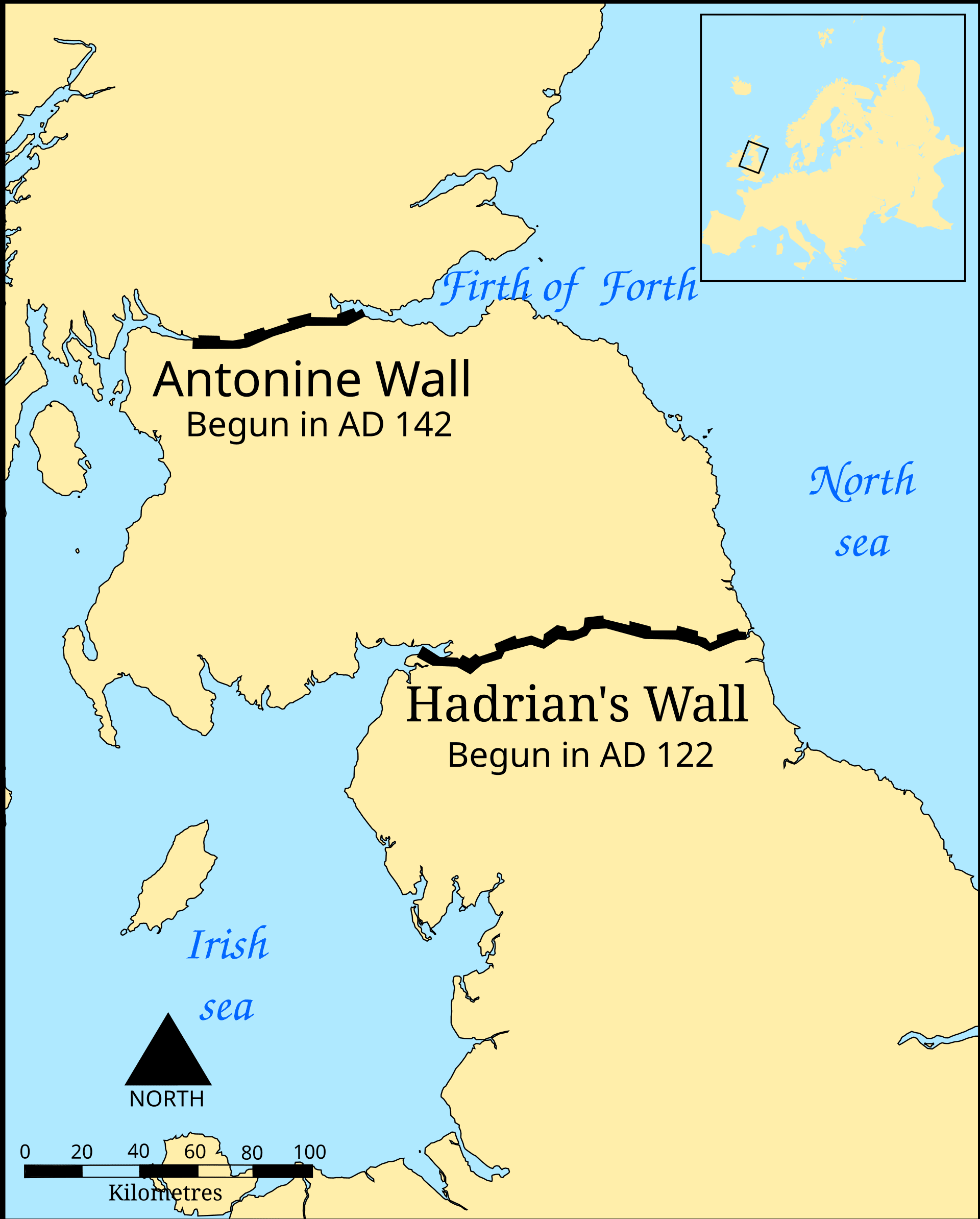
## Evolution and Abandonment Even before the initial design was finished, significant changes were made, including the addition of larger forts directly on the Wall line at intervals of about 7 miles (11 km). Over its nearly 300-year occupation, the Wall underwent further modifications and repairs. For a brief period around 142 AD, Hadrian's Wall was abandoned in favor of the Antonine Wall, a new turf and timber frontier built further north in Scotland. However, within two decades, the Antonine Wall was abandoned, and Hadrian's Wall was re-established as the primary frontier. By the 5th century, after the Roman army's departure from Britain, the Wall fell out of use and much of its stone was repurposed for local buildings.
## Preservation Efforts Despite centuries of stone removal, the remaining foundations and forts continue to draw visitors. Much of the Wall's preservation is credited to 19th-century antiquarian John Clayton, who purchased land along its route, excavated forts and milecastles, and initiated restoration efforts. Hadrian's Wall was designated a UNESCO World Heritage Site in 1987, and in 2005, it became part of the larger transnational 'Frontiers of the Roman Empire' World Heritage Site, which also includes sites in Germany and Scotland.
To truly experience Hadrian's Wall, consider walking sections of the Hadrian's Wall Path National Trail, an 84-mile route that traces the Roman frontier. While you cannot walk directly on the Wall itself to preserve the ancient monument, the path runs alongside it, offering access to key sites.
Among the best-preserved sections and Roman forts to explore are:
Other notable sections include Walltown Crags for dramatic views along the Whin Sill ridge, and the area between Steel Rigg and Housesteads, known for its scenic beauty. Poltross Burn is one of the best-preserved milecastles, with surviving steps and an oven.
The best time to visit Hadrian's Wall for walking and cycling is between May and September, when the weather is generally warmer and drier, and daylight hours are longer. June to September offers prime hiking conditions, though July and August are the busiest due to school holidays. Spring (March-May) brings blooming wildflowers and newborn lambs, but can be wet. Autumn (September-November) offers beautiful golden foliage and fewer crowds, especially in September, but the weather can become wet and windy, and some accommodations may close by late October/early November. Regardless of the season, be prepared for unpredictable weather in northern England with warm clothing and waterproofs.
Hadrian's Wall spans three modern-day counties: North and South Tyneside, Newcastle, Northumberland, and Cumberland. While many sections are privately owned, English Heritage and the National Trust manage several key sites, offering free access to members. It is free to walk the Hadrian's Wall Path National Trail. You can begin your journey at various points along the Wall. The official Hadrian's Wall Country website provides comprehensive visitor information.
For those undertaking the full Hadrian's Wall Path, it typically takes 6-8 days to complete the 84 miles (135 km). Many companies offer guided walks or self-guided packages that include accommodation bookings and luggage transfers. It is advisable to carry a guidebook or use a navigation app, as signs can sometimes be missed. Accommodation options along the Wall include B&Bs, inns, and designated campsites. Be sure to pack good waterproof walking shoes or boots, comfortable walking clothes, and waterproof outerwear, as the weather is often unpredictable.