Hallmarkt
The bronze statues in Hallmarkt square tell a story that's deeper than just decorative art.
Full story unlocks in the tour
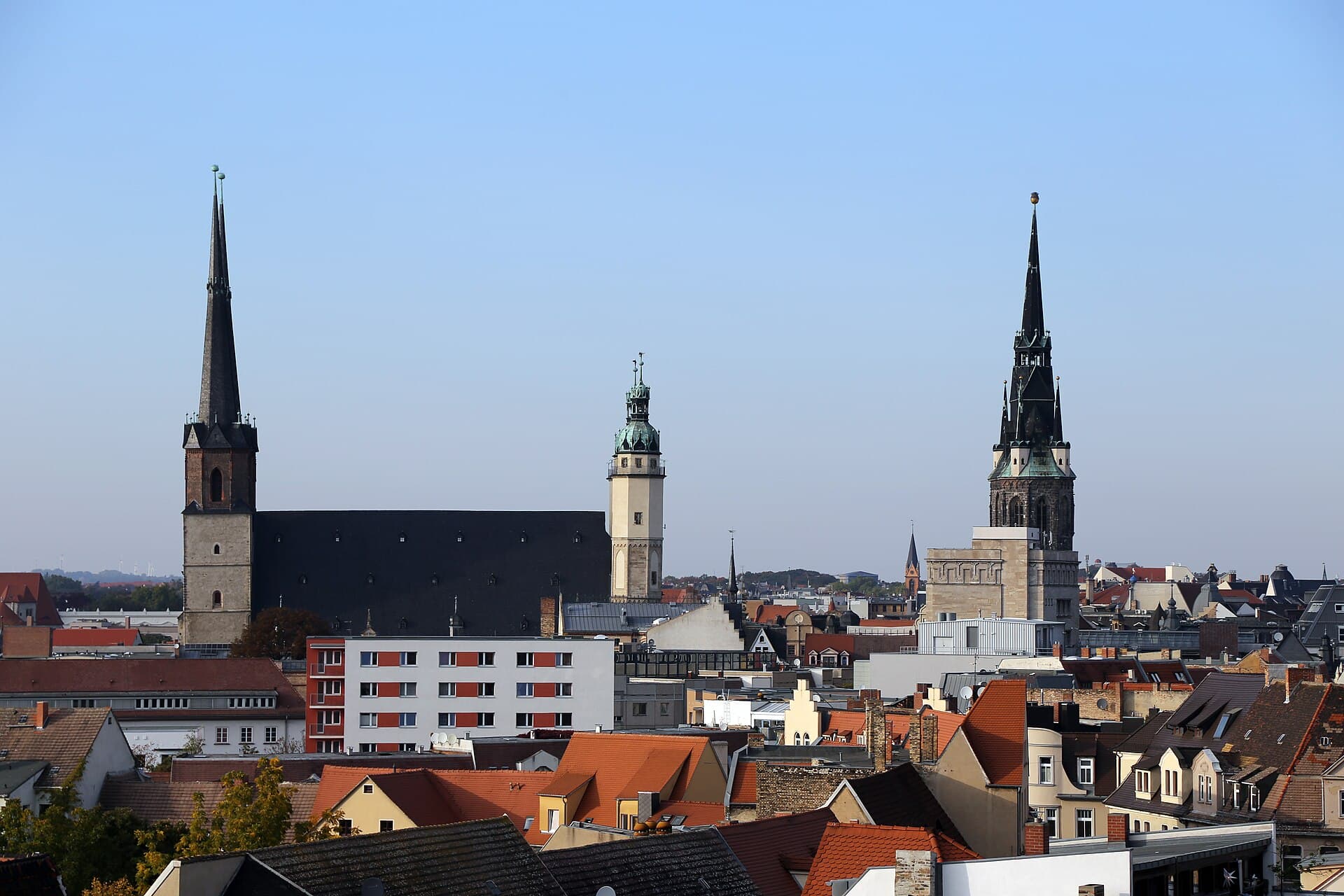 Vincent Eisfeld / CC BY-SA 4.0, via Wikimedia Commons
“Where ancient salt springs meet Baroque brilliance and modern innovation.”
Not the postcards. The stories even locals don't know — whispered in your ear, right where they happened.
The bronze statues in Hallmarkt square tell a story that's deeper than just decorative art.
Germany's oldest chocolate factory has a sweet secret in the name of its most famous treat.
Halle's historic university has a surprising connection to pioneering women in medicine.
Discover every secret of Halle
Every address, every reveal in full — in your ear, right where it happened.
You pick your stops. You walk. The voice reveals what the others miss.
No tours available yet. Check back soon — we're preparing them.
Halle (Saale), often simply called Halle, is a city in Saxony-Anhalt, Germany, with a history stretching back over 1200 years. Situated on the Saale River, it's a place where the echoes of ancient salt production blend with the melodies of Baroque music and the energy of a modern university town. The city's name itself is linked to salt, derived from a Celtic word meaning "a place where salt is produced."
Once a significant economic and educational center, Halle has navigated a complex past, from its medieval prosperity built on salt to its role as an industrial hub in East Germany. Today, Halle offers a unique blend of preserved historical architecture and contemporary life, with a lively cultural scene and a reputation as a center for science and education.
Visitors can explore a cityscape that reveals layers of Gothic, Renaissance, Baroque, Art Nouveau, and modern architectural styles. The city's commitment to culture is evident in its numerous museums, theaters, and musical events, making it a compelling destination for those seeking both historical depth and a lively present.
## The Salty Foundations Halle's story is inextricably linked to salt, a resource so vital in the Middle Ages it was dubbed "white gold." Archaeological evidence suggests human settlement and Bronze Age salt mining in the area as early as 3000 BCE. The city's first official mention dates to 806 CE, when Charlemagne established a fortress here. By 981, Emperor Otto II granted Halle city status. The systematic mining of salt began in the 10th century, and by the late 13th century, Halle's economic power was further solidified by joining the Hanseatic League. The salt-makers, known as "Halloren," formed powerful guilds, and their trade was the primary economic engine for centuries.
## A Center of Learning and Culture Beyond its salt wealth, Halle became a significant intellectual and cultural center. For nearly 700 years, from the mid-10th century, it was part of the Archbishopric of Magdeburg. In 1522, Halle embraced the Protestant Reformation, becoming an important hub for Martin Luther's movement. A pivotal moment arrived in 1694 with the founding of the University of Halle, which quickly became one of Europe's leading centers of enlightenment. The city is also the birthplace of the renowned Baroque composer George Frideric Handel, born in 1685.
## Modern Transformations Halle passed to Brandenburg in 1648, marking the beginning of its Prussian era. During the War of the Fourth Coalition, French and Prussian forces clashed in the Battle of Halle in 1806. In 1815, it became part of the Prussian Province of Saxony. Halle largely escaped significant damage during World War II, preserving much of its historic cityscape. After the war, it became part of East Germany, serving as the capital of the Halle district until German reunification in 1990. During the GDR era, Halle was a major center for the chemical industry, and the extensive new town of Halle-Neustadt was built. Following reunification, the city underwent significant reconstruction and renovation, transforming from a chemistry metropolis into a hub for education and science.
The Marktplatz (Market Square) is the historic heart of Halle, featuring the impressive Market Church of Our Lady with its distinctive four towers and the 84-meter-high Red Tower from 1506, which contains Europe's largest carillon of 76 bells. A bronze statue of George Frideric Handel stands prominently in the square. Just a short walk away, the Handel House (Händel-Haus) is the composer's birthplace and now a museum dedicated to his life and work, as well as the musical history of Halle.
For a taste of Halle's industrial heritage, visit the Halloren Chocolate Factory, Germany's oldest continuously operating chocolate factory, which includes a museum and tasting opportunities. Explore the Hallors and Saline Museum to learn about the city's ancient salt production, where you can still witness traditional salt-making methods. The State Museum of Prehistory houses the world-famous Nebra Sky Disc, a 3,600-year-old Bronze Age artifact.
Other notable sites include Moritzburg Castle, now an art museum, and Giebichenstein Castle, which houses an art school and offers panoramic city views. The Stadtgottesacker Cemetery is considered one of Germany's most beautiful Renaissance cemeteries.
The best time to visit Halle for pleasant weather and outdoor activities is from mid-May to mid-September, when temperatures are warmest and skies are clearer. July is typically the warmest month, with an average temperature of 66.6°F (19.2°C). For fewer crowds and mild conditions, consider the shoulder seasons of late spring (May) and early autumn (September-October). Winter (November-March) is colder with shorter days, but can be ideal for budget travel outside of holiday periods.
Halle is well-connected within Germany, accessible by fast train from Berlin in just over an hour, and from Leipzig in about 20 minutes. Leipzig/Halle International Airport is conveniently located between the two cities. The city's tramway network is extensive and reliable, offering an efficient way to get around. Monthly or weekly tickets are recommended for cost-effectiveness. While credit cards are widely accepted, it's advisable to carry some euros for smaller shops. Advance reservations for popular restaurants and museums are recommended, especially during peak season. Halle is also known for its pedestrian-friendly areas, making walking a pleasant way to explore the historic center.