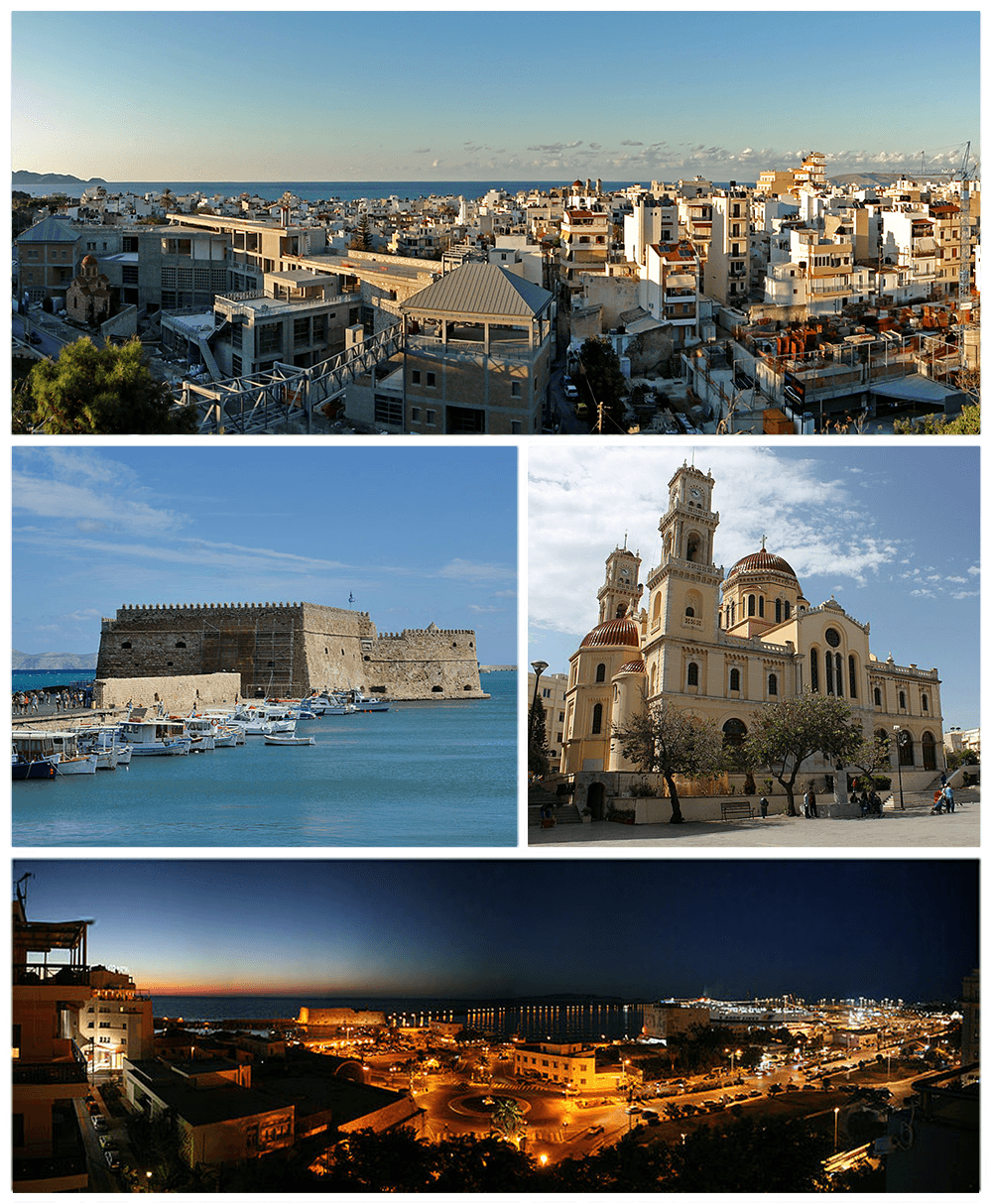
Héraklion, GreeceSilentResident (compilation, sources to attribute see above; if any of the sources used in the Montage are removed from Wikimedia Commons, or better ones are found, please inform its creator so that they can update it. You can contact the creator by leaving a message here: [1]) / CC BY-SA 3.0, via Wikimedia Commons
GR

Héraklion

Where ancient myths meet modern life, a city etched by empires and alive with Cretan spirit.

The secrets of Héraklion

Héraklion, as no one tells it.

Not the postcards. The stories even locals don't know — whispered in your ear, right where they happened.

3 secrets below. Many more wait inside the tour.
Agios Titos Church and the tiny Agios Minas Chapel

Most visitors make their way to the prominent Agios Titos.

Full story unlocks in the tour
Ammoudara Beach

Ammoudara is the closest beach to Heraklion, but few stay for its 'golden hour miracle.'

Full story unlocks in the tour
Morosini Fountain (Lions Square) to the market street

The Morosini Fountain is a popular meeting point, but the true pulse of local life lies just beyond.

Full story unlocks in the tour
The full tour

Discover every secret of Héraklion

Every address, every reveal in full — in your ear, right where it happened.

Get the key to Héraklion

You pick your stops. You walk. The voice reveals what the others miss.

Choose your time

How long do you have in Héraklion?

No tours available yet. Check back soon — we're preparing them.

About Héraklion

The story of Héraklion

Heraklion, also known as Iraklion, is the largest city on Crete and the fourth largest in Greece. It serves as the administrative capital of the island and the Heraklion regional unit. With a continuous habitation history dating back at least 7000 BCE, it is one of Europe's oldest inhabited regions. The city is a lively blend of ancient history and contemporary life, acting as a significant economic, commercial, and scientific hub for Crete. Its international airport is the second busiest in Greece and a major gateway for travelers to the island.

While some might initially perceive Heraklion as a bustling urban center, it is a city that reveals its allure over time. It offers a wealth of cultural and historical sites, an animated atmosphere, and authentic local spirit, attracting international visitors throughout the year. Heraklion's central location on Crete also makes it an ideal base for exploring the diverse landscapes and attractions of the wider island.

History

## From Minoan Port to Venetian Stronghold Heraklion's history is deeply intertwined with the Minoan civilization, considered by many to be Europe's oldest. The area that is now Heraklion served as the port for the ancient city of Knossos, a major Minoan center that flourished from the 16th to the 14th century BCE. Archaeological evidence suggests the port was in use from the Early Minoan period (3500 to 2100 BCE).

After the decline of the Minoans, Heraklion, like the rest of Crete, experienced a period of limited development. Construction began to pick up with the arrival of the Romans, though the early Byzantine era saw the area troubled by pirates. The city as we largely recognize it today was founded in 824 CE by the Arabs, who named it Khandaq, meaning "Moat." This period marked the city's rise as the capital of Saracen Crete. The Byzantines attempted to reclaim Crete repeatedly, with one notable but unsuccessful campaign in 826 CE led by General Krateros, whose name is still preserved in an area east of Heraklion.

Crete was eventually bought by the Venetians in 1204, who renamed the city Candia, a modification of Khandaq. Under Venetian rule, Candia became the capital of the island, a significant urban center in the eastern Mediterranean, and a hub of intellectual and artistic life. The Venetians heavily fortified the city, constructing extensive walls that are among the best-preserved medieval fortifications in Europe. These fortifications famously withstood a 21-year siege before the city fell to the Ottomans in 1669, one of the longest sieges in history. During the Ottoman period, economic and cultural development slowed, but the city maintained its administrative importance. In 1898, an autonomous Cretan State was established, and the city was renamed Heraklion, after the ancient Roman port of Heracleum. Heraklion officially became the capital of Crete in 1971.

## Modern Heraklion Heraklion suffered significant damage from German bombing during the Battle of Crete in World War II. Despite this, the city has rebuilt and continues to flourish as a dynamic center. It was recognized as Europe's fastest-growing tourism destination in 2017, experiencing an 11.2% increase in international visitors. Today, Heraklion is a city that embraces its layered past while looking towards a future full of potential.

What to see

Begin your exploration at the Heraklion Archaeological Museum, one of Greece's most important museums, housing artifacts spanning 5,500 years, with a particularly rich collection of Minoan treasures from sites like Knossos. Afterward, visit the Palace of Knossos, located just south of the city, often referred to as Europe's oldest city and the heart of the Minoan civilization. Consider an early morning visit to avoid crowds.

Return to the city center to experience Lions Square, officially Morosini Fountain, a popular meeting spot with its distinctive four lions. Nearby, the Venetian Loggia, once a gathering place for Venetian nobles, now serves as Heraklion's City Hall. Stroll along the impressive Venetian Walls, some of Europe's best-preserved medieval fortifications, offering expansive views of the city and sea. At the Venetian Harbor, the imposing Koules Fortress stands guard, inviting visitors to explore its interiors, which once held prison cells and officers' rooms. For a deeper dive into more recent history, the Historical Museum of Crete features collections from early Christian times to the present day, including works by El Greco.

When to visit

Heraklion enjoys a classic Eastern Mediterranean climate with over 300 days of sunshine annually. The optimal times to visit are the shoulder seasons: May-June and September-October. During these months, the weather is warm, the water is pleasant for swimming, and there are fewer crowds compared to peak summer. July and August are extremely hot, crowded, and more expensive. For those interested in culture and local life, the milder winter months (November-March) offer a quieter experience with fewer visitors, though with occasional rain. Greek Orthodox Easter, usually in April, is a significant celebration in Heraklion. The Heraklion Summer Arts Festival, featuring theater, music, and dance, takes place in July.

Practical

Heraklion International Airport (Nikos Kazantzakis Airport) is located approximately 5 kilometers east of the city center and is the second busiest airport in Greece. From the airport, you can reach the main tourist areas by bus or taxi. Heraklion is also a major port, with ferries connecting to other Greek islands like Santorini, Mykonos, and Rhodes, as well as daily services to Piraeus, the port of Athens. Within the city, the center is highly walkable, with many pedestrianized streets. For longer distances or exploring outside the city, taxis, local buses, or rental cars are convenient options. While ride-sharing apps like Uber are not available in Crete, the island has a good bus network for inter-city travel. Heraklion is generally considered a safe city for tourists, though standard precautions are always advisable.

Good to know
Is Heraklion a good base for exploring Crete?
Yes, Heraklion's central location, international airport, and busy port make it an excellent base for day trips to beaches, villages, and archaeological sites across the island.
What are the best ways to get around Heraklion?
The city center is very walkable. For exploring further, taxis, local buses, or a rental car are convenient options. Ride-sharing apps like Uber are not available.
Are there beaches near Heraklion?
Yes, Ammoudara Beach is just a few kilometers west of the Old Town and is a popular spot, especially in the summer.
What kind of cultural experiences can I find in Heraklion?
Heraklion offers traditional Cretan music, dance, art, and cuisine, particularly during local festivals and at museums like the Heraklion Archaeological Museum.
Is Heraklion safe for tourists?
Heraklion is considered a safe city with a low crime rate, but it's always wise to take basic precautions as you would in any major city.
What is Heraklion known for?
Heraklion is primarily known as the home of the ancient Palace of Knossos, the center of the Minoan civilization and often called Europe's oldest city. It's also recognized for its Venetian fortifications and as the largest city on Crete.
Héraklion
From€9.00
No booking · activate anytime · 12h to walk it
Get the key to Héraklion