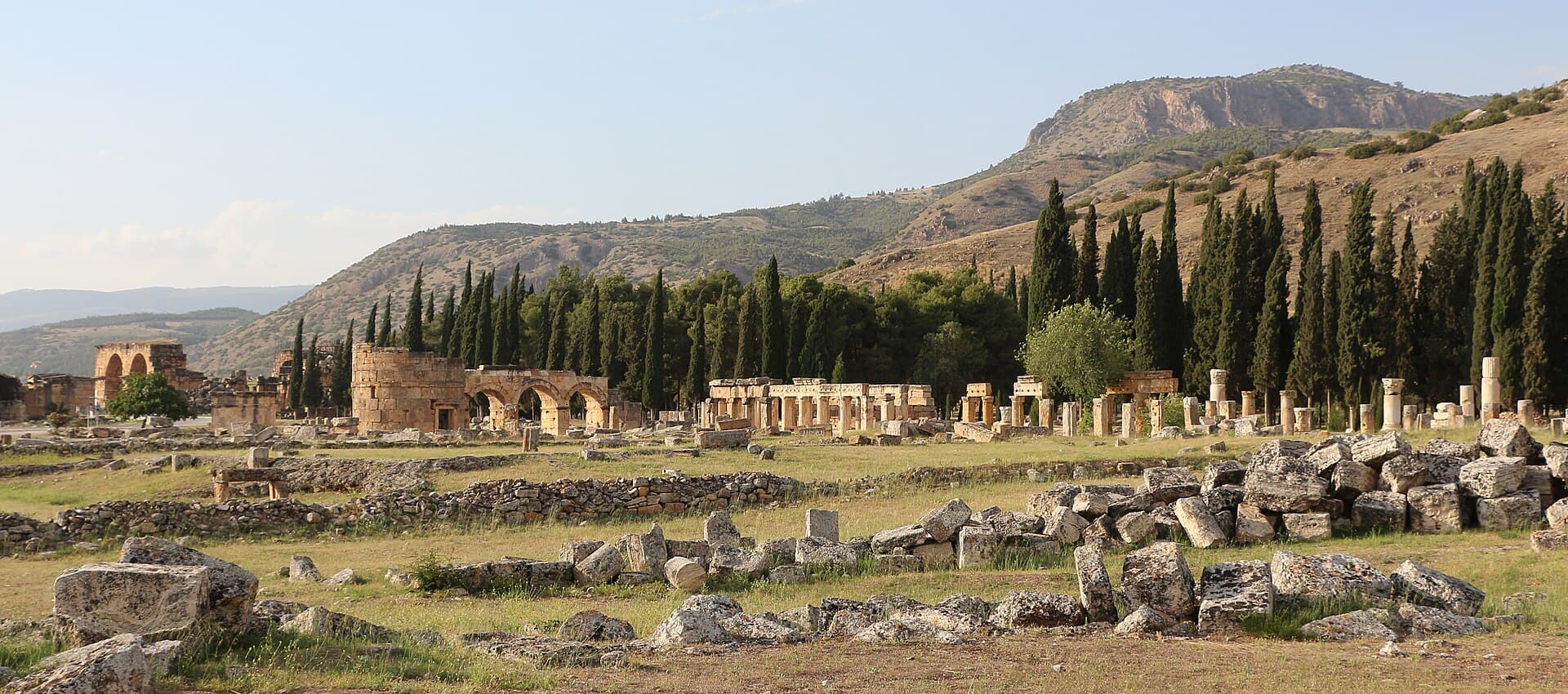
Pluto's Gate
Ancient priests performed seemingly miraculous feats at this site, surviving where animals instantly perished.
Full story unlocks in the tour
 Bernard Gagnon / CC BY-SA 3.0, via Wikimedia Commons
Self-guided audio walking tour of Hierapolis — GPS route, offline playback, story-driven narration in 32 languages.
“Where ancient ruins meet the 'Cotton Castle' of thermal wonders.”
Not the postcards. The stories even locals don't know — whispered in your ear, right where they happened.
Ancient priests performed seemingly miraculous feats at this site, surviving where animals instantly perished.
This ancient city of healing was also a final resting place for many, and one tomb holds a surprising technological secret.
The architectural design of this significant early Christian pilgrimage site holds a profound symbolic meaning.
Discover every secret of Hierapolis
Every address, every reveal in full — in your ear, right where it happened.
You pick your stops. You walk. The voice reveals what the others miss.


Your self-guided audio tour of Hierapolis is ready — pick your landmarks, choose your language, and start the moment you arrive.
BuyLume has a built-in augmented-reality guide. Hold your phone up and its camera shows the street ahead of you, with a glowing arrow laid over the real view that always points to your next stop — no map to puzzle over, no wrong turns. Like everything in Lume, it works fully offline.
Hierapolis, an ancient Hellenistic city in southwestern Turkey, stands as a remarkable testament to the interplay of natural wonder and human endeavor. Situated atop the dazzling white travertine terraces of Pamukkale, often called the 'Cotton Castle,' this UNESCO World Heritage Site offers a unique landscape where mineral-rich hot springs have sculpted petrified cascades and pools. For centuries, people have been drawn to Hierapolis, initially for its therapeutic thermal waters, believed to possess divine healing properties.
Beyond its striking natural beauty, Hierapolis reveals a sprawling archaeological site that flourished under Roman rule. Visitors can explore well-preserved structures that speak to its past as a prominent spa city and an early Christian center. The city's extensive ruins, including a grand Roman theater, a vast necropolis, and sacred sites, offer a profound journey into ancient civilizations.
The origins of Hierapolis can be traced back to the 3rd century BCE, founded on the site of an earlier Phrygian cult center dedicated to the Anatolian mother goddess Cybele. Some attribute its official founding to King Eumenes II of Pergamon around 190 BCE, though evidence suggests settlements existed centuries prior. The city's name, meaning 'Holy City' in Greek, may derive from Hiera, the mythical wife of Telephos, or simply reflect its sacred nature.
Hierapolis quickly gained renown for its hot springs, high-quality wool fabrics, and dyes. It also became the birthplace of the Stoic philosopher Epictetus. Following the Battle of Magnesia in 190 BCE, Hierapolis came under the control of Pergamon, and in 133 BCE, it was bequeathed to Rome, along with the rest of the Kingdom of Pergamon. The city was largely rebuilt after a devastating earthquake in 60 CE, with most of the visible structures today dating from the Roman period.
Hierapolis holds significant importance in early Christian history. The apostle Philip is believed to have spent his final years here and was martyred in 80 CE, reportedly by crucifixion. An early Christian community was established in Hierapolis, influenced by the teachings of Saint Paul. From the 4th century onward, the city transformed into an important pilgrimage center, with the Martyrium of St. Philip, an octagonal structure built in the 5th century CE, becoming its most significant Christian building. The city continued to thrive until it was abandoned after another earthquake in 1334.
After centuries of being largely unknown, excavations began in the 19th century, revealing the splendid ruins of Hierapolis. The Italian Archaeological Mission of Hierapolis of Phrygia (MAIER) has been actively working at the site since 1957. In 1988, Hierapolis was designated a UNESCO World Heritage Site, recognizing its exceptional blend of natural and cultural significance. Today, the ongoing archaeological work continues to uncover new insights into this ancient metropolis.
Begin your exploration at the Roman Theater, a grand 15,000-seat structure from the 2nd century AD, recognized as one of Turkey's best-preserved ancient theaters. Its stage building is adorned with reliefs depicting mythological scenes. Next, wander through the expansive Hierapolis Necropolis, one of the largest and best-preserved ancient cemeteries in Turkey, featuring over 1,200 tombs and sarcophagi from various eras. The Martyrium of St. Philip, an octagonal structure built in the 5th century AD, marks the traditional site of the apostle's martyrdom and was a significant early Christian pilgrimage destination.
Visit the Temple of Apollo, the city's oldest local sanctuary, adjacent to which lies Pluto's Gate (Ploutonion), an ancient shrine once believed to be a portal to the underworld, known for its lethal carbon dioxide emissions. For a unique experience, swim in Cleopatra's Pool (Antique Pool), where you can bathe in warm, therapeutic thermal waters among submerged Roman columns that toppled during an earthquake. The Hierapolis Archaeological Museum, housed in the former Roman baths, displays artifacts unearthed from the ancient city, offering deeper insights into its daily life and culture. Do not overlook the Frontinus Gate and the Colonnaded Street, which once served as the city's main thoroughfare.
The ideal times to visit Hierapolis and the adjacent Pamukkale travertines are during spring (April-May) and autumn (September-October). During these months, temperatures are mild and comfortable, typically ranging between 18°C and 28°C (64°F–82°F), and the crowds are moderate, allowing for a more relaxed exploration. Summer (June-August) brings very hot temperatures, often exceeding 35°C (95°F), and the largest crowds. While winter (November-March) offers fewer crowds and a unique atmospheric scenery with steam rising from the thermal waters, temperatures are cooler, between 5°C and 15°C (41°F–59°F). Arriving early in the morning or late in the afternoon, especially around sunset, is recommended for fewer crowds and optimal lighting for photography.
Hierapolis is located in Pamukkale, approximately 18 kilometers north of Denizli, Turkey. A combined ticket typically grants access to both the Hierapolis archaeological site and the Pamukkale travertine terraces. Cleopatra's Pool usually requires a separate admission fee. The site is open year-round, with summer hours (April-October) generally from 6:30 AM to 8:00 PM and winter hours (October-April) from 8:00 AM to 6:00 PM; however, it is always best to check the official site for current timings.
Wear comfortable shoes, as exploring the extensive ruins involves a good amount of walking. For the travertine terraces, you will need to remove your shoes, so bringing a bag to carry them is advisable. Sun protection like a hat, sunglasses, and sunscreen is essential, especially during warmer months. Golf carts can be rented on-site for efficient travel across the expansive area. Lockers are available near Cleopatra's Pool for storing belongings. Restaurants are available, but bringing your own snacks and water is also an option.
Hierapolis in Korean, in Chinese or in Hebrew — and 29 more languages, every stop narrated by a native voice. The widest language range of any self-guided audio tour.
Available in: