Hveragerði Geothermal Park
The ground beneath Hveragerði isn't just warm; it's a living oven.
Full story unlocks in the tour
 TommyBee / Public domain, via Wikimedia Commons
“Where the Earth Breathes Warmth and Life.”
Not the postcards. The stories even locals don't know — whispered in your ear, right where they happened.
The ground beneath Hveragerði isn't just warm; it's a living oven.
In a land of ice and fire, some unexpected tropical fruits thrive.
A shopping center might seem an unlikely place to confront a natural disaster.
Discover every secret of Hveragerði
Every address, every reveal in full — in your ear, right where it happened.
You pick your stops. You walk. The voice reveals what the others miss.
No tours available yet. Check back soon — we're preparing them.
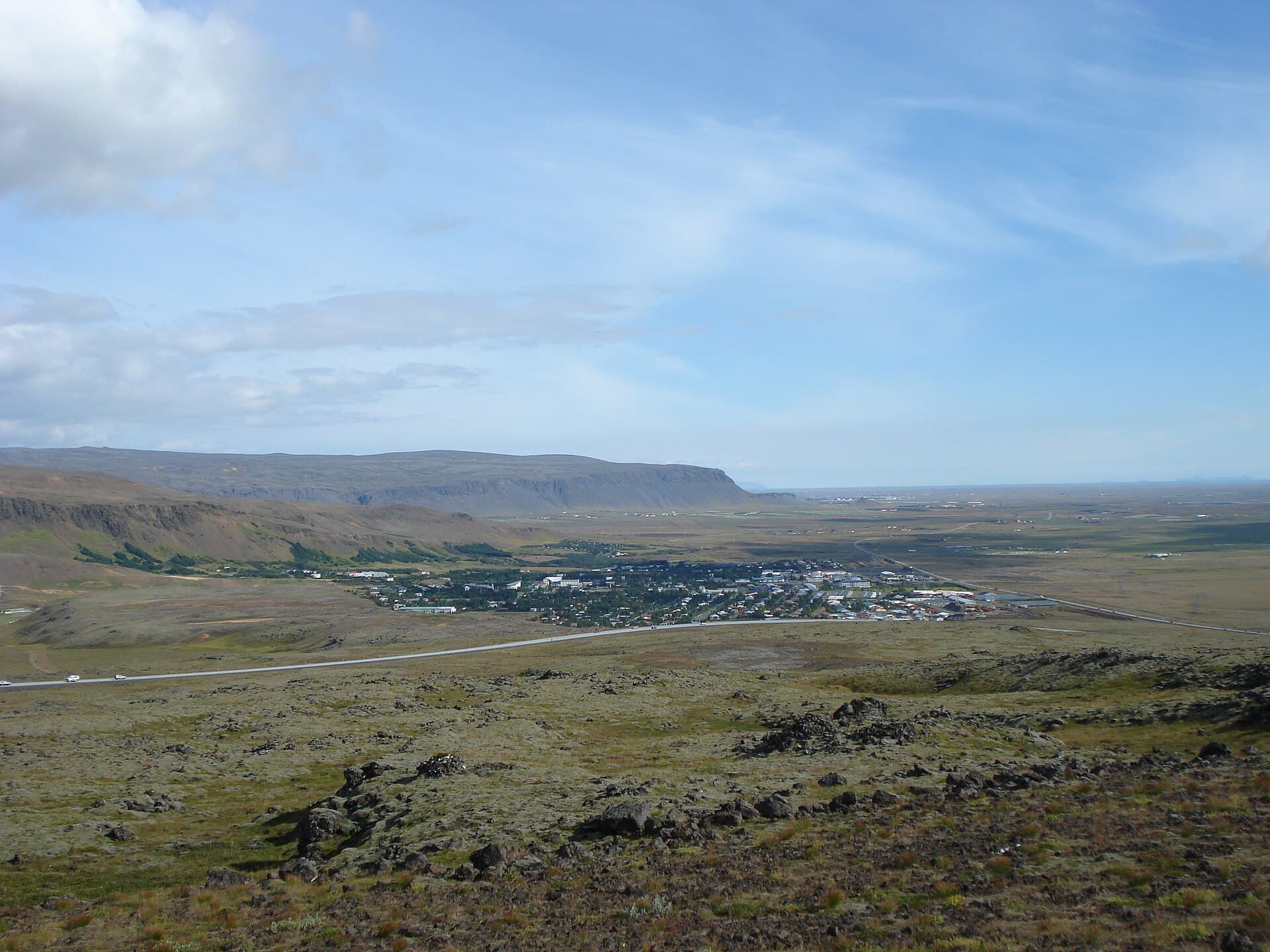
Hveragerði, often called 'The Hot Spring Town' or 'The Geothermal Town,' is a settlement in South Iceland, approximately 45 kilometers (28 miles) southeast of Reykjavík. This community of around 3,000 residents is uniquely built directly on an active geothermal field, where hot springs and fumaroles emerge within the village itself. Constant plumes of steam rising from the surrounding hills are a visual testament to the volcanic activity bubbling beneath the surface, part of the Hengill central volcano system.
The town's existence and development are deeply intertwined with this geothermal energy, which locals harness for everything from heating homes to cooking and cultivating produce year-round. Hveragerði serves as a gateway to Iceland's South Coast and is a convenient stop on Route 1, the country's iconic ring road. It offers a blend of natural wonders, cultural insights, and outdoor activities, making it a destination worth exploring beyond a quick pass-through.
From its unique geological features to its sustainable practices, Hveragerði provides a fascinating glimpse into how Icelandic life coexists with the powerful forces of nature. The town's nickname, 'Flower Town of Iceland,' also speaks to the flourishing horticulture that thrives here thanks to the geothermal heat.
Hveragerði's history is inextricably linked to the geothermal activity that defines its landscape. The town's name itself, meaning 'hot springs garden,' reflects this deep connection. Early settlers were drawn to the area as far back as the 9th century, attracted by the fertile soil and abundant fish stocks in the Ölfusá Valley. However, it was in the early 20th century that the community truly began to harness the geothermal potential. In 1902, a hydroelectric power station was established at Reykjafoss on the Varmá River, providing power to a local wool factory. This marked an early step in utilizing natural resources for the town's benefit.
The 1920s saw a significant turning point with the development of geothermal energy for heating. Hot water was piped into homes for heating by 1929, and the first geothermally heated greenhouse was built in 1923. This innovation transformed Hveragerði into Iceland's horticultural center, allowing for year-round cultivation of vegetables and flowers despite the cold climate. The town became a primary producer of these goods, supplying markets across the country. This 'greenhouse revolution' also led to Hveragerði being known as 'The Greenhouse Village' and the 'Flower Town of Iceland.'
Being situated on the Mid-Atlantic Ridge, Hveragerði is an active earthquake location, earning it another nickname: 'The Earthquake Town.' While most tremors are mild, the town has experienced significant seismic events. A powerful 6.3 magnitude earthquake struck on May 29, 2008, with its epicenter just two kilometers southeast of Hveragerði. This event caused damage to buildings and the environment, and even created new hot spring areas on the hillsides above town. The resilience of the community is evident in how houses are built to withstand such phenomena, and the 'Quake 2008' exhibition commemorates the event, allowing visitors to understand its impact and even experience a simulated tremor.
Today, Hveragerði continues to thrive as a community of approximately 3,000 people. It has evolved into a popular tourist destination, drawing visitors with its geothermal parks, hot springs, and the beauty of its volcanic terrain. The town maintains a strong community culture, with residents actively working to develop their blossoming town further. Its strategic location near the Golden Circle and the South Coast makes it an ideal base for exploring the wider region.
Hveragerði offers a variety of attractions that highlight its unique geothermal landscape and local culture. The Hveragerði Geothermal Park is a central point of interest, allowing visitors to walk among hot springs and fumaroles. Here, you can boil an egg in geothermally heated water or sample rye bread baked underground.
A compelling activity is the hike to Reykjadalur Hot Spring Thermal River. This 3-kilometer (1.9-mile) trail leads through a steaming valley with mud pools and hot springs, culminating in a natural river where you can bathe year-round. The water temperature in the river varies, becoming hotter further upstream. Remember to bring a swimsuit and towel, as changing facilities are minimal.
For those interested in the town's seismic history, the 'Quake 2008' exhibition in the Sunnumörk Shopping Centre provides insights into the 2008 earthquake, including an earthquake simulator. Hveragerði is also known for its geothermally heated greenhouses, which grow a diverse range of produce, including tropical fruits like bananas. You can also visit the Ölverk Pizza & Brewery, which uses geothermal energy in its brewing process.
Beyond these, the town has the Laugarskarð swimming pool, once one of Iceland's largest, featuring hot baths, whirlpools, and a natural sauna. The LÁ Art Museum showcases modern and contemporary Icelandic art.
Hveragerði is a destination that can be enjoyed throughout the year, each season offering a different experience. Summer (June to August) is ideal for hiking and enjoying the geothermal pools, with milder temperatures ranging from 10°C to 15°C (50°F to 59°F) and long daylight hours. Spring (March to May) and Autumn (September to November) offer fewer crowds and are suitable for outdoor activities, with autumn bringing the possibility of seeing the Northern Lights. Winter (December to February) transforms the landscape into a snow-covered wonderland, providing a magical backdrop for Northern Lights viewing, though temperatures can be colder, ranging from -1°C to 5°C (30°F to 41°F). Road conditions can be challenging in winter, so proper footwear and checking local weather are essential.
Hveragerði is easily accessible, located just 45 kilometers (28 miles) from Reykjavík. The most convenient way to reach the town is by car via Route 1, the Ring Road, a drive that takes approximately 40-45 minutes. Public buses operated by Strætó also connect Reykjavík and Hveragerði, though having a car provides greater flexibility for exploring the surrounding areas.
When visiting, it's advisable to pack layers of clothing, a waterproof jacket, and sturdy hiking boots, as Icelandic weather can be unpredictable. For those planning to visit the Reykjadalur Hot Spring Thermal River, a towel, swimsuit, and a waterproof bag are essential. The town provides essential services for travelers, including gas stations, supermarkets (like Bónus), and a tourist information center located at Sunnumörk Shopping Centre. Respect geothermal areas by sticking to marked paths and avoiding touching hot springs, as they can be dangerously hot.