Ismailia Canal (Sweet Water Canal)
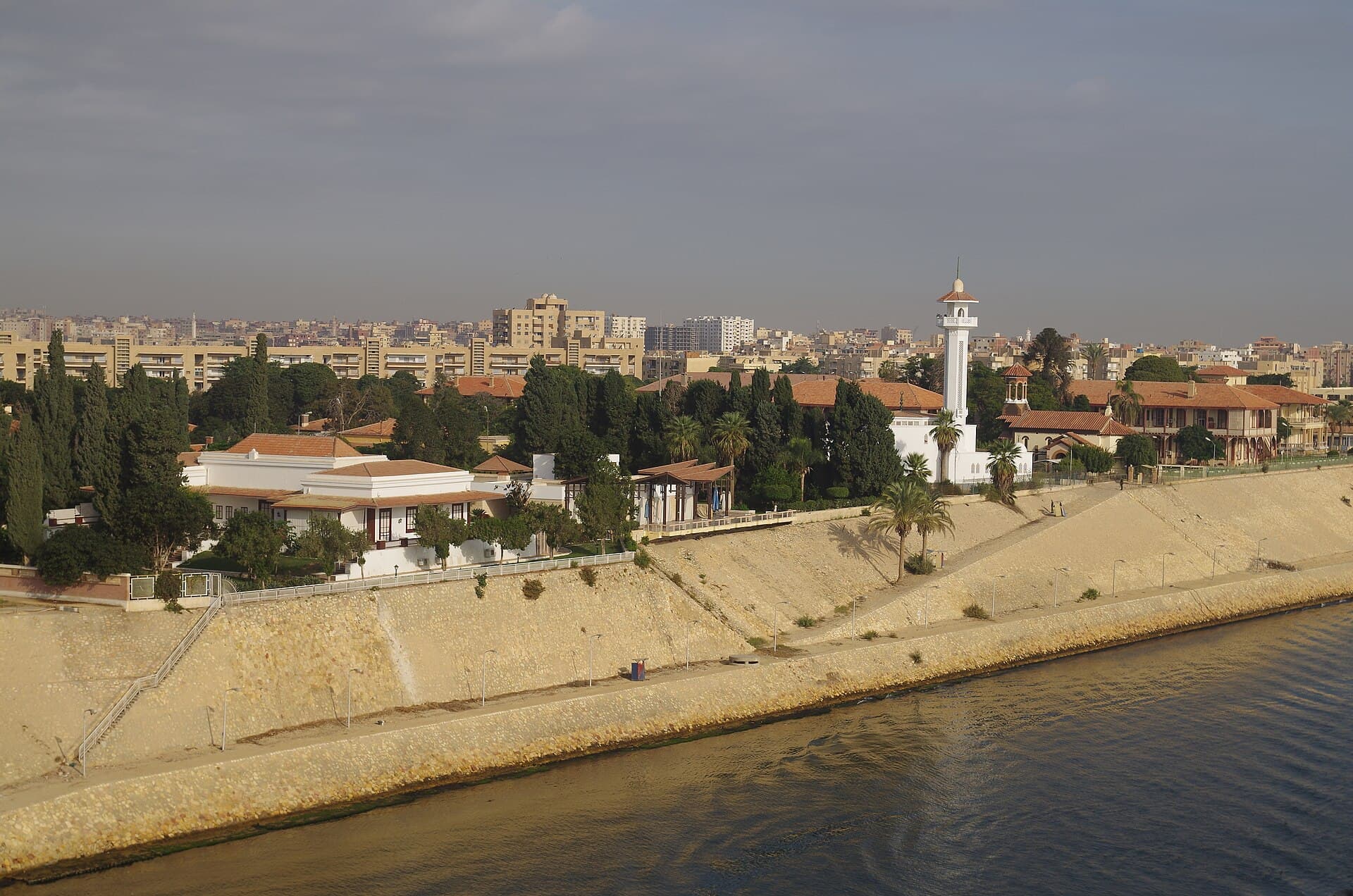
The waterway that brought life-giving fresh water to the desert settlement also carried a grim history during a period of conflict.
Full story unlocks in the tour
 Balou46 / CC BY-SA 4.0, via Wikimedia Commons
Self-guided audio walking tour of Ismailia — GPS route, offline playback, story-driven narration in 32 languages.
“Where European grace meets Egyptian calm along the Suez Canal.”
Not the postcards. The stories even locals don't know — whispered in your ear, right where they happened.
The waterway that brought life-giving fresh water to the desert settlement also carried a grim history during a period of conflict.
A record-setting flight to Australia departed from Ismailia, yet the base's wartime function was considerably more intense.
This quiet cemetery holds an unexpected connection to an unsuccessful World War I assault.
Discover every secret of Ismailia
Every address, every reveal in full — in your ear, right where it happened.
You pick your stops. You walk. The voice reveals what the others miss.


Your self-guided audio tour of Ismailia is ready — pick your landmarks, choose your language, and start the moment you arrive.
BuyLume has a built-in augmented-reality guide. Hold your phone up and its camera shows the street ahead of you, with a glowing arrow laid over the real view that always points to your next stop — no map to puzzle over, no wrong turns. Like everything in Lume, it works fully offline.
Ismaïlia, often known as the "City of Beauty and Charm," offers a peaceful respite from Egypt's more bustling urban centers. This serene and verdant city, situated on the west bank of the Suez Canal and the scenic Lake Timsah, distinguishes itself with a pronounced European character. Established in 1863 during the construction of the Suez Canal, it served as the administrative heart of this monumental engineering endeavor. Its broad, tree-lined avenues and graceful British and French-style villas evoke a cosmopolitan past, inviting visitors to unwind and experience a different facet of Egypt.
Ismaïlia is a city where history and natural splendor intertwine. Beyond its strategic importance as a Suez Canal nexus, it is celebrated for its abundant gardens, delectable mangoes, and a tranquil ambiance. Whether your interest lies in exploring its colonial-era architecture, enjoying water activities on Lake Timsah, or simply taking a leisurely walk along the Corniche, Ismaïlia provides a refreshing interlude. It is an ideal destination for those seeking a quieter, more provincial yet remarkably well-maintained experience in Egypt.
## Founding and Early Development Ismaïlia's beginnings are inextricably linked to the ambitious 19th-century project of the Suez Canal. The city was established in 1863 by French engineer Ferdinand de Lesseps, who supervised the canal's construction. Initially, it functioned as a headquarters and base for the engineers and administration of the Suez Canal Company. The city was named in honor of Khedive Isma'il Pasha, the then-ruler of Egypt, who championed the project. The official inauguration of Ismaïlia coincided with the grand opening of the Suez Canal itself in 1869.
Unlike many traditional Egyptian cities with their narrow, winding streets, Ismaïlia was meticulously planned by French architects according to European urban design principles. This resulted in a city characterized by wide, perpendicular avenues, abundant parks, and colonial-style villas, earning it the designation "garden city" or "pearl of the canal." Its strategic location on the west bank of the Suez Canal, midway between Port Said and Suez, and on the shores of Lake Timsah, provided ideal conditions for the development of a port and residential areas.
## British Influence and 20th Century Events Following the establishment of British control over Egypt in 1882, Ismaïlia and the entire Canal Zone gained considerable strategic importance, with the British establishing a base there. During World War I, the British maintained an air base in Ismaïlia, and the nearby Battle of Romani unfolded. The city continued to thrive during the periods when the Suez Canal was open to traffic (1869–1956; 1957–67), serving as the operating headquarters of the Suez Canal Company and the Central Movement Office.
Ismaïlia played a pivotal role in modern Egyptian history, particularly in the events leading up to the 1952 Egyptian Revolution. The British suppression of an uprising by defiant Egyptian police in Ismaïlia in January 1952 was a key event that contributed to the overthrow of King Farouk I later that year. When the canal was closed for eight years after the 1967 Six-Day War, the city's economy faltered, and much of its population was relocated. However, with the reopening of the Suez Canal in 1975 after the 1973 Yom Kippur War, Ismaïlia experienced a return to prosperity, with refugees returning, new housing projects, and the creation of a tax-free industrial zone.
Ismaïlia presents a blend of historical sites and natural attractions. Begin with a walk along the Ismailia Corniche, a two-kilometer promenade overlooking Lake Timsah, offering views of vessels traversing the Suez Canal. The Suez Canal Authority Building, with its distinctive architecture, stands as a prominent landmark, and nearby gardens offer additional scenic perspectives.
For a deeper exploration of the region's past, the Ismailia Museum, established in 1932, ranks among Egypt's oldest museums. Its collection spans prehistoric times, ancient Egyptian history, and Greco-Roman and Islamic eras, including a Roman floor mosaic from the 3rd century B.C. The city's historic downtown merits exploration for its appealing French colonial architecture, tree-lined streets, and old villas. The El A'bbasy Mosque, with its Ottoman architectural style and intricate Islamic motifs, stands as another significant cultural landmark.
Those who appreciate nature can enjoy Lake Timsah, where activities such as swimming, relaxing on sandy shores, boat rides, and fishing are popular. The lake's calm waters are also suitable for windsurfing and kayaking. For individuals interested in military history, the Tanks Museum Abu Atwa on the city's outskirts displays tanks captured by the Egyptian army during the 1973 war. Additionally, the Ismailia War Memorial Cemetery commemorates Commonwealth casualties from both World Wars.
The most favorable time to visit Ismaïlia is during the cooler months, from October to April. In this period, the weather is sunny and moderately warm, making it ideal for walking and outdoor pursuits. Spring (March–May) and autumn (September–November) offer particularly mild and agreeable conditions. While summers can be hot, the proximity of Lake Timsah and the city's abundant greenery help to moderate the heat.
Ismaïlia lies approximately 120-130 kilometers northeast of Cairo. The most convenient ways to reach the city are by taxi, bus, or private car from Cairo, with the journey typically lasting 1.5 to 3 hours depending on traffic. Trains also operate regularly from Cairo's Ramses Station to Ismaïlia, providing a scenic travel option that takes about 2.5 to 3 hours.
Within the city, taxis and microbuses are the most convenient modes of transport. For exploring the city center and historical district, walking is an excellent choice. When preparing for your trip, select light clothing made from natural fabrics, especially during warmer months. While the atmosphere is generally open, modest clothing covering shoulders and knees is advisable, particularly when visiting religious sites. Always remember to carry sunscreen, a hat, and remain hydrated.
Ismailia in Korean, in Chinese or in Hebrew — and 29 more languages, every stop narrated by a native voice. The widest language range of any self-guided audio tour.
Available in: