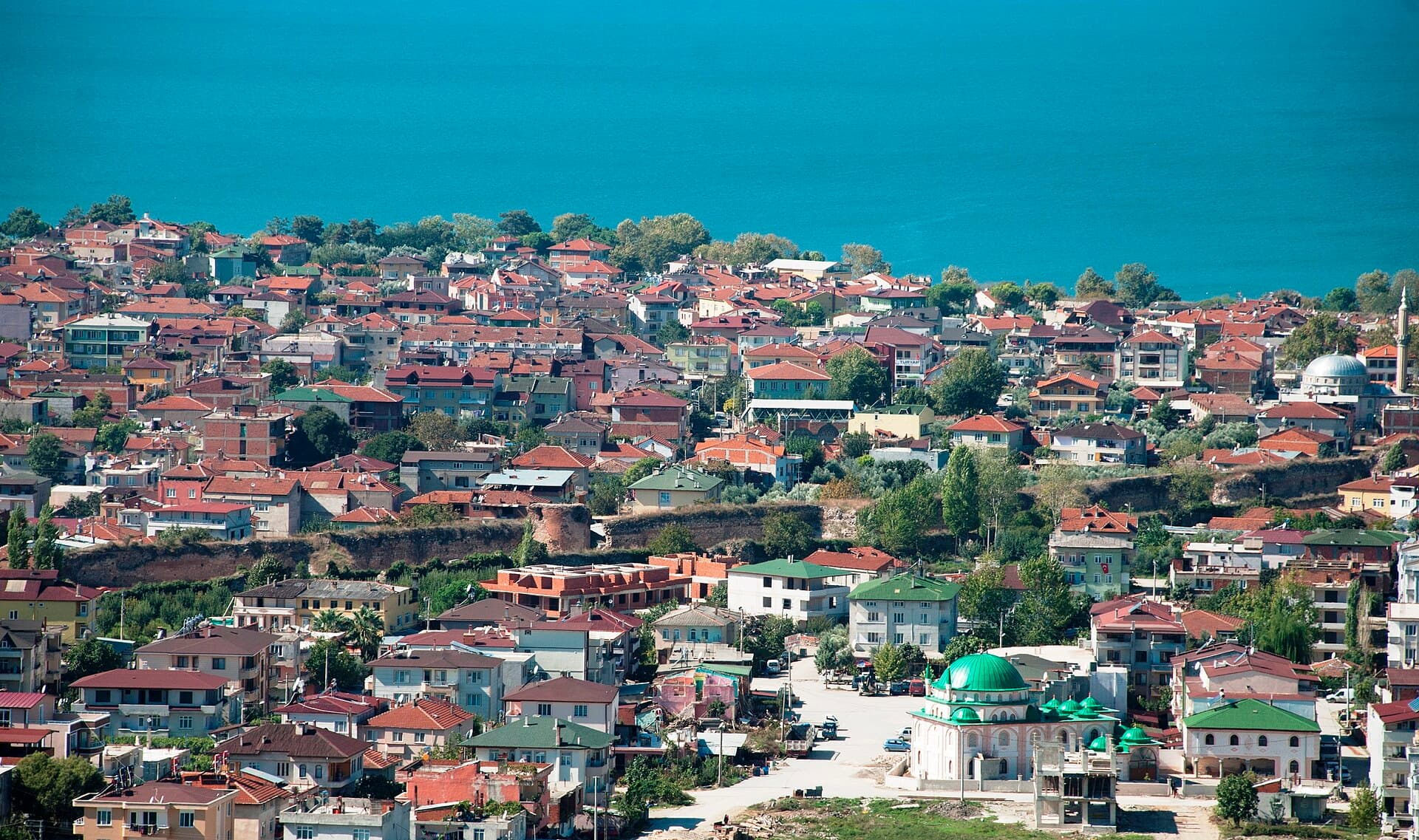
These formidable walls, stretching for nearly 5 kilometers, once protected a city of immense historical importance. What lies between their inner and outer layers?
Acar54 / CC BY-SA 4.0, via Wikimedia Commonsİznik
Self-guided audio walking tour of İznik — GPS route, offline playback, story-driven narration in 32 languages.
“Where ancient councils shaped the world, and vivid tiles tell tales.”
İznik, as no one tells it.
Not the postcards. The stories even locals don't know — whispered in your ear, right where they happened.
This building, now a mosque, hosted pivotal moments in Christian history. Before its current form, it held a secret that allowed a significant artistic tradition to flourish.
Beneath the tranquil surface of Lake İznik, a significant structure lay undisturbed for centuries, only to be rediscovered in a surprising way.
Discover every secret of İznik
Every address, every reveal in full — in your ear, right where it happened.
You pick your stops. You walk. The voice reveals what the others miss.
How long do you have in İznik?
Your self-guided audio tour of İznik is ready — pick your landmarks, choose your language, and start the moment you arrive.
BuyThe story of İznik
İznik, historically known as Nicaea, is a town in the Bursa Province of Turkey, situated at the eastern end of Lake İznik. This captivating destination is an open-air museum, where layers of Bithynian, Roman, Byzantine, Seljuk, and Ottoman civilizations are evident at every turn. Its strategic location and fertile basin have made it a significant center throughout history, drawing visitors interested in its profound past, unique craftsmanship, and serene natural beauty.
The town is globally recognized for its exquisite İznik tiles and pottery, which reached their zenith during the Ottoman Empire, adorning palaces and mosques across Turkey and beyond. Beyond its artistic legacy, İznik holds immense religious significance, having hosted two pivotal Ecumenical Councils that shaped early Christianity. Today, İznik offers a blend of historical exploration, cultural immersion, and peaceful lakeside experiences, making it an unforgettable stop for those touring Turkey.
From Ancient Nicaea to Ottoman İznik
İznik's history spans over two millennia, beginning in the 4th century BCE when it was founded as Antigoneia by Macedonian general Antigonus I Monophthalmus. It was later renamed Nicaea by Lysimachus, one of Alexander the Great's generals, after his wife. The city flourished as a major center during the Roman and Byzantine Empires, becoming a capital of the Bithynian Kingdom for a period.
A pivotal moment in Christian history occurred in 325 AD when Nicaea hosted the First Council of Nicaea, convened by Emperor Constantine the Great, where over 300 bishops gathered to establish fundamental Christian doctrines, including the adoption of the Gospels of Matthew, Mark, Luke, and John as official. The city also hosted the Seventh Ecumenical Council in 787 AD, which addressed the use of icons in the Byzantine Empire. The Hagia Sophia of İznik, originally a 6th-century basilica, was the venue for this significant council.
After a period under Seljuk rule in the 11th century, İznik was eventually conquered by the Ottoman Turks in 1331 under Orhan Ghazi. This marked a new era for the city, which briefly served as an Ottoman capital before Bursa. During the 14th and 15th centuries, İznik became a center of art, culture, and trade. It gained international renown for its distinctive ceramic tiles and pottery, which reached their peak production in the 15th and 16th centuries. These exquisite İznik wares, characterized by their high-quartz fritware body and lively underglaze decoration, adorned numerous Ottoman mosques and palaces. The city's production of ceramics began to decline in the 17th century, with the knowledge largely lost by the 18th century, though revival efforts have begun in recent times.
The ancient city was fortified with approximately 5 kilometers of walls, some reaching 13 meters in height, featuring four main gates and 12 secondary gates. These walls, originally built in the 4th century BCE and strengthened over centuries, have largely survived to the present day despite sieges and earthquakes. Today, İznik stands as a testament to its layered past, with remnants of Roman, Byzantine, and Ottoman structures preserving its historical narrative.
Begin your exploration at the İznik City Walls, a nearly 5-kilometer circuit with four main gates (Istanbul, Yenişehir, Lefke, and Lake Gate) and 12 secondary gates, offering a tangible connection to the city's ancient defenses. Drive through these historic entrances to fully appreciate their scale.
Visit the Hagia Sophia of İznik (Orhan Mosque), a significant Byzantine basilica converted into a mosque after the Ottoman conquest in 1331. This structure, rebuilt after an 11th-century earthquake, hosted the Second Council of Nicaea in 787 AD. The Green Mosque (Yeşil Camii), an early example of Ottoman architecture built between 1378 and 1391, is notable for its minaret adorned with green, yellow, turquoise, and dark purple glazed terra-cotta tiles, which give the mosque its name.
While the İznik Museum (Nilüfer Hatun Imaret) has undergone renovations, it traditionally showcases Roman antiquities, glass, and a significant collection of Seljuk and Ottoman tiles and Islamic art. Do not miss the opportunity to browse local artisan shops for authentic İznik tiles, a craft for which the town is world-renowned. For a serene experience, take a leisurely walk along the shores of Lake İznik, Turkey's fifth-largest lake, offering picturesque views and opportunities for boat tours.
The most pleasant times to visit İznik are during spring and autumn, specifically April, May, June, September, and October. During these months, temperatures are mild, ranging from 18°C to 28°C, providing comfortable conditions for exploring the historical sites and countryside. Summers can be warm, with daytime temperatures averaging around 30°C in July and August, and muggy conditions are more common then. Winters are cool to chilly, with more rain and occasional snow.
İznik is in northwest Turkey, accessible from major cities. From Istanbul, it's about a 2-hour drive or bus journey. Alternatively, you can take a fast catamaran ferry from Istanbul's Yenikapı terminal to Yalova, then a minibus to İznik. From Bursa, İznik is approximately a 1-hour drive. Within İznik, the town center is compact and easily walkable. Taxis are available for trips to surrounding areas, and minibuses (dolmuş) connect to neighboring districts. Accommodation options include boutique hotels, lakeside guesthouses, and historical inns, many offering lake views. Consider staying at places like Aşiyan Yalısı or İznik Seyir Otel for highly-rated experiences. Local cuisine includes traditional Turkish dishes, with specialties like soups and stews made from carp and catfish. If your visit coincides with a Wednesday, explore the local market for fresh produce and a glimpse into daily life.
- What is İznik famous for?
- İznik is globally recognized for its exquisite İznik tiles and pottery, which were a hallmark of Ottoman art and adorned many significant buildings.
- What is the historical significance of İznik?
- İznik, as ancient Nicaea, was the site of two major Ecumenical Councils of the early Christian Church in 325 AD and 787 AD, which played crucial roles in shaping Christian doctrine.
- How far is İznik from Istanbul?
- İznik is approximately 200 kilometers (124 miles) by road from Istanbul, a journey that typically takes around 2 hours by car or bus.
- Can you buy authentic İznik tiles in İznik today?
- Yes, while the main production center for tiles is now Kütahya and many İznik tiles are sold in Istanbul, you can still find and purchase authentic examples in İznik itself at various art galleries and souvenir shops.
- What is the Green Mosque in İznik?
- The Green Mosque (Yeşil Camii) is a historic Ottoman mosque in İznik, built between 1378 and 1391. It is one of the earliest examples of Ottoman architecture and is named for the distinctive green, yellow, turquoise, and dark purple tiles decorating its minaret.
- Is there a museum in İznik?
- Yes, the İznik Museum, housed in the former Nilüfer Hatun Imaret, showcases a collection of Roman antiquities, glass, and Seljuk and Ottoman tiles and Islamic art.